Desert Online General Trading LLC
Dubai, United Arab Emirates
Desert Online General Trading LLC
Dubai, United Arab Emirates


Full description not available
T**D
Addictive reading
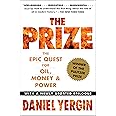
Whatever this book's flaws--and there are a few--it is compulsive reading. Yergin has wisely focused on the commanding figures of the oil industry from Rockefeller through Yamani (the book ends with the first Gulf War). Oil is definitely a macho game, and only one woman plays anything more than a walk-on role. The winners of the "Prize" fall into four categories--the buccaneers (independent producers and wildcatters), the executives of major oil companies, the leaders of oil-producing countries, and the leaders of their customers. There is no firm division between the last two categories: the United States was the leading oil exporter and consumer up to WW2, and is now the leading consumer by far. But it also is the home of most of the oil companies.However colorful, entertaining and illuminating these mini-biographies are, this focus tends to drive other serious questions to the margins. For instance, most of the world's proven oil reserves are in Muslim countries. Once a nation has a dominant oil industry, all other forms of economic activity tend to die out. Nothing else is remotely as profitable. A few years ago I read that the total value of non-oil exports from all Middle-Eastern countries is less than that of Finland. The only Muslim country with a dynamic modern economy is Turkey--and they have no oil (and a long tradition of secular governments). The net result is that relatively few Muslims have opportunities for interesting and dynamic careers--which is why so many of them emigrate to the West.By the same token, Mexico and Venezuela--the two major oil exporters in Latin America--are missing out on the boom that is propelling Brazil into the world's front rank of economic powers. Yergin does mention that oil destabilised Iran under the Shah, but he attributes this more to Westernising policies than the economic dislocation caused by oil.Nonetheless, this is a valuable book and a compelling read. As others have mentioned, the epilogue is pretty thin gruel. But this is hardly surprising--Yergin has written other books about contemporary oil policy and likely future trends, such as "The Quest: Energy, Security, and the Remaking of the Modern World". You can hardly blame an author for wanting you to buy more of his books.
R**0
Fantastic history of the oil industry
Passion, greed, the pursuit of money, double dealing, lying, cheating, corruption, coups......this book has it all. It may sound like a description of JR Ewing (of Dallas fame) but the real life characters that Daniel Yergin describes are every bit as loud as JR.It is hard to write a history of any industry that is both comprehensive, educational and entertaining. I was surprised how well written and engaging this book is. It is a lot of book however - at over 900 pages and the text is in a fine font. But by the end of it you will know more about oil than most industry participants. It also brings about an understanding of present day politics - for instance it helped me understand why the UK is referred to by Iran as 'Little Satan' (with the US as 'Big Satan').Some of the trivia that Yergin covers is what makes this book so memorable and entertaining - yet the book also serves a very serious purpose in explaining how the oil industry evolved over more than a century. It is surprisingly easy to read - but due to the sheer size one ideally wants to go through it whilst on the beach for a fortnight!I still refer to it regularly and it is never far from my desk when I am active in the markets.
R**M
Very good
Broad and history of the oil industry. Very good.
K**T
Fascinating history of oil
Fascinating history on the history of oil. Combines the geopolitical with the personal to highlight the pivotal role oil played in shaping human development over last 170 years.
N**B
A MUST-READ FOR ANYONE SERIUOSLY INTERESTED IN THE OIL INDUSTRY AND ITS INFLUENCE ON MANKIND
The engaging way this book is written makes it difficult to put aside and carry on with one's daily duties. After reading "The Prize" I have got a far better understanding of the oil industry history, its structure, its evolution, its "heroes and villains", its influence in our lives since 1859, the way its lack of or abundance of changed crucial moments in the last century and a half of human history and much more.It is hard to say something about this book that has not been said in previous Reviews (Apart from those two 3-star rating, which are, in my opinion, irrelevant) But if you are interested in the geopolitics of energy and want to know why we are so dependent on oil this book and its sequel (The Quest) are the two books to be read. Just be prepare to dedicate a good portion of your time to read them, that is why you must be "seriously interested"All in all this book is an excellent reading, go for it!!!!
M**G
A page turner.
A page turner! An entertaining way to learn about oil and its history. Oil is a fascinating subject and its history has some good lessons on what entrepreneurship is about. In The Prize we learn how from a chaotic beginning oil becomes the most organised and well established of industries, which all from its very beginnings has tremendous influence on world history. In this last sense, The Prize is a nice lesson on how new industries are born and how complicated and messy the subsequent process of regulation and consolidation can be.
D**O
have only read 150 pages but its a true gem ...
have only read 150 pages but its a true gem: covers the History of oil and how it reshaped the political and social landscape since the late 19 hundreds. Its a dense reading but the author writes very well ( well its a pullitzer winner..), I consider it a true resource and worth every pence
A**R
brilliant book, essential reading for anyone engaged in the energy industry
This highly engaging book provides detailed context on the evolution of the modern oil and gas industry. The book is especially insightful in explaining how the evolution of energy industries has been shaped by geopolitics.
A**R
History of the world with 'oil' tinted glasses.
This is the longest book I have read for a while but it did not drag. This book chronicles the role of oil in world events for half of the 19th century, all of the 20th century and the 21st century so far. For me, the message of this book is that access to oil played a (perhaps, the) major role in world history since the late 19th century. By the end of the book, I realized how much all of us are dependent on oil and furthermore, how difficult it is going to be to move on from our oil-based economy as atmospheric emissions from fossil fuels are a major contributor to climate change. After reading this book, my understanding of world history is much improved. If someone wants to read just one book that will educate them about the history of the world since 1850, this book is probably the best choice.
T**E
Excelente!
Vital para entender a indústria do petróleo e tudo que envolve a busca por óleo ao longo dos séculos.
A**R
Awesome work
This is a must read book if you want to know the history of the oil industry. The best thing is that you do not need any previous knowledge of the industry and is written for the general public
D**N
Oil is blood to the earth
If oil is blood to the earth will it die when it’s empty? This book is a crucial read if you appreciate power politics and ever wondered about the genius of commodity and its manner in which its placed to market but is it genius because you get the feeling near the end it’s importance to the earth without directly mentioning it.
L**O
Excellent ouvrage sur l'histoire de l'industrie pétrolière depuis la Standard Oil !
The Prize est l'ouvrage de référence retraçant l'histoire de l'industrie du pétrole depuis le milieu du 19e siècle en partant des Pays-Bas, du Royaume-Uni et naturellement des Etats-Unis.The Prize est écrit dans un style narratif et non professoral rendant cette histoire qui vous mènera en Europe, en Asie mineure, aux Etats-Unis d'autant plus passionnante.Daniel YERGIN s'emploie à retracer cette histoire avec beaucoup de justesse et de détail permettant d'éclairer et de comprendre le fonctionnement actuel du marché du pétrole, les conflits associés à l'exploitation de "l'or noir" et la place des grandes firmes (à noter que les pages sur l'histoire de la Standard Oil sont passionnantes).
Trustpilot
1 week ago
5 days ago