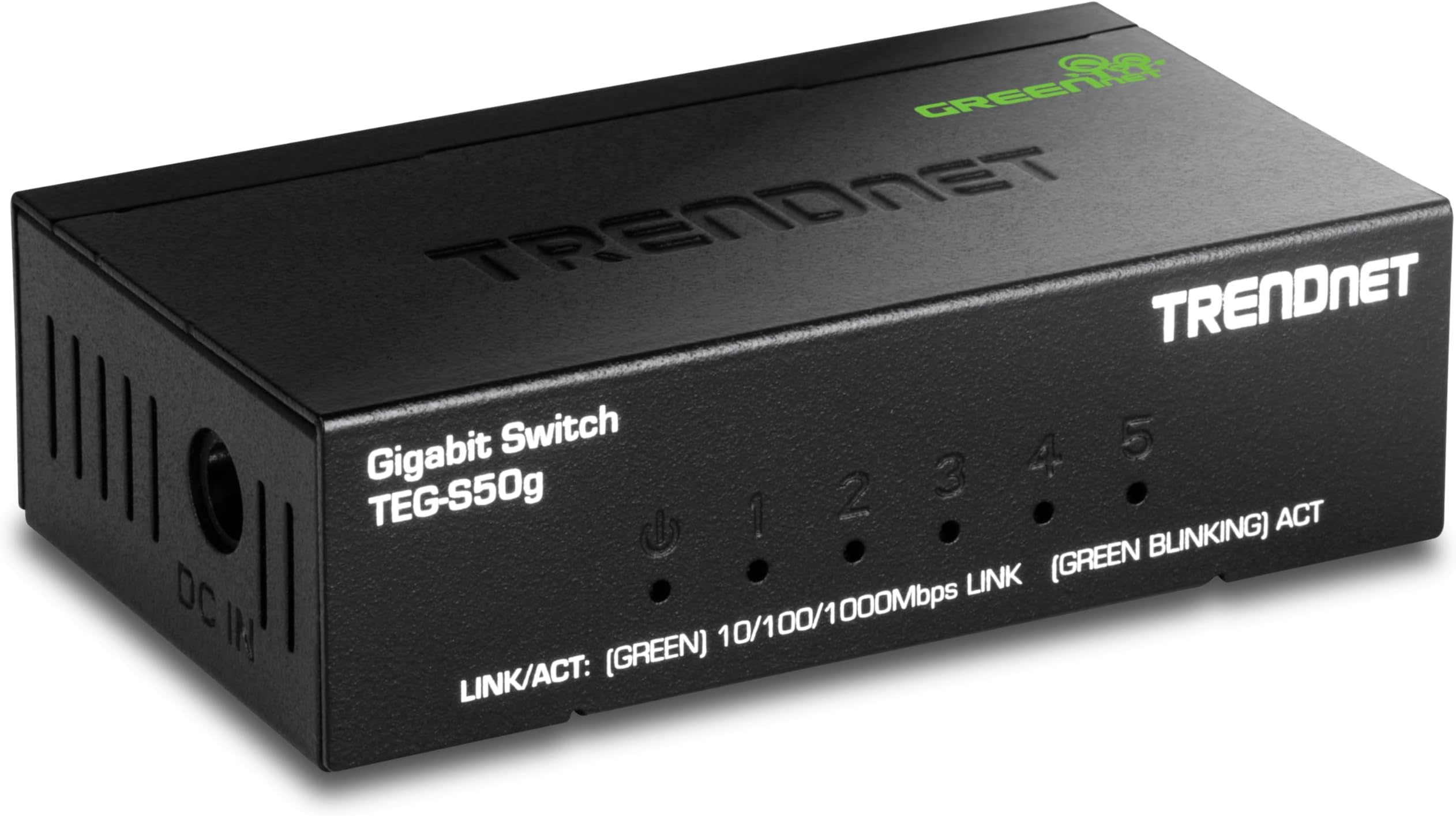
🚀 Elevate your network game with the TEG-S50G — speed, stealth, and sustainability in one sleek switch!
The TRENDnet TEG-S50G is a compact, fanless 5-port Gigabit Ethernet switch delivering blazing 10Gbps switching capacity. Its durable metal housing supports desktop or wall mounting, while GREENnet technology optimizes energy use automatically. NDAA and TAA compliance plus lifetime protection make it a future-proof, professional-grade solution for seamless, silent, and secure network expansion.


| ASIN | B001QUA6R0 |
| Best Sellers Rank | #36 in Computer Networking Switches |
| Brand | TRENDnet |
| Built-In Media | TEG-S50g |
| Case Material Type | Metal |
| Color | Black |
| Compatible Devices | Desktop |
| Current Rating | 1 Amps |
| Customer Reviews | 4.6 out of 5 stars 2,326 Reviews |
| Data Transfer Rate | 10 Gigabits Per Second |
| Global Trade Identification Number | 00710931610147 |
| Included Components | TEG-S50g |
| Interface | RJ45 |
| Item Dimensions L x W x H | 3.24"L x 1.84"W x 0.9"H |
| Item Height | 1 inches |
| Item Type Name | TrendNet 5 Port 10 1000Mbps GB Switch (TEG-S50G) |
| Item Weight | 3.84 ounces |
| Lower Temperature Rating | 32 Degrees Fahrenheit |
| Manufacturer | TRENDnet |
| Number of Layers | 1 |
| Number of Ports | 8 |
| Platform | Windows |
| Product Dimensions | 3.24"L x 1.84"W x 0.9"H |
| Switch Type | Gigabit Ethernet |
| UPC | 710931980684 710931610147 |
| Unit Count | 1.0 Count |
| Upper Temperature Rating | 104 Degrees Fahrenheit |
| Voltage | 110 Volts |
| Warranty Description | Limited Lifetime Warranty |
T**E
Very simple, very easy, it works.
Overall this is a terrific switch. I replaced an old Ethernet hub with this. The hub was severely adversely impacting my bandwitdth over the network. The switch is now plugged in to my home (wired) Ethernet port and I have it plugged in my XBox 360 and Denon AVR-3310ci receiver to the switch. Both receive full signal now and work great. It was such a no-brainer. Just plug in the router to the power supply, plug in your internet cable, and then your other devices (PC's, game systems, receivers, etc.) to the other available ports. Works great and was super easy. Also nice is that the switch apparently can detect differences in cable lengths, along with knowing when data is needed and which ports are being unused and adjusts power consumption accordingly to presumably be "green" and save money. Not sure how much I'll save with this, but it's a nice feature. Attractive packaging and look (which I personally really couldn't care less about, but it is nice and makes me think TRENDNet is a credible, mass-market kind of company if I ever need support, etc.). The device is actually smaller than it looks online (which I also like- a small footprint helps when placed inside a media cabinet with a bunch of A/V stuff.). The device itself is very clean and simple- the display shows you which ports are active, the speed of the connection (I, sadly just have a 10/100 modem, so that's what it shows- someday I'll have a Gigabit but in function, everything works great for now with 10/100 so no big deal). Some of this will vary by cable provider (I have Brighthouse), but since I installed this switch, I've watched Netflix HD, listened to internet radio, etc. and it has never readjusted for quality problems, etc. (If you have streaming Netflix, you have probably experienced the 'quality' adjustments mid-viewing which is super annoying. With this switch- haven't had a problem yet- full HD). I also am streaming recorded HD video from my PC through Windows Media Center, which I use like a DVR/PVR. I just watched a full HD recording of 'Fringe' and it looked amazing. Fast-forwarded, rewound, played, paused with no issues and it looked and sounded perfect. Anyway- this was so easy to install, and the price is great for what it does. You can get cheaper Gigabit routers if you really shop around and wait for deals, but you probably won't find one for much less (I would say there is maybe a $5.00 +/- differential between this and the cheapest generic 5-port Gb routers I saw). I justified the little bit of extra money for this because of the build quality, good reviews, power saving features and 'branded' manufacturer which I felt might provide better support if I ever need it (though you never really know). All in all, a great switch. Should've bought one years ago. So far, so good! Strongly recommend the product.
R**R
This device solved my AV network problem
This router solved a digital interference problem that occurred when I plugged network AV devices into the network port of my uVerse set-top box. I had been using a powerline network adapter to connect internet to my network enabled DVD player, TV and home theater PC (HTPC). For video, powerline networking is a slow connection, even though this powerline adapter was advertised as good for video. However, I frequently saw that my streaming Netflix was dropping back to a low bandwidth connection because the powerline network adapter couldn't provide the bandwidth required to stream HD from Netflix. Recently I subscribed to AT&T uVerse, and I discovered that the uVerse set-top box had a network output port. So I plugged the HTPC into that, did some DSL speed tests and discovered that the uVerse network connection was a lot faster than the powerline adapter. Apparently the uVerse box gets it's internet connection via the video coax cable. So I ordered the TrendNet router just to split the internet signal from the uVerse box to all three audio/video devices. A gigabit switch is overkill for that purpose, but the price was right, and it's nice to have technical headroom as well as some future-proofing. While waiting for the router to arrive, I left my HTPC connected directly to the network port on the uVerse box. Soon I was disappointed to find that as long as the computer was connected to that uVerse port, I would often get digital interference (giant pixelation) on the TV shows I was watching or recording in the uVerse set top box. "Uh-oh," I thought, "This probably means the TrendNet router is going to create the same kind of digital interference. The uVerse documentation doesn't mention using the network port as a local internet connection, so maybe it's not really meant to be used that way." I ended up disconnecting all devices from the uVerse network port, because every device did cause interference in the uVerse signal. (It's possible there was something defective in the uVerse box, of course. I didn't pursue that with AT&T, probably should have.) Well, I received the TrendNet router. I wasn't going to return it because I knew I could use it elsewhere in the house. However, I decided on a whim to try it as a router on the back of that uVerse box. It worked! I was able to hook up all three devices to the network with the TrendNet as the "buffer" router between the uVerse box and the AV devices. I've never seen the digital interference again, and my streaming Netflix movies always connect at the highest HD bandwidth. So, I don't know what magic is inside this TrendNet router that solves the digital interference problem, but I'm happy that it did. I've been using it for 2 months now with no problem. Installation required no drivers - I just plugged in everything and it worked perfectly. The sturdy metal enclosure is good because the router tends to get shoved into the back of the cabinet and gets things piled on top of it, so it is handling a lot of physical abuse. Update October 2012: Has now worked flawlessly for 15 months.
H**M
Awesome Gigabit Switch - Cheap Price - Can't Go Wrong
I've been networking computers for over 18 years and I've been a Network Engineer for 9 years. I can hands down say I'm very impressed with this product. Despite working with Cisco products for almost a decade, I however sadly admit that my home network definitely needed some upgrades. You see, back in 1999, my friends and I decided to upgrade from a hub to a switch. You can't find hubs these days any longer but just know that switches replaced the hub. That switch, an 8-port 10/100 switch costed us $120. I ended up keeping that switch when all of us moved away. Surprisingly it still works but because of my shoddy network performance lately transferring from PCs and my NAS (network attached storage), I realized it was time to upgrade it and the 100Mbit speed was my bottleneck. What's amazing is that recently, switches are very cheap. This TRENDnet 5-port Gigabit switch is an AMAZING value for $25.80 (purchased in June 2013). I didn't need many ports, just a switch to replace my 10/100 switch. Here's what I like about this switch. What's amazing about this switch is that it has a large packet buffer. Larger buffer = better performance when transferring files. And because of the 10Gbps forwarding capacity specs, you can guarantee that this switch will perform very fast EVEN if you had all 5 ports occupied and transferring data. What's icing on the cake is that it also supports 9K jumbo frames. While the majority of you readers may not even know what that is or use it, just know that this switch is letting you future proof yourself by allowing you to support a high performance Gigabit Ethernet LAN. The auto-MDIX (medium dependent interface crossover) is a nice touch, allowing you to use crossover and straight-through Ethernet cables without any issues. Aesthetically, I like & don't like this switch. The metal housing is the same as what was on my old switch and it just feels like it's well made. There are no mechanical fans inside, so this thing also runs very cool. Although being light & small is sometimes a good thing, in my case I don't like that it's not a bit heavier. I have 4 devices plugged into it and all that weight makes it shift relatively easy. Honestly, four Ethernet cords are heavier than the switch. So if you're looking for a Gigabit switch and need one that packs a punch on a budget, look no further than this device.
D**R
Used to recommend, but no longer
I liked these little switches before. However, the most recent model I received no longer fits that description. As a switch, it works fine - full bandwidth, easy to hook up, low power consumption... It's still a fine switch. However, there are two serious steps down with the new one v/s the old ones. The biggest one: the power cable attaches from the side now. There's plenty of room on the back, but for some completely incomprehensible reason, they moved the barrel jack power connector to the *side*. This is ridiculous; other cables will be coming from the back, which is also where the power cable should be going - so now the power cable has strain on it at all times. And it doesn't fit into as narrow a place as before. Wall mount? Do you want network cables with 90 degree strain, or the power cable? :/ The other change is that there is just one LED per port now. It blinks for activity, and lights up for a link. It's a single-color LED, too, so no link speed indication. On the old model, there were two rows of LEDs - one for activity, and one for link speed (the traditional "amber = 10/100, green = 1000" scheme). This means the new switch doesn't make it easy for you to tell if your cable is sketchy and your gigabit NIC only established a 100Mbps link like with the old one. Given the target audience for these isn't likely to be the enterprise-grade pros who have cable testers, that's annoying. How expensive are five SMD LEDs in quantity (and five extra holes punched in teh faceplate)? Not very. The other electronics are likely cheaper now, so it's unclear why the price hasn't dropped to match the even cheaper build.
R**B
Does its job well
Build quality: This model is all metal, and is built like a tank. The LED's are bright enough that you'll know at a glance which mode (10/100/1000) your individual connections are operating in. Even after running constantly for days, this device isn't even warm to the touch, and I have no doubt that heat won't be an issue even during the summer. The LED panel at the front displays the link information (what speed, if any, a port is connected to) which makes it easy to see if your connection is properly auto-negotiating to the full speed of your network interface card, or if something is keeping that from happening (a bum ethernet cable, for instance) Ease of use: This device couldn't be simpler to use. You plug (this isn't wireless) an ethernet cable from your modem or router into the switch, and the switch essentially multiplies that connection by four. I suppose the switch is technically "5-Port" (you could connect five computers together with crossover cables probably, for instance) but really, with the one taken by the connection coming from the router/modem, you've got four effective ports to be used to connect anything with a standard ethernet jack. This device is auto-negotiating as well, which means that it will automatically select the highest speed available on your network card (as long as your card supports auto-negotiation). Connecting the device to my computer, a connection was instantly established between the switch and the computer at 1gbit (1000 Mbps). Plugging in another computer, I was able to use the full 1Gbit speed to transfer files between them. Connecting to an Xbox 360, I was greeted by the 100mbps LED on the switch, which instantly let me know the speed of the connection. All devices were instantly able to connect to the internet, and take full advantage of the 23ish mbit download speed, and 3ish mbit upload speed of my internet connection. If you need to ask about some of the advanced features of the device (like jumbo frames, which I believe this device supports) you definitely don't need to be using those features. Run one ethernet cable between your modem/router and the switch, and one between the switch and each of your devices, and you should be ready to go without having to do anything else (use CAT5E or CAT6 ethernet cable for Gigabit LAN) My Uses: We recently switched from Comcast cable internet to AT&T U-verse. With Comcast, any room in the house was capable of housing the modem (as long as it was wired for cable TV) and as such, I was able to place the modem in my office, where it directly ran multiple devices (computers, game consoles, etc). After switching to U-Verse however, I found out that the residential gateway (the box that controls U-Verse TV/Internet/Phone) could only be located within a short distance to a box outside where U-Verse enters the house, which is located far away from my office. This didn't work for me, as I have too many devices without wireless adapters, and I didn't want to go out and spend the money to buy some. The solution I came up with, was to run a CAT5E cable through the wall, terminating it on both ends with a wall plate. With a hard line now run into my office, all I had to do was split the connection somehow, and run ethernet cables to all of my components. This switch has been working perfectly in that regard, with everything auto negotiating properly. I couldn't be happier with this device, and for the price compared to the quality of the construction, I would definitely recommend this to others (as long as they don't need the features of a router).
C**E
The best network switches
I have been using Trendnet switches for a decade or more. They form the backbone of my home wired network. The switches are flawless for managing data and internet traffic. The low energy usage is also a plus. The gigabyte switches work 24/7. i have never had an issue with any of them. Metal enclosures, network status lights. No software to install. You cannot go wrong with Trendnet switches. The picture on the left is the 5 port one. The other pictures show 3 Trendnet 16 port switches on the hub of the system. On an Apple network it is super easy to share data around the system. I built a robust home network for under $1000 that would have cost 10-20 X that if I had someone else do it. You need some networking tools, RJ-45 connectors ( cable ends and wall jacks), Cat 5E or now Cat 6 cable. Having access to the walls is key in an older house. You Tube videos will show you how to arrange the twisted wire pairs and terminate them. I used the 506 B wiring system throughout. I followed old wired phone lines and made them into double outlets of phone and Cat 5e in many areas. Having attic access to drop lines into bedrooms also helps. The value this adds to a home is dramatic. Wifi networks will never give you the speed of a wired connection and are vulnerable to hacking. Never buy a network cable again when you can make one to any length you need. I do not do this for a living, and never had any training other than reading books and watching You Tube videos on the subject.
P**.
Solid performance in my home network
I bought two of these TRENDnet switches (a 5 port and an 8 port) when I upgraded our home network from 100 Mbps to 1 Gbps speed. I'm very happy with their performance and stability. I haven't had to think of them once since connecting them to the network. Both switches are connected to a D-Link DIR-655 Router : one with 100 feet of CAT-6 cable and the other with 25 feet. This switch isn't very large - about the size of a paperback book. I've uploaded a picture to the product page to give you an idea of its relative size. The measurement from our Kill A Watt meter agrees with what others have already noted; this switch uses very little power. The lights on the front are helpful: green indicates a 1 Gbps connection while amber means a 100 Mbps connection. To get a measure of speed through the switch I copied a 26 GB file between two computers connected to the same switch using drag and drop in Windows Explorer. Average speed for the transfer was 102 MB/sec. That was before enabling jumbo frames on the source and target computers. This router supports jumbo frames up to 9216 bytes. In real world performance I achieved best performance with the computers configured for 4k frames. Between two Windows 7 64-bit computers I averaged 114 MB/sec tranferring the 26 GB file. Between a Windows 7 computer and a Windows Home Server (version 1) I averaged 109 MB/sec. To enable jumbo frame support in Windows, right-click on Computer and select Manage. Click on Device Manager, open Network Adapters, right-click on your adapter and select Properties. Under the Advanced tab select Jumbo Frame and choose an appropriate value. Note this only applies to wired adapters; wireless connections don't support jumbo frames. I've got absolutely no complaints about this switch. It's a great value and perfect for our home network.
D**V
Better than expected!
I bought this switch because of the minimal wireless strength I get in my room. I decided to hardwire my PS3, 360, and two computers. I was expecting this switch to be rather larger and cumbersome but since it was going to be hidden it wouldn't matter for me. This was definitely not the case. It is no larger than 2.5" by 4.5" about. Very small! Set up: (Warning! This does not come with any ethernet cables. Just a warning to those who need to possibly buy more to use on this switch.) Set up was a dream. I plugged the live ethernet feed into the first slot. This leaves the other four as outputs to run my two computers, PS3, and 360. Small caveat though, It has one input and four outputs. For those who think this is a 5 port switch, it does have 5 ports, true, but one is used as an input switch (if you need more you can daisy chain these switches or simply buy the larger version). Running: This is completely silent, has almost no heat, and works immediately out of the box. No software, no bloatware, no freeware, no -ware at all. Just plug in, and surf the web! I can not think of a con for this device at all. It is wonderful and cheap! It does not run hot at all, it makes no noise, the only thing it has is lights that might annoy some at night if its visible in a bedroom (just hide it then). This deserves a full 5/5 review! I will definitely buy more if I have a need for more!
Trustpilot
4 days ago
3 weeks ago