Desert Online General Trading LLC
Dubai, United Arab Emirates
Desert Online General Trading LLC
Dubai, United Arab Emirates
Full description not available
Z**N
Most people think that democracy is not only the best government around
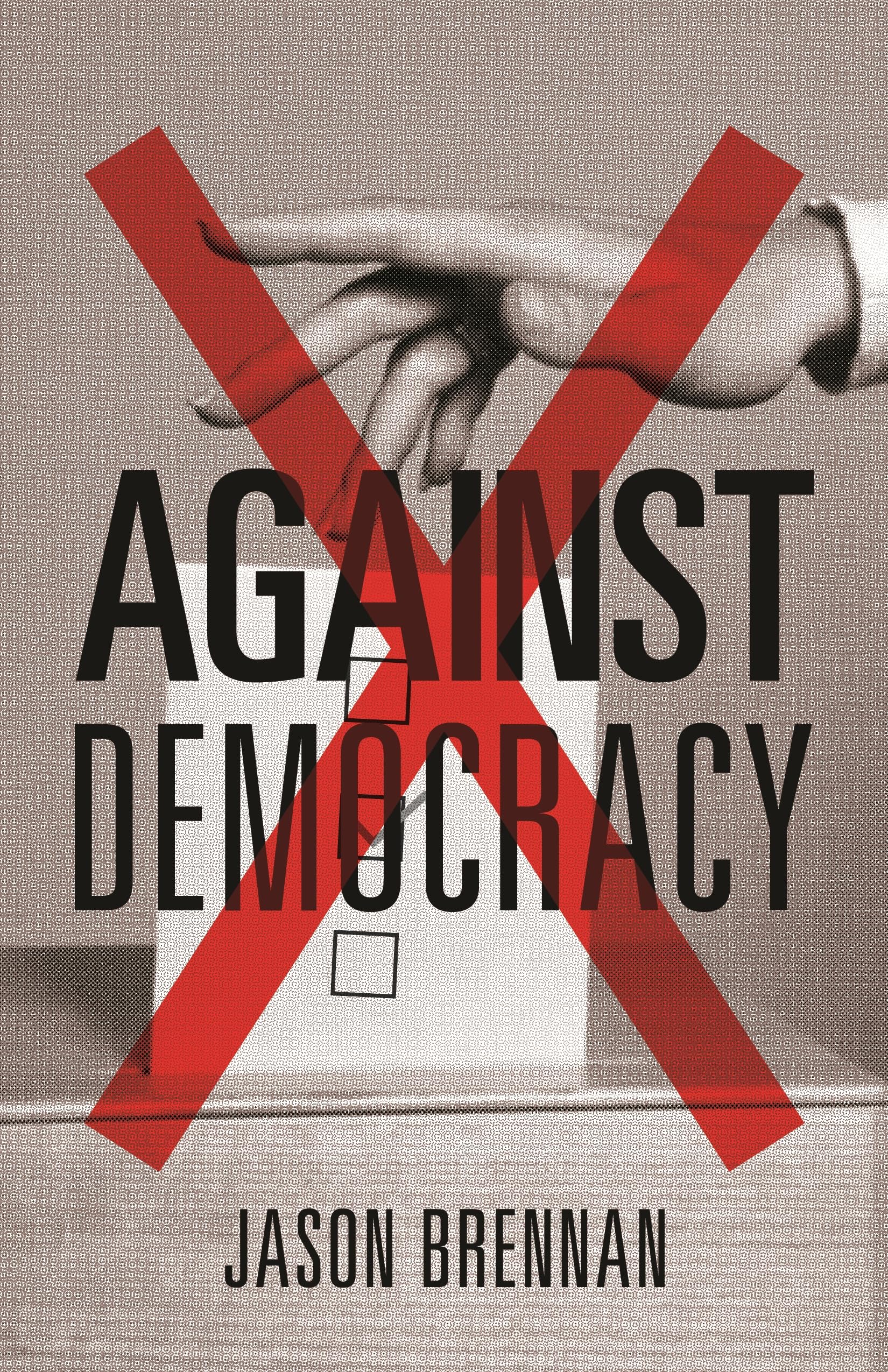
Note: This review was written for SFL and can be found here, [...]Most people think that democracy is not only the best government around, but is also the best government conceivable. Many political philosophers and nearly all lay political voters think that democracy is somehow uniquely just, and any deviations from democratic political processes are inherently unjust. However, recent experience with democracies has caused unease for many proponents of democracies; it seems voters are regularly choosing bad policies, such as Brexit, and bad leaders, such as Trump or Clinton. These trends in the West have challenged the blind faith in the premise that democracy is the ideal form of government.k10843It is in an intensely dogmatic pro-democratic discourse that Georgetown University philosopher Jason Brennan’s new book Against Democracy comes to the scene. Brennan argues that democracy is not inherently just and we should choose what procedural form government takes (e.g. democracy, monarchy, or oligarchy) based off of the results of their form of governments. Though democracy might be the best form of government we have tried yet, it still has some pretty hefty flaws, and we might be able to settle for another form of government which works better. Brennan considers these flaws and argues that we should consider an alternative called epistocracy or “rule of the knowers.”The first two chapters point out the flaws in democracies as they operate in the real-world, summarizing key insights from political science and public choice theory. First Brennan divides people into three ideal types: hobbits, hooligans, and vulcans. Hobbits, who comprise a majority of the population, are generally apathetic about politics. Hooligans, who comprise a majority of politically active voters in the population, treat politics like a sporting event; they are extremely ignorant and misinformed, they process political information in a systematically biased and irrational way to conform to their pre-existing ideologies and dogmatically cheer for their political “team” no matter what. Vulcans, meanwhile, are a tiny minority who are knowledgeable about politics and care only for the facts when deliberating about how to vote.The empirical evidence shows that most voters are hooligans and most hobbits are more likely to be potential hooligans than vulcans. This isn’t because most people are inherently ignorant or irrational, but because the democratic process creates an incentive to be so. Brennan summarizes the empirical research and public choice theory surrounding the phenomenon of voter ignorance: the costs of becoming knowledgeable are extremely high, yet the chances of one vote making a difference in an election are vanishingly small, meaning voters have no incentive to become informed. This is called rational ignorance. Further, since the stakes are very low for an individual voter in an election, they have little incentive to making voting decisions rationally, what economist Bryan Caplan calls “rational irrationality.”Brennan next spends several chapters debunking views for why democracy is inherently the most just forms of government. It will be shocking to many people how many arguments in favor of the divine rule of the majority fall apart similar to pre-Enlightenment era arguments for the divine right of Kings.Next, Brennan summarizes his view of democracy by arguing that citizens have a right to a “competent government.” He summarizes his argument in the entire book as follows:"It is presumed to be unjust and to violate a citizen’s rights to forcibly deprive them of life, liberty, or property, or significantly harm their life prospects, as a result of decisions made by an incompetent deliberative body, or as a result of decisions made in an incompetent way or in bad faith. Political decisions are presumed to be legitimate [the government may create and enforce laws] and authoritative [citizens have a duty to obey these laws] only when produced by competent political bodies in a competent way and in good faith."Intuitively, this argument makes sense. For example, we believe that it would be unjust to have a jury of racists who decide to punish a citizen based off of racial prejudice and not deliberation of the evidence (i.e. in “bad faith”) or a jury of incompetent ignoramuses who are unable to understand the evidence and make the decision based off of ignorance and misinformation (incompetence). We would not say that a defendant in these cases must follow the irrational or ignorant jury’s verdict. Why would we think of it any differently for government decisions in which incompetent or irrational voters make decisions which may be forceful or harmful which affect everyone, not just an individual in a criminal case?Most people have no problem with banning children to vote on the basis that most children are not mature enough to form political opinions correctly. Why is it any different for adults who are unable to politically deliberate? The implication of this principle is that many political decisions made by democracies are not just, and we might want to consider institutions which would allow for more competent government. This is where epistocracy comes into play.Chapter Eight is probably the most controversial part of the book, in which Brennan considers the various institutional forms epistocracy might take, including arrangements such as allowing citizens who prove political knowledge to have additional votes, tests which quiz citizens on basic political knowledge, the creation of an “epistocratic council” of vulcan-like citizens who may veto decisions made by a democratic process, or “government by simulated oracle,” a complex policy by which democratic votes are weighted against citizen’s knowledge on basic social scientific and political questions to try and simulate what the electorate would vote for if it had basic political knowledge.It is in responding to some of the objections to these proposals that there is some weakness in Brennan’s arguments. For example, he responds to the point that most politically knowledgeable are disproportionately white, wealthy, middle-aged men. Epistocratic policies will exclude poorer minorities, such as black women, from having proportional representation in the electorate. Brennan’s response to this objection, for the most part, seems right. First, it is not clear that giving ignorant minorities the right to vote helps them in any way because they are ignorant of what policies are needed to help them. Second, most voters do not vote their self-interest in the first place. Third, those imbalances in political knowledge reflect deeper injustices in mistreatment of those minorities, many of which are continued by allowing the politically ignorant to rule. Having a more knowledgeable electorate may be able to fix those injustices in the first place.Though the first two responses seem perfectly right to me, the third one could use some qualification. Part of what an electorate does (or, at least, should do) in a democracy is not only vote for candidates who advocate their preferred solutions to problems, but also candidates who recognize the problems they face are problems in the first place and take those issues to be a high priority, prolonging these injustices. Though a better-informed electorate might be better able to recognize when something is a problem based off the facts, they still might give issues that do not affect them a very low priority simply due to the availability bias in their communities.For an example, many white Republicans erroneously deny that police brutality against African-Americans is a serious problem. Well-informed rich white people living in suburbs do not experience issues like police violence or the drug war the same way poorly informed minorities do, and even though they might be able to read a white paper telling them it is a serious problem with statistics they still might not prioritize very highly because it is something they do not experience very regularly. As a result, the injustices and needs of those communities may be pushed to the back burner as they aren’t present in political discourse.My objection here does not really mean that Brennan is wrong, nor is it a decisive objection to epistocracy. It simply means that epistocracy may not be the solution to these injustices Brennan thinks it is and, at the very most, we should fix those injustices before pursuing epistocratic solutions. Of course, this objection is also dependent on the empirical evidence of whether this is a problem for epistocracies, and it may be the case that even with this flaw, epistocracies address the injustices causing minorities to be ill-informed better than democracies.Moreover, all epistocracies will be plagued with special interests trying to capture and control who gets to vote by manipulating the structure of the epistocratic policies. For example, trying to manipulate the statistical weight of the simulated oracle, or the questions that go on the exam for voting, to better screen for voters who will vote for their preferred policies. Brennan concedes this point, and rightly points out this also happens under democracies (for example, Republicans with voter ID laws or incumbent congressmen gerrymandering districts) and it is an empirical question whether these public choice issues involved in the imperfect epistocratic solutions result in worse policies than we have in imperfect democracies. However, I think he under-appreciates the extent to which epistocratic solutions could be captured to serve special interests.Finally, Brennan concedes a Burkean point that radically changing our form of government to epistocracy might have high, unseen costs. One such cost he implicitly recognizes, though perhaps doesn’t fully appreciate, is the fact that most people currently believe that political liberties ennoble them and give them some sort of meaningful symbolic “voice” in government. Though Brennan spends many pages convincingly showing why these beliefs are false and correctly notes that people valuing political involvement symbolically is a socially contingent cultural fact which can be changed (and should be changed if valuing political involvement is harmful to society), he ignores a potential positive function of this social value for democracies.Even if people do not really have any meaningful “voice” in government by voting, the fact is they believe they do now and democracy, by ennobling them with this belief, decreases the likelihood that dissenters with the current political regime will become angry and foment violent revolution because they at least believe they are somehow making a difference by voting. Symbolic belief in political liberties may provide an important “release valve” for dissent that helps to maintain political stability. Perhaps one day in the distant future the when everyone, like Brennan, sees through the illusions in blind faith in the “ennobling” symbolic arguments for voting and political involvement, epistocracy will work fine, but as long as people think that restricting them from voting is somehow meaningfully silencing them, they may react violently to attempts to stop them. The hooligans may, in fact, act like hooligans if you take away their right to vote and threaten political stability. Again, this is ultimately an empirical question and does not alone refute Brennan’s arguments, however it could be a potential obstacle to overcome for epistocrats.Despite these minor objections, Brennan’s book is among the best works in political philosophy in recent memory. Though I have some skepticism about his solutions, he has no doubt succeeded in his argument on its own terms and correctly identified a serious problem. Despite democracy’s preferability to existing alternatives, it could very well be improved with epistocratic tweaks if he’s is right. Brennan makes extremely convincing, highly readable arguments for an extremely controversial view.
S**N
Devastating critique of democracy
Against Democracy, as the name suggests, is a devastating critique of democracy both in terms of the efficacy of real-world democracies to provide competent government and the moral justifications for democracy (more precisely, universal suffrage as a moral right). It is at its best when it challenges and debunks our cherished assumptions about and views of democracy.I find the book less convincing when it comes to Brennan’s proposed alternative: epistocracy. This is the rule of the knowers; or more precisely, the idea that in some way voting or governing is restricted by some kind of test of knowledge. For example, you only get to vote if you can pass an exam like the citizenship test or everyone gets a vote, but people who can pass such an exam get extra votes. Brennan briefly discusses several possible ways epistocracy might work (and there are many), but without any actual full-blown epistocracies to look at, it is hard to get a feel for just what such a system would really look like and how such a system would actually work. This is hardly Brennan’s fault; there just aren’t any real-world examples to present.He does discuss some of the epistocratic elements already in place (e.g. Supreme Court) and this helps make things clearer. Nevertheless, I think he might have spent more time fleshing out a few of the more promising alternatives in greater detail. After all, the discussion of epistocracy proper is only one chapter (I would assume Brennan is saving this for his next book.)Without the more fleshed out alternatives, it is harder to evaluate them and compare them to democracy (which is what Brennan wants us to do). It also makes it harder to determine whether some of the objections raised against epistocracy are answered adequately. For example, I am not sure the demographic objection is satisfactorily met. This is the concern that epistocracy would, given the current demographic realities, disenfranchise individuals that are part of already disadvantaged groups. Brennan’s response boils down to the claim that since epistocracy should yield better policies (especially for such groups, who have been ill served by democracy), these individuals will be better off under epistocracy. This might be true but it sure doesn't seem like it would convince someone deeply concerned about this issue. Of course, that doesn’t show that Brennan is wrong, but it tugs at how deep the perceived value of voting is and that at least from a rhetorical point of view more work needs to be done.Another practical concern is that Brennan never addresses how we get there from here. What is the realistic path to adopting his vision? If democracies are as incompetent as he convincingly argues, then how do we get democracies to change and implement epistocracy (peacefully)?Another concern I have, and this runs through a lot of Brennan’s work that I have read, is that he has way more confidence in empirical social science than I tend to think is warranted. I am not denying the value of this science or its importance in making these kinds of arguments. Nevertheless, I think more humility and caution is needed when using it. The empirical data seems to me to be more limited in terms of scope and generalizability than Brennan seems to treat it. That said, he is explicitly cautious at times, just not as much as I think he needs to be.I am sympathetic to Brennan’s arguments against democracy and for epistocracy. But I worry that's because I am not part of the groups that are disenfranchised by Brennan's proposals: my position in society is not likely to be affected. Would someone in those groups find the view as appealing? Probably not. But, then, such people aren't reading books like these I (and maybe that’s part of the problem).As a realistic alternative, I don’t think epistocracy will win the day anytime soon. But I think the book has important value in the present forcing us to rethink the way see democracy and by making the case that more epistocratic elements need to be added or strengthened in our republic.
Trustpilot
2 days ago
3 weeks ago