

Desert Online General Trading LLC
Dubai, United Arab Emirates
Desert Online General Trading LLC
Dubai, United Arab Emirates
Full description not available
P**E
Entertaining, informative and challenging
Entertaining, informative and challenging in equal measure. Brings early Chinese philosophy alive and pertinent to the present day with reference to some neuroscience, I am returning to study early Chinese philosophy after a 40 year break and this has really energised me so that I will be following up with other works and initiatives of his....his style is lucid and light, fully engaging. Recommended.
F**R
Four Stars
As described
C**E
Five Stars
Good book for history! Spoiler alert; Turns out you can't try not to try ;)
J**J
Wu Wei
An effortless read. Interesting and engaging. Worth reading.
C**
Five Stars
Came on time and as described. My mum is loving it!
D**R
Interesting but fundamentally flawed
Interesting book, containing a great summary of the evolution of Wu-Wei thinking in China, and some great cross-referencing with modern psychology.If you’re approaching this book as a pop psychology book with a grounding in Chinese philosophy, it’s very, very good - five stars.However, if you’re approaching it to get insights into Wu-Wei and effortless action, it fails quite thoroughly to get the point of the philosophies it discusses (at least in this humble reader’s opinion). The focus on achieving Wu-Wei *in order to be more successful in social situations* is like the tail wagging the dog. As someone who is pursuing a more effortless, “doing nothing” way of life, it is not something I’m doing because I want more social grace. It’s something I’m doing for spiritual reasons, to reach a more peaceful inner state. I couldn’t care less about the social implications. Well, I care a little, but it’s certainly not my primary motive.So, if you’re looking into Taoism and other Chinese philosophies from a spiritual perspective, this book is unfortunately a dud. An interesting dud, but still, essentially misguided.If you’re looking for a more utilitarian, social-success oriented perspective on effortless action, however, this is great.
C**S
This is not a self-help book
This is wonderful exploration of the Chinese concept of Wu Wei, which is difficult to translate into English. It is approximately about effortless action, the zenith that masters of their arts achieve. It is not a self-help manual, I think deliberately, because the notion of self-help contradicts the idea at the heart of the book. So read this not for a ten step guide to spontaneity, rather read it for a fresh perspective on life, to enjoy and to contemplate.
B**A
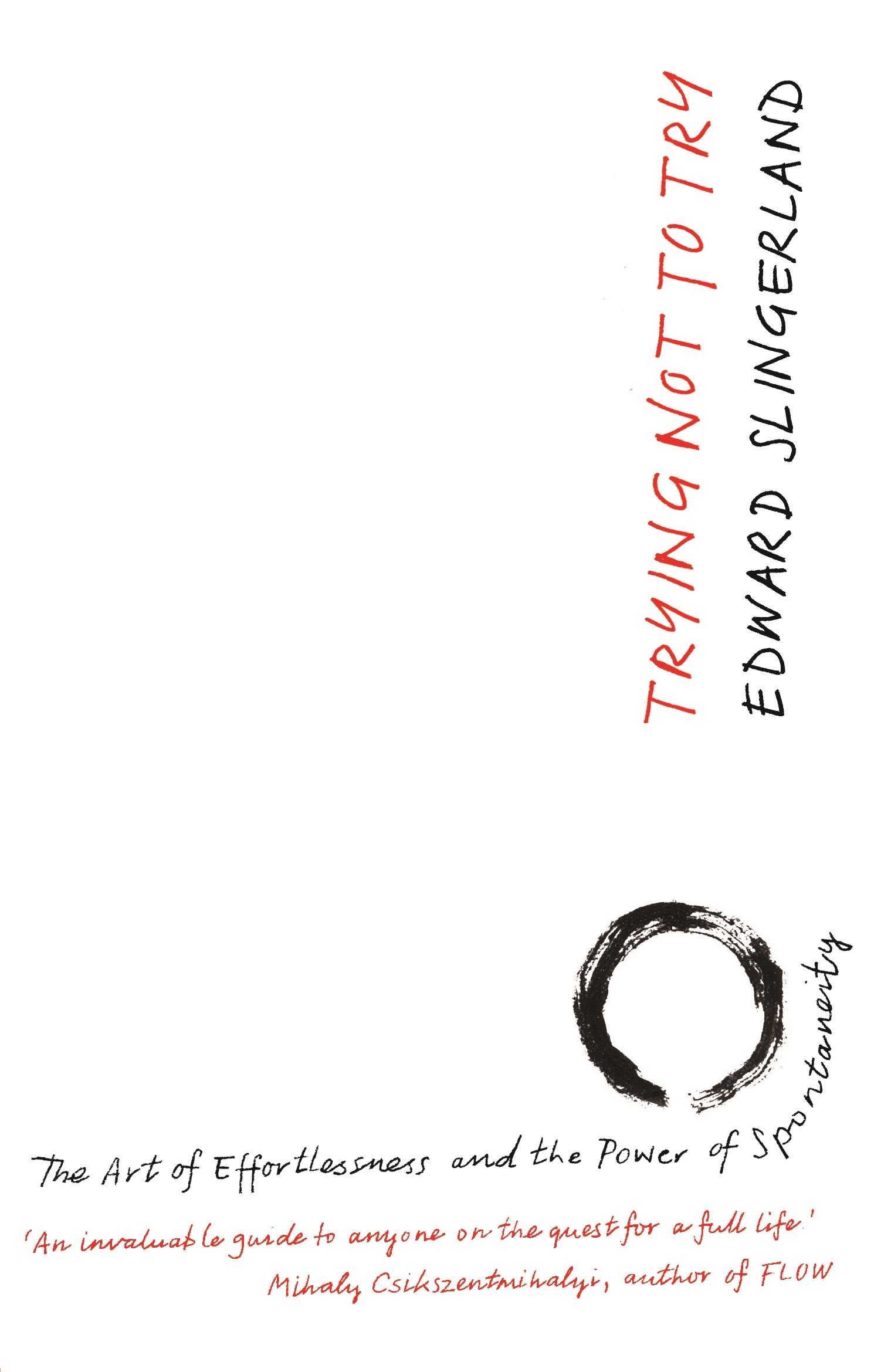
Trying Not to Try by Edward Slingerland
This book will not teach you how to be more spontaneous. Because of the very nature of spontaneity it is not something you can learn from a book. However it does show how not concentrating on a task will help achieve the desired outcome.This book also explores the meaning of the Chinese concepts of wu-wei. The book is full of examples of the action-less doing of wu-wei (being in the zone) as well as examples from contemporary neuroscience. It even goes as far as comparing wu-wei to Luke Skywalker using the force in Star Wars.This is not a self-help book, it doesn’t have a simple step-by-step guide on how to be more spontaneous. However it does have concepts that you can put into practice in every day life to try and be more spontaneous. Whether that be in sport, art, blogging or just falling asleep.
Trustpilot
4 days ago
3 weeks ago