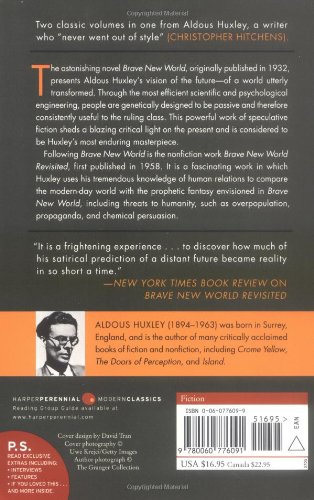


Brave New World and Brave New World Revisited [Aldous Huxley, Christopher Hitchens] on desertcart.com. *FREE* shipping on qualifying offers. Brave New World and Brave New World Revisited Review: A Must Read In Our Day A Age - Showcases Huxley's Velvet-Fist Dystopia That Is Comparable To Orwell's 1984's Iron-Fist Dystopia - “It is rather alarming to find that only twenty-seven years [after writing Brave New World] quite a number of those forecasts have already come true, and come true with vengeance…Some of them were foreseen, and I think some of them I didn’t have the imagination to foresee, but I t think there is a whole armory at the disposal of potential dictators at the moment.” – Aldous Huxley [1958] Known for being one of the most influential dystopian authors of all time, Aldous Huxley, who was a jack of all trades, created his magnum opus, Brave New World in 1931, which was published a year later. Nigh nine decades later, many of his ominous and scholarly insights are manifesting right before our eyes. For these reasons, Brave New World should be read through rather carefully, for it serves as a severe warning not only about what might be coming, but what is already here. This particular fusion of Brave New World and Brave New World Revisited by Aldous Huxley truly is as fascinating as it is disturbing in scope. The former offers his vision of what a dystopian world might be like, while the latter offers a trenchant examination of Brave New World. While some may call some of Huxley’s ideas ‘prophetic’ in a sense, it’s more of a logical deduction given the available information that there was at a time. If one has a reasonable amount of quality information, one surely would be able to postulate a reasonable result given humanity’s penchant for falling for propaganda in droves historically. After all, most nations historically don’t operate under true freedom. What’s more, many ‘modern’ nations already implement many of the disturbing trends written about in this sobering, if intense account of could have happened, although in fiction, which is now turning into reality. Brave New World has been compared to Orwell’s 1984 due to the engineered control grid – each of which carries different methods – and with good reason. Whilst 1984 is ruled with an iron fist, Brave New World is ruled with a velvet one. Endless arguments have ensued in many circles as to which one we are gravitating towards, and it’s definitely intriguing although distressing contemplating such facts. Huxley does an outstanding job of painting a disturbing portrait within his fictional realm. The individuals within his society – who are essentially drones – have fallen over themselves for the ‘good of all’ – for the collective. The book is littered with countless examples of this. The individual, who is the foundation of society, is thrown aside, by the wayside. In respect to this troublesome and pernicious pervasive issue, which is seen more and more nowadays, Huxley noted the following words: “Brave New World presents a fanciful and somewhat ribald picture of a society, in which the attempt to recreate human beings in the likeness of terminates has been pushed almost to the limits of the possible. That we are being propelled in the direction of Brave New World is obvious. But not less obvious is the fact that we can, if we so desire, refuse to co-operate with the blind forces that are compelling us. As Mr. William Whyte has shown in his remarkable book, The Organization Man, a new Social Ethic is replacing our traditional ethical system – the system in which the individual is primary. The key words in this Social Ethic are “adjustment,” “adaptation,” “socially oriented behavior,” “belongingness,” “acquisition of social skills,” “team work,” “group living,” “group loyalty,” “group dynamics,” “group thinking,” “group creativity.” Its basic assumption is that the social whole has greater worth and significant than its individual parts, that inborn biological differences should be sacrificed to cultural uniformity, that the rights of the collective take precedence over what the eighteenth century called the Rights of Man.”[1] Furthermore, as Huxley notes, the: “…ideal man is the man who displays “dynamic conformity” (delicious phrase!) and an intense loyalty to the group, an unflagging desire to subordinate himself, to belong.”[2] Talk about a conformity crisis! That’s exactly where society is torpedoing to as we speak. And it all starts in youth, through the public schooling system. This conformity crisis in public schooling has been spoken about at length by John Taylor Gatto in his books, Dumbing Us Down, A Different Kind Of Teacher and Weapons Of Mass Instruction. In Dumbing Us Down – The Hidden Curriculum Of Compulsory Schooling, Gatto mentions the following explosive remarks: “Mass education cannot work to produce a fair society because its daily practice is practice in rigged competition, suppression and intimidation. The schools we’ve allowed to develop can’t work to teach nonmaterial values, the values which give meaning to everyone’s life, rich or poor, because the structure of schooling is held together by a Byzantine tapestry of reward and threat, of carrots and sticks. Official favor, grades, and other trinkets of subordination have no connection with education; they are the paraphernalia of servitude, not of freedom.”[3] “Schools are intended to produce, through the application of formulas, formulaic human beings whose behavior can be predicted and controlled.”[4] “…schools and schooling are increasingly irrelevant to the great enterprises of the planet. No one believes anymore that scientists are trained in science classes or politicians in civics classes or poets in English classes. The truth is that schools don’t really teach anything except how to obey orders.”[5] Gatto minces no words. If you wish to see what is happening, right from the start via the public indoctrination system, READ John Taylor Gatto’s work. It is HIGHLY recommended. Returning to Huxley, the latter part of Brave New World & Brave New World Revisited also features Huxley’s letter to Orwell. Additionally, and arguably more importantly, the second book, Brave New World Revisited is absolutely mind bending. Brave New World Revisited includes intriguing information at length that supplements droves of added substance for the reader to familiarize themselves with some of the deeper niches of everything Brave New World stands for. One could view it as a few different essays on many of the most disturbing components and trends, featured in Brave New World, which society is currently following. Topics which are discussed include conformity, the collectivization of society, the attack on individuals, brainwashing, propaganda, social engineering, distractions within society, chemical persuasion, possible solutions and much more. Brave New World Revisited encompasses nigh 100 pages of additional information that should be essentially mandatory in education. It would be interesting to see what Huxley would have thought about the precision condition that is currently taking place on a mass scale in society today. There are so many angles to this, that one could write many essays and analyze it in a myriad of ways. Many have, and rightly so. With the recipes featured in Orwell and Huxley’s books, the system seems to be changing day by day, and not for the better. Propaganda, entrainment technology, social engineering, overmedication of the population, and more, are all being used to maliciously mold society to become not only uniform, but obedient to boot. Incisive individuals who value freedom and have inquiring minds should not only make this part of their library, but should prepare for what’s already here and much of what’s coming soon. Couple Brave New World with 1984, and you have the recipe of what the world is beginning to look like, which is a merger of those two ideals. And that’s a very, very disturbing proposition. Be warned. _______________________________________________________________ Sources: [1] Aldous Huxley, Brave New World & Brave New World Revisited, p. 257. [2] Ibid., p. 257. [3] John Taylor Gatto, Dumbing Us Down – The Hidden Curriculum Of Compulsory Schooling, pg. 69. [4] Ibid., p. 23. [5] Ibid., p. 21. _______________________________________________________________ If You are interested in the subject, the Book Reviews below follow as highly suggested reading: 1984 by George Orwell Dumbing Us Down by John Taylor Gatto A Different Kind Of Teacher by John Taylor Gatto Weapons Of Mass Instruction by John Taylor Gatto Rotten To The (Common) Core: Public Schooling, Standardized Tests & The Surveillance State by Dr. Joseph P. Farrell The Tavickstock Institute: Social Engineering The Masses by Daniel Estulin Technocracy Rising: The Trojan Horse Of Global Transformation by Patrick M. Wood Propaganda by Edward Bernays ______________________________________________ Kindest Regards, -Zy Marquiez TheBreakaway.wordpress.com Review: A dystopian classic that should be required reading for everyone hoping to graduate High School. - Brave New World is a dystopian classic. Written in the early 1930's, its message is still powerful 90 years later. This book was required in at least one of my high school classes and I would think with Ayn Rand's Anthem or George Orwell's 1984 should remain required reading. The future, set forth in Brave New World is one of where "Community, Identity, Stability" are the foundation of the World State which controls its population from creation in a bottle to their inevitable death. Through conditioning and selective breeding, the World State has achieved its goals, but at what cost? It may be cliche to say, but this book is timeless and its themes and ideas about individuality, what the price of freedom is and even what a shallow nightmare pop culture can be. Huxley predicted a world that almost a hundred years later, seems like we might be just a few steps away from creating ourselves. The book is thought provoking and as I've said, should be required reading for those in school and the rest of civilization when we are older. This print of the book was nice and easy to read. It comes paired with Brave New World Revisited, basically a commentary by Huxley on the books impact and whether he sees his dark vision of the future coming to pass at all. He does also share that he resisted the temptation to rewrite or try and perfect the novel. A move, that although might have been inspirational too, he let the work stand on it's own. Over the years we've seen a few creators go back and monkey around with their original works, an undertaking that doesn't always pan out well and sometimes makes their works weaker in the process, and frustrates those want to find their beloved classics. I would advise anyone to pick up this book and even this copy of the book and it should sit on your shelf with other classics and given thought from time to time.


| Best Sellers Rank | #9,427 in Books ( See Top 100 in Books ) #144 in Dystopian Fiction (Books) #431 in Classic Literature & Fiction #949 in Literary Fiction (Books) |
| Customer Reviews | 4.7 4.7 out of 5 stars (2,431) |
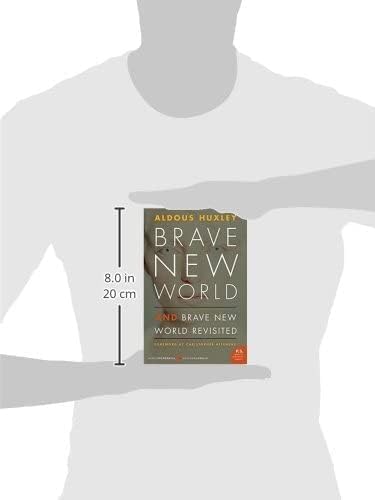
| Dimensions | 8.04 x 5.46 x 0.93 inches |
| Edition | Reprint |
| ISBN-10 | 0060776099 |
| ISBN-13 | 978-0060776091 |
| Item Weight | 10.2 ounces |
| Language | English |
| Print length | 340 pages |
| Publication date | July 5, 2005 |
| Publisher | Harper Perennial Modern Classics |
Z**X
A Must Read In Our Day A Age - Showcases Huxley's Velvet-Fist Dystopia That Is Comparable To Orwell's 1984's Iron-Fist Dystopia
“It is rather alarming to find that only twenty-seven years [after writing Brave New World] quite a number of those forecasts have already come true, and come true with vengeance…Some of them were foreseen, and I think some of them I didn’t have the imagination to foresee, but I t think there is a whole armory at the disposal of potential dictators at the moment.” – Aldous Huxley [1958] Known for being one of the most influential dystopian authors of all time, Aldous Huxley, who was a jack of all trades, created his magnum opus, Brave New World in 1931, which was published a year later. Nigh nine decades later, many of his ominous and scholarly insights are manifesting right before our eyes. For these reasons, Brave New World should be read through rather carefully, for it serves as a severe warning not only about what might be coming, but what is already here. This particular fusion of Brave New World and Brave New World Revisited by Aldous Huxley truly is as fascinating as it is disturbing in scope. The former offers his vision of what a dystopian world might be like, while the latter offers a trenchant examination of Brave New World. While some may call some of Huxley’s ideas ‘prophetic’ in a sense, it’s more of a logical deduction given the available information that there was at a time. If one has a reasonable amount of quality information, one surely would be able to postulate a reasonable result given humanity’s penchant for falling for propaganda in droves historically. After all, most nations historically don’t operate under true freedom. What’s more, many ‘modern’ nations already implement many of the disturbing trends written about in this sobering, if intense account of could have happened, although in fiction, which is now turning into reality. Brave New World has been compared to Orwell’s 1984 due to the engineered control grid – each of which carries different methods – and with good reason. Whilst 1984 is ruled with an iron fist, Brave New World is ruled with a velvet one. Endless arguments have ensued in many circles as to which one we are gravitating towards, and it’s definitely intriguing although distressing contemplating such facts. Huxley does an outstanding job of painting a disturbing portrait within his fictional realm. The individuals within his society – who are essentially drones – have fallen over themselves for the ‘good of all’ – for the collective. The book is littered with countless examples of this. The individual, who is the foundation of society, is thrown aside, by the wayside. In respect to this troublesome and pernicious pervasive issue, which is seen more and more nowadays, Huxley noted the following words: “Brave New World presents a fanciful and somewhat ribald picture of a society, in which the attempt to recreate human beings in the likeness of terminates has been pushed almost to the limits of the possible. That we are being propelled in the direction of Brave New World is obvious. But not less obvious is the fact that we can, if we so desire, refuse to co-operate with the blind forces that are compelling us. As Mr. William Whyte has shown in his remarkable book, The Organization Man, a new Social Ethic is replacing our traditional ethical system – the system in which the individual is primary. The key words in this Social Ethic are “adjustment,” “adaptation,” “socially oriented behavior,” “belongingness,” “acquisition of social skills,” “team work,” “group living,” “group loyalty,” “group dynamics,” “group thinking,” “group creativity.” Its basic assumption is that the social whole has greater worth and significant than its individual parts, that inborn biological differences should be sacrificed to cultural uniformity, that the rights of the collective take precedence over what the eighteenth century called the Rights of Man.”[1] Furthermore, as Huxley notes, the: “…ideal man is the man who displays “dynamic conformity” (delicious phrase!) and an intense loyalty to the group, an unflagging desire to subordinate himself, to belong.”[2] Talk about a conformity crisis! That’s exactly where society is torpedoing to as we speak. And it all starts in youth, through the public schooling system. This conformity crisis in public schooling has been spoken about at length by John Taylor Gatto in his books, Dumbing Us Down, A Different Kind Of Teacher and Weapons Of Mass Instruction. In Dumbing Us Down – The Hidden Curriculum Of Compulsory Schooling, Gatto mentions the following explosive remarks: “Mass education cannot work to produce a fair society because its daily practice is practice in rigged competition, suppression and intimidation. The schools we’ve allowed to develop can’t work to teach nonmaterial values, the values which give meaning to everyone’s life, rich or poor, because the structure of schooling is held together by a Byzantine tapestry of reward and threat, of carrots and sticks. Official favor, grades, and other trinkets of subordination have no connection with education; they are the paraphernalia of servitude, not of freedom.”[3] “Schools are intended to produce, through the application of formulas, formulaic human beings whose behavior can be predicted and controlled.”[4] “…schools and schooling are increasingly irrelevant to the great enterprises of the planet. No one believes anymore that scientists are trained in science classes or politicians in civics classes or poets in English classes. The truth is that schools don’t really teach anything except how to obey orders.”[5] Gatto minces no words. If you wish to see what is happening, right from the start via the public indoctrination system, READ John Taylor Gatto’s work. It is HIGHLY recommended. Returning to Huxley, the latter part of Brave New World & Brave New World Revisited also features Huxley’s letter to Orwell. Additionally, and arguably more importantly, the second book, Brave New World Revisited is absolutely mind bending. Brave New World Revisited includes intriguing information at length that supplements droves of added substance for the reader to familiarize themselves with some of the deeper niches of everything Brave New World stands for. One could view it as a few different essays on many of the most disturbing components and trends, featured in Brave New World, which society is currently following. Topics which are discussed include conformity, the collectivization of society, the attack on individuals, brainwashing, propaganda, social engineering, distractions within society, chemical persuasion, possible solutions and much more. Brave New World Revisited encompasses nigh 100 pages of additional information that should be essentially mandatory in education. It would be interesting to see what Huxley would have thought about the precision condition that is currently taking place on a mass scale in society today. There are so many angles to this, that one could write many essays and analyze it in a myriad of ways. Many have, and rightly so. With the recipes featured in Orwell and Huxley’s books, the system seems to be changing day by day, and not for the better. Propaganda, entrainment technology, social engineering, overmedication of the population, and more, are all being used to maliciously mold society to become not only uniform, but obedient to boot. Incisive individuals who value freedom and have inquiring minds should not only make this part of their library, but should prepare for what’s already here and much of what’s coming soon. Couple Brave New World with 1984, and you have the recipe of what the world is beginning to look like, which is a merger of those two ideals. And that’s a very, very disturbing proposition. Be warned. _______________________________________________________________ Sources: [1] Aldous Huxley, Brave New World & Brave New World Revisited, p. 257. [2] Ibid., p. 257. [3] John Taylor Gatto, Dumbing Us Down – The Hidden Curriculum Of Compulsory Schooling, pg. 69. [4] Ibid., p. 23. [5] Ibid., p. 21. _______________________________________________________________ If You are interested in the subject, the Book Reviews below follow as highly suggested reading: 1984 by George Orwell Dumbing Us Down by John Taylor Gatto A Different Kind Of Teacher by John Taylor Gatto Weapons Of Mass Instruction by John Taylor Gatto Rotten To The (Common) Core: Public Schooling, Standardized Tests & The Surveillance State by Dr. Joseph P. Farrell The Tavickstock Institute: Social Engineering The Masses by Daniel Estulin Technocracy Rising: The Trojan Horse Of Global Transformation by Patrick M. Wood Propaganda by Edward Bernays ______________________________________________ Kindest Regards, -Zy Marquiez TheBreakaway.wordpress.com
P**E
A dystopian classic that should be required reading for everyone hoping to graduate High School.
Brave New World is a dystopian classic. Written in the early 1930's, its message is still powerful 90 years later. This book was required in at least one of my high school classes and I would think with Ayn Rand's Anthem or George Orwell's 1984 should remain required reading. The future, set forth in Brave New World is one of where "Community, Identity, Stability" are the foundation of the World State which controls its population from creation in a bottle to their inevitable death. Through conditioning and selective breeding, the World State has achieved its goals, but at what cost? It may be cliche to say, but this book is timeless and its themes and ideas about individuality, what the price of freedom is and even what a shallow nightmare pop culture can be. Huxley predicted a world that almost a hundred years later, seems like we might be just a few steps away from creating ourselves. The book is thought provoking and as I've said, should be required reading for those in school and the rest of civilization when we are older. This print of the book was nice and easy to read. It comes paired with Brave New World Revisited, basically a commentary by Huxley on the books impact and whether he sees his dark vision of the future coming to pass at all. He does also share that he resisted the temptation to rewrite or try and perfect the novel. A move, that although might have been inspirational too, he let the work stand on it's own. Over the years we've seen a few creators go back and monkey around with their original works, an undertaking that doesn't always pan out well and sometimes makes their works weaker in the process, and frustrates those want to find their beloved classics. I would advise anyone to pick up this book and even this copy of the book and it should sit on your shelf with other classics and given thought from time to time.
L**I
Passt
A**K
This book is spectacular. Must read for everyone, especially since this story is coming true before our eyes, and most of us are walking with a blindfold on not seeing the forest in the trees. Everything about it is great. Just get it and read the heck out of it. The Revisited book is also nice. Crazy how in 1931 and then in 1957 he was fearing what the world is turning into... I'd love to see what Huxley would think if he visited 2020. Somehow he was so impressively accurate it seems like he travelled into the future. Amazing man and two great books. This is a must-read, and I must say I enjoyed it more than in 1984. At least here everyone is happy... Also, this version of the future seems much more realistic.
य**श
The first 80 pages or so were blank. The book therefore had to be returned.
J**S
Quizá lo único que puedo agregar es que por el precio uno cree que puede ser un libro con hojas de mayor calidad...es paperback, no obstante todo ok.
Q**L
good product and delivery
Trustpilot
3 weeks ago
2 months ago