Desert Online General Trading LLC
Dubai, United Arab Emirates
Desert Online General Trading LLC
Dubai, United Arab Emirates


Full description not available
V**N
A timeless masterpiece filled with wisdom still applicable today
Edwin Lefèvre does a fantastic job bringing the experiences of Jesse Livermore (disguised in the pages as Larry Livingston) to life in this fantastic book. This work is written as a novel and almost as a biography, in which Livermore describes his career as a stock operator. He starts from his childhood days in bucket shops (which earned him the title of "boy plunger"), continues with his experiences on Wall Street - where he made and lost millions of dollars over and over again, and finishes with intriguing stories on price manipulation and speculation back in the earlier half of the 20th century.All throughout the book, amidst the inspiring stories and witty humor, the reader will find numerous pieces of advice - on anything from human psychology and public behavior to insider trading and investing/speculation strategies. I completely agree with other reviewers who state that this book needs to be read more than once. You simply won't absorb all the useful information the first time. Maybe not even the first two times. Or three.Some of the book's advice is very obvious, as it is repeated many times over. Livermore makes his basic strategy clear - incremental or "probe" approach, where he would slowly build his position in a certain stock/commodity by buying (or selling) blocks of securities until he reached his target - if the ticker tape confirmed his outlook. For example, assume Livermore wanted to go long on A with an investment target of $10,000. He'd first buy $1,000 and wait. If the price moved up, his assessment seemed to be correct - so he'd buy another $2,000 of A at the slightly higher price. If the price kept going up, he'd then increase his position to $6,000 - and eventually up to $10,000 - his original target. If, of course, the price reacted differently, his market "probe" would tell him that his assessment may not have been correct.Other "obvious" advice in the book is equally important - history repeats itself (he describes 2 amazing cases - Stratton's corner on corn and insider boosting of Tropical Trading - where he used the same technique to turn a commodity or stock bearish), don't ever follow tips from anyone (trust in yourself only), and don't cash out quickly for a small profit - but rather ride your investment out (go long in a bull market, short in a bear market).Amidst examples and stories in which the above pieces of advice appear to shine over and over again, other small and hidden tid-bits pop up throughout the entire book. Livermore is unafraid to talk about his mistakes, and he makes it clear that it's not his wish to brag about his successes - but to simply inform the reader why he did what he did. And he does a fantastic job in that.The book is very well written. It feels like a novel, where every chapter follows the main story arc but talks about something different each time, with great insight on yet another topic. The stories are very engaging, often witty and humorous. I read through more than half of the book carefree, simply enjoying the great prose and Lefèvre's literary skill - before I realized that Livermore has been giving me timelessly precious advice all throughout, and that I need to pay more attention.I will read this book again. I will take notes again. I don't want to miss anything.In conclusion, I highly recommend this book to anyone who is interested in the stock or commodities markets. It is enjoyable and entertaining, and it is eye-opening and insightful. It can be read simply as a collection of intriguing stories, or as an "investment bible" with much advice that is still applicable today. While the rules of the exchanges and the amount of money that flows through them have changed, the people trying to beat the market haven't.Pros:+ beautiful literary prose+ intriguing, engaging, witty stories+ lots and lots of investment advice that still holds true today (80+ years later!)+ many examples of historical events that have and will continue to repeat themselves+ great as either a low-key bed-time book or as a serious stock/commodity investment and speculation guide+ each chapter talks about something new, making it easy to read the book over time without losing track of the main storyCons:- first published in 1923 - so keep in mind that, of course, some things are outdated (i.e. certain rules and practices are in place now that weren't then, the amount of money has increased to a point where stock price manipulation is not as easy, etc.) - but treat this as a history lesson- probably needs to be read more than once (but is that really a con?) for the investment advice
A**.
Cited by Many Professionals Among Their Top 10 Investment Books
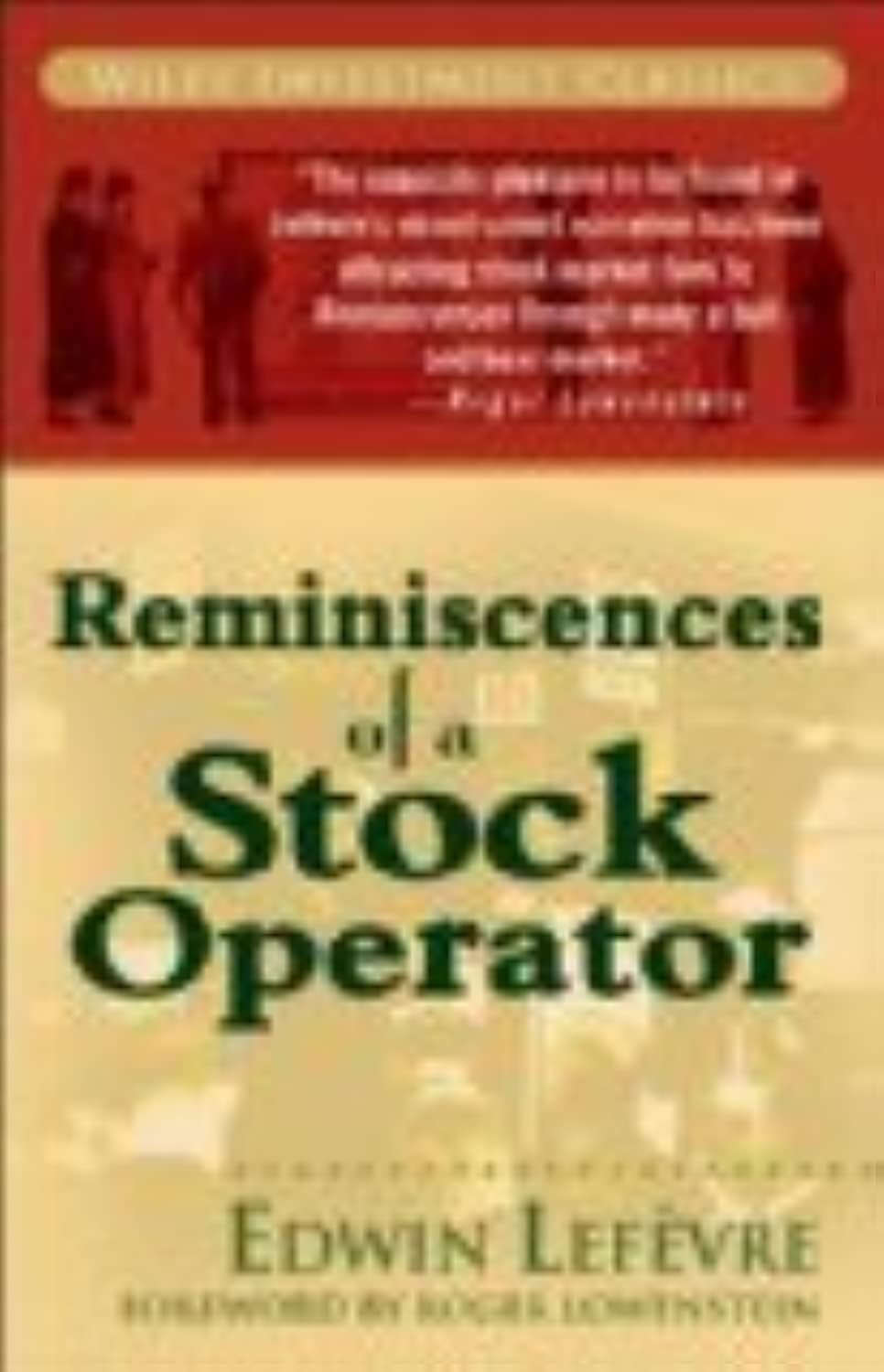
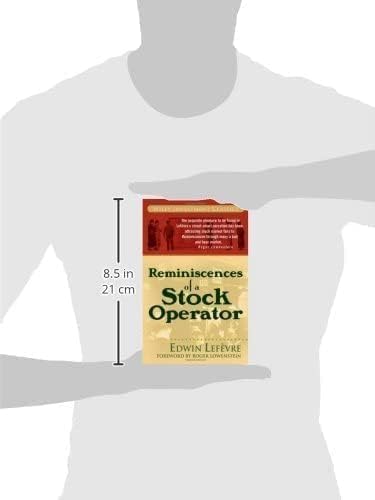
This is a great book and an investment classic. Likely you are reading this review because someone you know and trust recommended the book to you. It is, after all, possibly the most famous investment book ever among professional investors.Reminiscences of a Stock Operator is a work of historical fiction, a roman à clef, originally published in 1923. At the time of publication, people who read about the key character, Larry Livingston, believed that to be a pseudonym for a famous securities trader of the day, Jesse Lauriston Livermore. The wisdom and knowledge of events portrayed could only come from one deeply engaged in the stock and commodity markets from late 19th to early 20th century.You can buy several modern versions of this entertaining and educational investment classic these days. There are already hundreds of reviews of this book in its various versions posted on Amazon. I have purchased and read the top three versions over the years. Rather than tread over ground that has already been thoroughly covered by others, this review focuses on the differences among versions to hopefully assist you in deciding which one to purchase.The main three print versions are these. Included are links to the Amazon page for each book.- The Wiley Investment Classic Version with Foreword by Jack Schwager, author of the Market Wizards series. Reminiscences of a Stock Operator (Wiley Investment Classics)- The MarketPlace Book with Foreword by Market Wizard William J. O'Neil, Founder of Investor's Business Daily. Reminiscences of a Stock Operator (A Marketplace Book)- The Annotated Edition by Jon D. Markman with Foreword by Market Wizard Paul Tudor Jones, Founder of Tudor Investment Corporation. Reminiscences of a Stock Operator: With New Commentary and Insights on the Life and Times of Jesse Livermore (Annotated Edition)There is also a PDF Version available online via search engines. Here are brief summaries of the differences among versions.The Wiley Investment Classic Version. This is the original book without embellishment. There are no illustrations. There is no table of contents. This version includes a short Foreword by Jack Schwager. This is the one to buy if you want the original work but cannot afford the gilded price tag of a very rare original edition.The MarketPlace Book. This book reproduces a series of 12 articles by Edwin LeFevre published in The Saturday Evening Post in 1922. It includes one installment, the first, that does not appear in the Reminiscences book. This version is richly illustrated with black and white cartoons in the Saturday Evening Post style, that is, humorous and wickedly ironic. In his Foreword William J. O'Neil says that of his thousands of investment books, Reminiscences is "one of the top 10 or 12" in his library. This is the one to buy if your objective is to see the markets as did the public in the years before the 1929 stock market crash.The Annotated Edition. This is the best of the lot in my opinion. The commentary by Jon D. Markman and the Foreword by Paul Tudor Jones, one of the most successful investors operating today and perhaps in history, make this the one to buy if your objective is investment education.The PDF Version. This is a typewritten copy of the original text of the book. You get the whole story. Personally, I find Reminiscences so valuable a reference that I want a hard copy in hand to mark up and re-read from time to time, in part or in all. You may want to read it first in PDF and then decide.This is a five star book and a must-read for every investor. Enjoy!
Trustpilot
1 month ago
2 months ago
2 months ago
2 weeks ago