💡 Light up your life—smart, simple, and always connected.
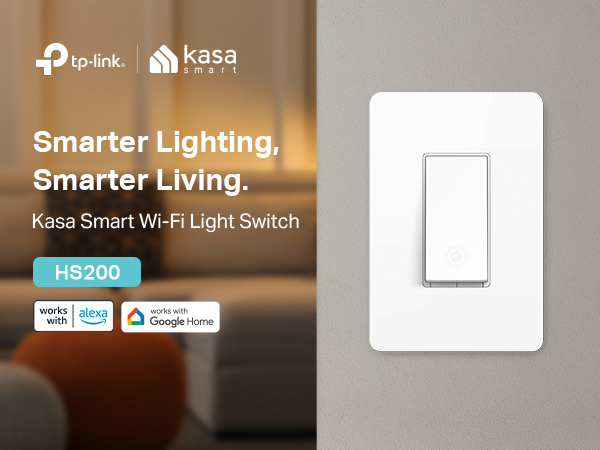
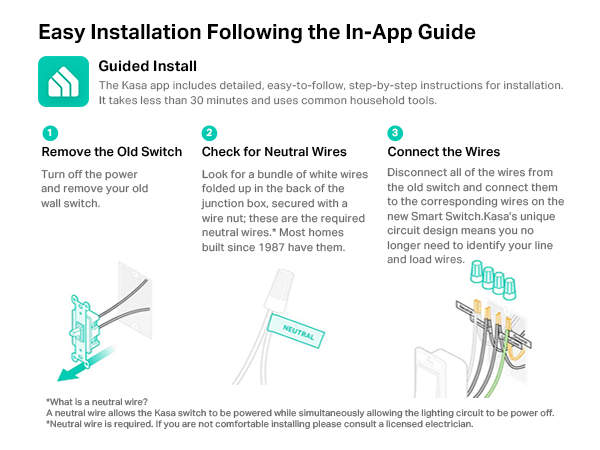
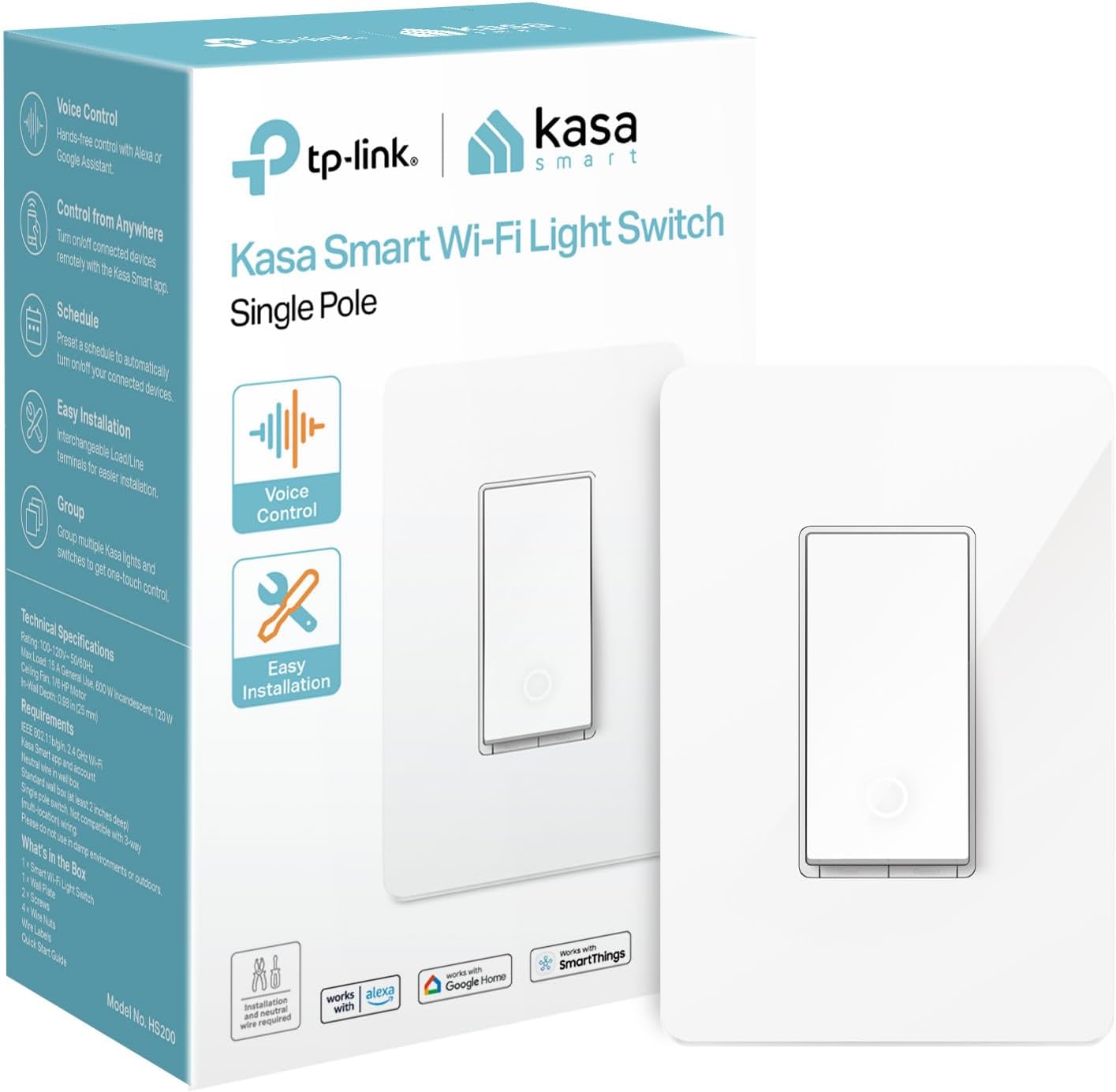
The Kasa Smart Light Switch HS200 is a UL-certified, single-pole Wi-Fi switch designed for 2.4GHz networks requiring a neutral wire. It supports 15 amps and integrates seamlessly with Alexa, Google Assistant, and Cortana for voice control. With app-guided installation, remote access, customizable schedules, and no hub required, it’s a reliable smart home upgrade trusted by millions.


| ASIN | B01EZV35QU |
| Actuator Type | Push Button |
| Best Sellers Rank | #585 in Tools & Home Improvement ( See Top 100 in Tools & Home Improvement ) #1 in Electrical Light Switches #4 in Home Automation Devices |
| Brand | Kasa Smart |
| Brand Name | Kasa Smart |
| Circuit Type | 1-way |
| Color | White |
| Connectivity Protocol | Wi-Fi |
| Connector Type | Screw |
| Contact Material | Copper |
| Contact Type | Normally Closed |
| Control Method | Voice |
| Controller Type | Amazon Alexa, Android, Google Assistant, iOS, vera |
| Current Rating | 15 Amps |
| Customer Reviews | 4.5 out of 5 stars 43,151 Reviews |
| Global Trade Identification Number | 00845973096113 |
| Included Components | smart light switch |
| International Protection Rating | IP00 |
| Item Dimensions | 1.5 x 3.3 x 5 inches |
| Item Height | 5 inches |
| Item Weight | 5.28 ounces |
| Lower Temperature Rating | 32 Degrees Fahrenheit |
| Manufacturer | TP-LINK USA |
| Material Type | Polycarbonate |
| Model | HS200 |
| Mounting Type | Pole,Wall,Mount |
| Number of Items | 1 |
| Number of Positions | 2 |
| Operating Voltage | 120 Volts |
| Operation Mode | OFF-NONE-ON |
| Specification Met | UL |
| Switch Type | One-way |
| Terminal | Spst |
| UPC | 845973096113 840460604949 |
| Unit Count | 1.0 Count |
| Upper Temperature Rating | 104 Degrees Fahrenheit |
| Warranty Description | 2 years |
| Wattage | 600 watts |
D**S
One was bad; the other switch was good and easy to install and set up
It is almond color which is what I wanted plus it is a single pole wifi switch and these were the other things I wanted. I ordered two. One was defective out of the box. Not a pleasant experience for the defective one but the other worked well and was an easy install. Two things. This must use a neutral so look for your white wires which may be capped together (older dimmer switches sometimes did not use a neutral because houses built before 1985 did not require a neutral for a switch) and thought the line wire is the hot wire...curiously enough the neutral wire keeps electric at the other side of the switch to keep it connected to wifi when the light switch is at the off position. It looks nice, it works, and it works well with Alexa. Setup was easy in the app.
J**T
Very impressive WiFi light switch
I usually don't give five stars to a product, but in this case, I must. I am so impressed about how easy it was to install and configure these switches (I bought two, installed side by side in the same wall box) and how well they work. I installed these to control some outdoor flood lights attached to my barn/work shop that is over 100 feet away from my house. The access point is located on the second floor of my house on the side facing the barn. With my cell phone, I can usually pick up about 2 bars of WiFi out there. So I wasn't sure that these switches would work with the weak signal. But they had absolutely no problem connecting and staying connected to the access point. Being able to create programs for these switches (like on at dusk and off at dawn) as well as being able to turn them off and on with my cell from anywhere is great. No hub needed. No subscription required. They just work. For those of you worried about installing these, keep in mind a few things: 1. You need a neutral (usually white) wire in the switch box. Not all electricians run neutral wires to the switch boxes. Fortunately, mine had a neutral wire in the box. 2. Physically install and configure just one switch at a time so things don't get confusing. Much easier this way. 3. Follow the step by step installation instructions exactly that are available through the mobile app. 4. When initially getting these switches on your network, you must connect your cell phone to the local peer-to-peer network broadcast by the switch when it is powered up. Keep your cell phone close to the switch to do this. Follow the prompts in the app. Once it adds itself to your network (it will ask for the network password), the switch's local peer -to peer network will disconnect and disappear. Your phone should then reconnect to your usual WiFi router or access point. Once that happens, the app will show your device (which you can assign a custom name and icon to) and then start programming or controlling it from your mobile device. You do need to create a free account with Kasa, but you can do this directly in the mobile app when you begin installation. As long as these switches hold up long-term, I will be very happy with them. Sure, they are a little pricey compared with some knock-offs from competitors, but otherwise they seem to be great. Oh, and they work with Amazon Alexa devices, too, using the Kasa skill. I guess they only slight gripe I have is that these switches should be available in ivory as well as white, as the rest of my wall switches and outlets are ivory. But with an ivory switch plate around these switches, they don't look too out of place.
J**H
Honest Opinion
Love these! Great way to add some automation to your home. I have installed about 15 of these in my home. Great for exterior lights! Install is simple for those that have a basic experience of 110 electrical wiring. I would suggest that if you are at all unsure of how to install, you get a professional to install. As with any of the classic junction boxes, there is very little room for wires and wire nuts behind the bulkiness of the switch. Setup on the Kasa app is easy. The app walks you though step by step. Easy to connect you your home wifi and operate with the app or with Alexa or Google devices. Switch appears to be decent quality. Of all the units I have installed, I have only have 1 fail. These are not dimmable nor are they designed for multiple poles. These are single pole units, but you can by multi pole units on Amazon. Overall, I would and have recommended this product to anyone who wants a non-subscription home automation product.
V**Y
READ THIS: If you are having trouble completing the setup process
I've had one of these switches for many, many years. It works fine in all aspects, and at the time of setup, I didn't have any trouble connecting to my network and completing the setup process. Fast-forward to November 2025, I needed another one. The HS200 model. For the life of me, I could not complete the setup. I tried restarting it. I tried resetting it. Turned off my Battery Saver. Nothing would work. I was exasperated and ready to send it back to Amazon, thinking I had a defective smart switch. But then, on a hunch, I looked at the available WiFi connections on my phone. There was one that said "TP-Link" and a bunch more letters and numbers, as far as I can recall. My Android 16 Pixel 7 phone also said that the TP-Link WiFi SSID did not have an Internet connection. Bingo! That is the temporary WiFi SSID for the TP-Link Smart Switch that enables its setup connection. But Android 16 will only connect to a non-Internet connection for a few seconds before switching back to another WiFi that does provide Internet. So, I connected to the TP-Link WiFi again via Android WiFi settings connections, but this time a checked the box that said to stay connected regardless of it not having Internet access. Eureka! That did it! I went back to my Kasa app and resumed the new device setup. This time, when Kasa searched for my new smart switch, it was able to make a permanent connection to the smart switch's non-Internet WiFi and stay connected. The rest of the setup went as expected. The switch was NOT defective. It was just how Android decides to "help" a user to not stay connected to a non-Internet WiFi connection. This help consists of disabling that connection after a few seconds, and switching back to one that does have Internet. And that is what was making the setup process fail. If you were having trouble, I hope you found this helpful.
E**R
Best value, one of very few available in light almond (!), reliable (see my correction at the end)
I probably have 20+ wireless switches and dimmers from about six or different manufactures (because I tend to buy the cheapest and the cost bears no relationship to quality of function). They all connect and work differently. These Kasa units are my current favorite but there are some minor issues with them that if you don't know about them will drive you crazy. First the good news, these Kasa units are one of the few that are available in Light Almond (thank you KASA. This is a big deal for me). They typically are among the least expensive, the quality is as good as any, they include a match switch plate, include some instructions that are not in 2 point print or light green, and are reliable ONCE connected. The latter point is critical. While these are Alexa compatible wifi devices, they can initially be setup with wifi or bluetooth. FORGET the wifi setup. Of the three that I have, I could not set them up wifi. However, setting them up using bluetooth was a snap. Once the are set up, they work using wifi. The bluetooth thing is only used once (unless your wifi changes). A couple of other minor points. When mounting, the wires come out at the top (light circle is at the bottom, the two black wires can be connected to the source or the load. The unit knows the difference. Lastly, remember that this particular model is a switch, not a dimmer. You want a switch for heavy loads or lights that do not dim. Also, while they say TP-LINK, you need to use the KASA app which works well Just remember to set up using bluetooth! ------------------------------------------------------------------------------------- I am amending a detail in the above review. It turns out that the color of the switch affects the connection method. If your switch is white, it connects via wifi. If your switch is Light Almond, like the ones I have bought, it connects via BlueTooth (where it connects very fast and no fuss). Why the color makes a difference in how the switch connects is beyond me and I can't think of any reason. However, I stand by everything else and it is my go-to switch.
B**L
Paired switches to turn on multiple lights from 1 switch
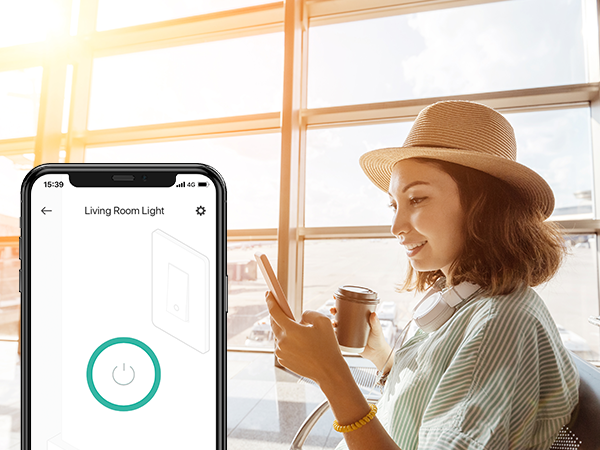
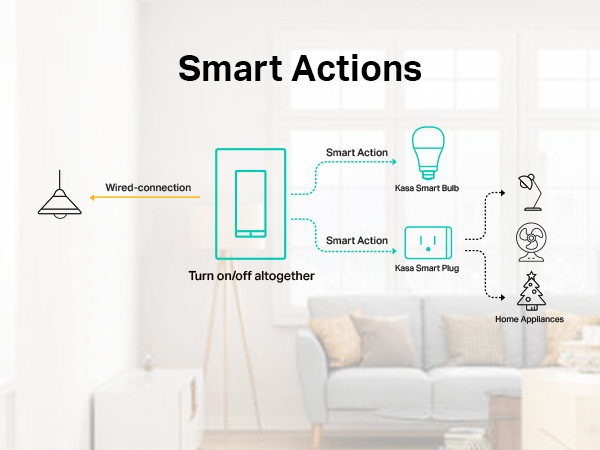
Our townhouse has an attached garage. The garage has 2 exterior lights that can only be turned on from inside the garage but not from inside the house. Near the garage is our front door. Inside the house there is 1 switch for the single exterior light near the front door. I was searching for a way to turn on all 3 lights using just the 1 interior light switch by the front door. I bought (2) Kasa Smart Light Switches (HS200) which I then added to my new Home Assistant setup (not required) and it works great and was easy to install / setup. Installing these switches cost less than $30. You do need to be comfortable replacing and wiring a light switch. You need to have a “neutral” wire in the light switch box. If you have an older house this might not work for you. Our town home was built in 2001 so it’s not that new but not that old either and had the appropriate wires needed. You can install these switches and use the native app on a smart phone to program a variety of tasks. There is no need for a home automation system / hub. From the app I was able to set the switches so that if I turn on/off one switch it turns on/off the other switch. Essentially pairing them together. They still function as individual light switches (non-smart switch) if the wifi goes out - so the pairing feature only works with an Internet connection but they still function as single light switches if the Internet is down. This smart switch has a small circular indicator light on the bottom of the switch which I set to only turn on if the lights are on. So, if I forget that the outside lights are on - the indicator light on the wall switch will be on. I like the visual clue so I don't leave them on all night. I like being able to use the smart switch just like a regular non-smart switch by pressing the switch - mostly because my wife won't bother with voice or phone app controls so we need a physical switch. I think it's fun to be able to control the lights from my phone and also from Google Home / Assistant. I can ask Google (or Alexa or my Home Assistant) to turn the lights on or off with voice commands too. They can also be programmed to come on/off at particular times of the day but I haven't used this feature. Another cool thing is that I can turn the lights on or off remotely with an internet or data connected phone - if I'm not at home. I use this feature if friends or family are going to arrive at my place before I do and I want to have the lights on for them. These smart switches were just the thing I was looking for and it gave me a real sense of accomplishment since it took me a few years to get around to solving this issue. I can now turn on 3 lights using 1 switch without having to hire an electrician and without running new wires in the house. For under $30 this was an outstanding value and I'm very pleased with the results.
T**M
Reliable and Good Value; Easy to install; Easy to use Kasa App
Bought one about 2 years ago and it has been working flawlessly. It controls our front porch exterior light. Just bought a second one to control our exterior garage door lights over the driveway. In both situations the switches are inside controlling exterior lights for dusk to dawn lighting. They automatically adjust when needed for daylight savings time - I don’t need to do anything. They are easy to install and easy to set up with the Kasa app to control the lighting. Good value and so far reliable for over 2 years.
A**Y
An Easy way to control multiple devices on a single circuit.
I made the jump to a "Smart Home" a little over a month ago after Alexa joined our family. After talking to some friends, doing some research and assesing my needs I settled on TP-Link because of the variety of Smart products they offered, no requirements for a Hub, the lower cost and the ability to control everything from one simple app on my Smart phone and Amazon"s Alexa. I have not been disappointed. After a very short learning curve, I surprisingly found the installation and set-up of all the TP-Link Smart devices extremely easy and intuitive. I have installed several different Smart devices including three different bulbs (LB-100, 120 & 130) depending on the area, as well as, Smart Switches (HB-200) and Smart Plugs. All of it has installed, programed and worked with few problems. The only criticism I have is the Kasa App. I have found it to be a bit bugy at times, but since I use it primarily for programming and setting up new devices and scenes, rather than operationally, it has not been an issue since Alexa handels most of that work. So far, in the six weeks my Smart Home has been in operation I have only had one problem where Alexa and the Kasa app lost communication with most of (but not all) of my TP-Link devices. But after a bit of head scratching I was able to restore communication. So here's a tip to remember: I first tried rebooting the devices by cycling the power breaker, but that didn't work. Probably due to multiple devices signaling simultaneously and overloading Kasa. But, powering each device down for a few seconds then back up, and testing it before moving on ro the next one worked without a problem. I also recommend using a different control application. I only have experience with Amazon Alexa, but it also interfaces with Google Home among others. I have found that controlling scenes from Kasa not to be reluable for some reason, while issuing the scene commands to Alexa works 90% of the time, with repeating the command becoming necessary about 10% of the time. But even with an occasional repeated command being necessary, TP-Link devices respond extremely well through Alexa's control. Plus Alexa is able to easily "group" multiple devices so you can control areas with a single command, or program macro activities that Alexa can perform with a single command. Capabilities Kasa does not have. This is another deficiency of the Kasa app. Without the ability to group devices or run macro routines, it relies on programmed scenes which are very limiting for operational control. So another controlling app like Alexa or Home is essential to the TP-Link Smart Home system. For me, because I have Alexa for operational control, both at home and away, these short comings in the Kasa app are non-issues. But if I didnt have this capability I think I would look to a different Hub controlled platform for my Smart Home lighting and device control. HS-200 Smart Switch: I am a retired electrician, so I found the installation easy. Most DIY homeowners with a basic knowledge of electricity and components should also have few problems with the installation. I found this Smart Switch easy to control and the installation is about the same as replacing a standard light switch. But, a big drawback is not have a dimming capability. To me this should be a no-brainer and i cant understand why this featire is lacking. Because that would makevthis a 5 star product. So before you procede there are a couple of precautions that should be noted. First, you must three wires plus the ground (usually bare or green), and one must be the neutral (usually white) third wire, or the switch simply will not work. This can be an issue in some older homes (and even in some newer ones too). The neutral wire is the "common" wire that runs throughout the house and is common to all circuits. It completes the loop in the circuit from the electrical box to the receptacle. The "hot" (or "line") wire (usually black) carries the electrical load for that circuit only (usually 15-20 amps max). And finally, the "load" wire (usually black, red, or it could even be white) completes the hot side of the circuit between the switch and the receptacle. To save time and money some electricians when wiring homes "old school" would complete the light circuit by running the neutral to the light receptacle and then run a 2 conductor (plus ground) to the switch. So even though you may have a white and black wire at the switch, the white wire is not a neutral, but the load wire that that completes the hot circuit when the switch is turned on (closed). So if you don't have 3 wires, one of them being the white neutral, you are out of luck using a Smart Switch. You can control the light however, by using Smart bulbs and then grouping them in the controling app (like Alexa). Another caution is wire management. Standard light switches don't take up much room, so the original installing electrician had lots of room in the box to stuff extra wire. This is a luxury you don't have since the Smart Switch is much deeper and takes up most of the box. The new switch also uses leads that are wire nutted to the circuit wires and not terminated on the switch itself. Because of this, it may be necessay to shorten the wires to make room in the box for the extra electronics and wire nuts. My advice is to open your intended switch boxes to survey your electrical wiring BEFORE you order the switches, so there are no surprises when it comes time to install. One last safety precaution. Be sure to turn off the circuit at the electrical panel (breaker box). Also don't assume that all switches in a multi-switch box are on the same circuit. It is often the case that multiple circuits are in the box. This is especially true when a switch is controling a plug. So check all wires in the box with a meter to insure nothing is hot. Finally, when wire nutting multiple wires it is VERY EASY to leave a wire loose. This can be very dangerous, as loose wires can work themselves free and cause arking and sparking that can damage connected equipment, and worse, start a fire. This is a common cause of electrical fires, and you might not know there is a problem until it's too late. So to ensure all wire nut connections are tight and secure, tug on each wire at the nut with needle nose pliers. If you can't pull it loose it should be good to go. Also make sure there are no bare wires poking out of the nuts. The switches use stranded wire so it's easy to have some stray strands loose outside the nut. So that's about it. The install is pretty easy most of the time, but if you don't think you're experienced enough to do the job safely, put this phase of the job in the hands of a professional. It should be an easy job for any professional electrician, and should not be terribly expensive. Consider it cheep insurance!
Trustpilot
1 week ago
3 weeks ago