We remain fully operational. Our teams are working around the clock to ensure your deliveries continue safely.

DOWNLOAD THE APP


Customer Services
Copyright © 2025 Desertcart Holdings Limited
DOWNLOAD THE APP
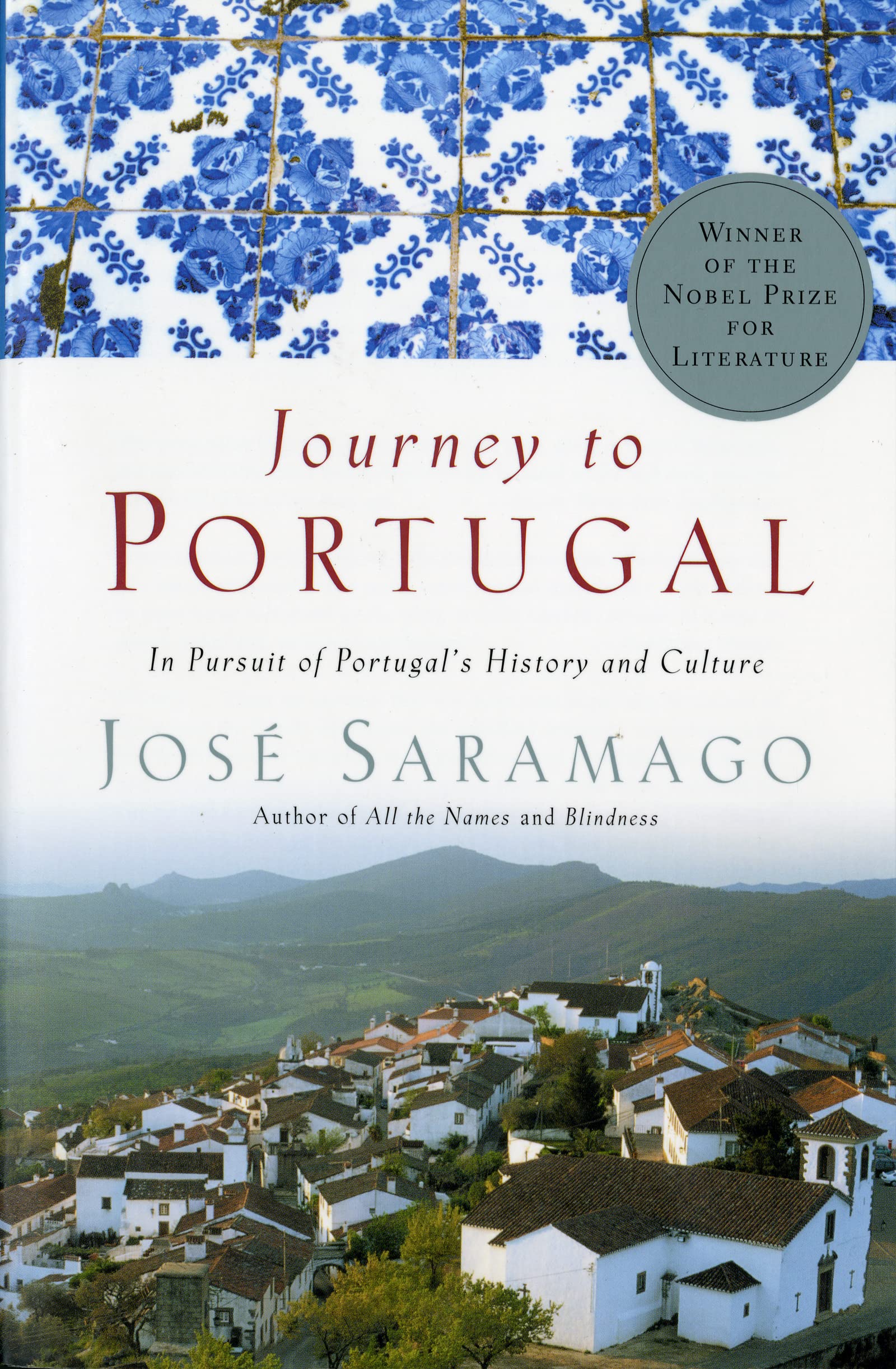
📖 Journey deeper than the map—Portugal like you’ve never seen it before!
Journey to Portugal by José Saramago is a richly detailed cultural and historical exploration of Portugal, blending literary brilliance with travel insights. Ideal for pre-travel reading, it offers an immersive experience beyond typical guides, revealing hidden gems and authentic stories that bring Portugal’s heritage vividly to life.
| Best Sellers Rank | #123,940 in Books ( See Top 100 in Books ) #15 in Historical Spain & Portugal Biographies #131 in Travel Writing Reference #495 in Author Biographies |
| Customer Reviews | 4.1 out of 5 stars 195 Reviews |
G**M
Not a travel guide
Got used for a good price. Is lovingly written and full of information, but organized in such a way that unless you are following the exact itinerary, difficult to find pertinent information and too large and clumsy to be a travel guide. Good for pretravel background reading.
O**N
Jornada em Portugal
My father-in- was Portuguese! Two years we started ou 2 week trip by car - from Lisbon up to San Tiago de Piaes - where he was born! I saw one mmm2 of Portugal - and said I had visited the country! Today I finished this book an read about at least a million smallish and great places - in the company of a genius Jose Saramago! Now I can say I REALlY visited Portugal! I loved the book and kiss the hand of this man!
J**E
NOT Bill Bryson
This is Jose Saramago's spiritual journey through (primarily rural) Portugal. It's not a light-reading travel narrative. The feeling of this book is something of a cross between Henry Adams and James Michener. It's a book to read slowly and savor, in order to appreciate Saramago's tremendous metaphorical skill. He paints the picture slowly, with deliberate brush-strokes that reveal the masterpiece when viewed from a distance. Yes, his descriptions of churches, winding roads, rain and his seemingly unconscious cultural insecurity (his came from a poor family and was not a university graduate) can become tedious, but that's only if you don't grasp the larger picture: Portugal is a settled land with hundreds of years of historic layers. Saramago wants to peel those layers back for you to expose the core. Only the reader can decide if he's been successful.
A**R
A spiritual and spatial journey
I eventually struggled through to the end of "Journey to Portugal", more as a duty than a pleasure. After the first third, the sameness of the descriptions of churches, buildings and art works became a bit boring. Sarmago certainly writes with insights that would resonate with readers who are familiar with the history, culture and art works of Portugal. I am not, so many of Saramago's allusions and comments on the churches and buildings he saw were opaque to me. Having read (and reviewed) "Seeing", "Blindness" and "The Cave" by Saramago, I was a little disappointed at first with "Journey to Portugal". However, my disappointment was relieved by beautiful passages sprinkled through the text. Saramago was born in Portugal and won the Nobel Prize for Literature in 1998. "Journey to Portugal" is nominally a travel book, but of a special kind: it describes spiritual as well as spatial journeys. The book is written in the third person, with Saramago referring to himself throughout as "the traveller". Reflective travellers will understand when Sarmago says "...when the street descends once more to the old cathedral so does the rain; it overflows the gutters and, as one idea follows another, the traveller remembers how the waters of the Minho ran down the hard shoulders beside the street, how small the world is, all its memories jumbled together in the minimal space inside the traveller's head." He also gives beautiful little word pictures of the lives and people he encountered on his journey. These are the real gems in this book, and why it is worth reading. In one especially memorable story ("The Man Who Could Not Forget") Saramago gets into conversation with the waiter at dinner about his travel plans and learns that the waiter was born in Cidadelhe, one of the small, remote villages Saramago plans to visit. Many years ago, when the waiter was a child, his sick young sister died on the way to get medical help, because none was available in their impoverished village. The waiter has never forgotten this family tragedy. His emotions are still raw as he talks to Saramago, who asks the waiter to come with him to the village and show him where he lived. Saramago concludes thus: "The traveller returns to his room. He spreads out his big map on the bed and looks for Pinhel. There it is, and the road which heads off into the hills. At some point in this space a seven-year-old girl died; then the traveller finds Cidadelhe, on the heights, between the Rivers Coa and Massueime, it really is at the ends of the earth, the end of life. If there is no one to remember." The book resonated with me for another reason. To quote Saramago: "The traveller preferred to admire the late afternoon gazing down towards the River Torto . . . . and then spent a long while leaning back against a wall . . . because from behind it there wafted the most exquisite perfume of flowers . . ." Far too often in our travels we are driven onwards by an inexorable schedule that allows little time to stop and actually enjoy moments such as Saramago describes.
C**.
wonderful travel companion
I’m visiting Portugal soon and this beautifully told companion by one of Portugal’s greatest writers is enchanting. You almost feel as though you are in the car with him, or staring at beautiful rock faces, or peering down at fish, or eating an incredible meal.
K**L
I did not realize the impact of Portugal's past on the world-fascinating!
This book was so helpful in filling all the facts and cultural references that originate in Portugal-really fascinating!
M**A
Too much information
We fell under Lisbons spell last April, so wanted more info on the magic. This step by step Journey might be perfect to carry along, but too much detail on streetlamps and doorways to read from afar. And very little about Lisbon. Written in 1990 by a native Portuguse the prose sounds more 19thc. Perhaps it suffers in Translation to English.
V**O
Great book by a laureate author
This book is a labour of love about Portugal by the country's most respected and laureate contemporary write. Saramago takes us on a journal to the regions and cities, past and present. The writing is a bit dense and this is not a typical history book, more of a free-flow narrative.
Trustpilot
1 day ago
2 days ago