DOWNLOAD THE APP


Customer Services
Copyright © 2025 Desertcart Holdings Limited
DOWNLOAD THE APP
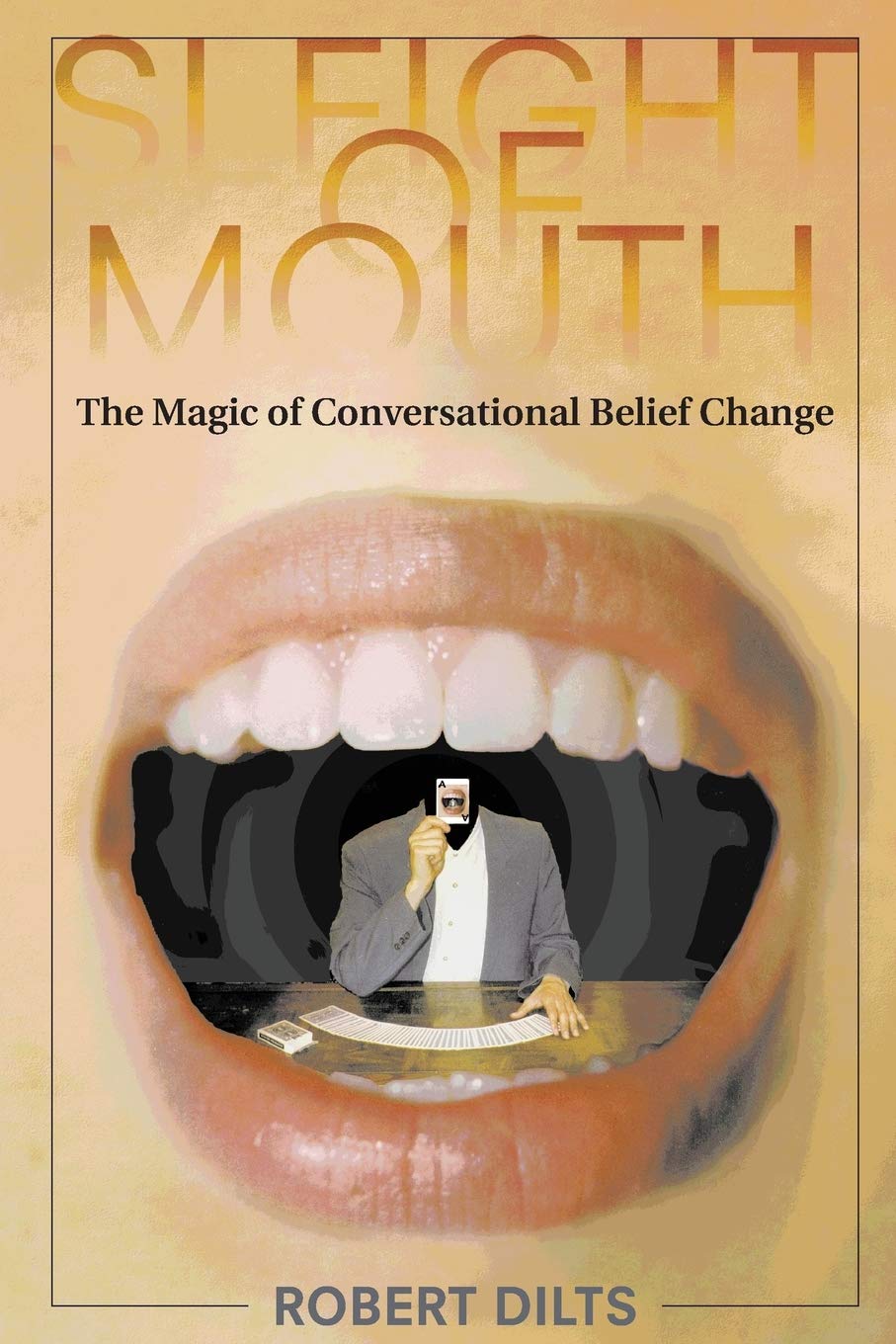
Buy Sleight of Mouth: The Magic of Conversational Belief Change by Dilts, Robert online on desertcart.ae at best prices. ✓ Fast and free shipping ✓ free returns ✓ cash on delivery available on eligible purchase. Review: Excelente livro pra quem gosta de desenvolvimento humano, aprendizagem de como superar crenças limitantes, recomendo para todos! Review: Sleight of Mouth (1999) certainly could lay claim as a practical guide to the inner and outer transformation of passivity in the art of persuasion. To ‘have in mind’ comes from the word ‘maenan’ and relates to the different contexts or patterns the product of someone’s values/beliefs (their perceptual filters) are held by. The book was first published 9 years after Dilts’s other two books on Beliefs, cementing his primary position as the NLP developer extraordinaire to map the processes of natural belief change. SoM not only has applications for many therapeutic healing areas, but it also acknowledges the fact that “people who are successful, enjoy living more of the world directly without contamination of judgement or reflection, through the richer choices they have available”. Therefore, SoM can benefit any situation which includes conversation. Where Dilts seems to concentrate his efforts on the most is in unravelling how a belief becomes a self-validating reality particularly when it is attached to a value that becomes a core-limiting belief. When this happens the belief is resistant to updating by counter-examples, and takes on the status of a ‘thought virus’ i.e. by becoming disconnected from its meta-structures. The idea of meta-structures is derived from Aristotle’s four causes (named in brackets) which enables the coach to reframe a constricted belief by establishing the answers to 4 questions: cause 1) chunking across - what is the fundamental definition derived from its higher positive intentions, i.e. the value criteria (formal)?; cause 2) chunking down - what is the new sensory or evidential data (constraints)?; cause 3) chunking back - what is the preceding internal state or attentional filter (precipitating)?; cause 4) chunking forward - what will be the improvement of the desired expectations (consequences)? It is interesting to note that Aristotle’s four causes could also be accredited to David Grove’s clean questioning compass. As you’d might expect Dilts’s Logical Levels, now firmly established in the field, acts as the spine for a number of tools. For example, Spatial Sorting - the Hierarchy of Criteria Technique, arranges someone’s beliefs into a natural hierarchy of steps on the ground in order to elicit the person’s sensory representations at each level using the counter-example process. Location 1, identifies a behaviour the client wants to do, but stops them self from doing (inner child); stepping into location 2, identifies the capability criteria that motivates them to want to do the new behaviour (adult); stepping into location 3, elicits the belief criteria that stops them from actually doing the desired behaviour (parent); stepping to location 4, elicits the higher level identity criterion that overrides limiting criteria of location 3 (tribe). Once each belief statement has been allocated a level along with its own criteria of representational systems a number of mapping across solutions can be artfully employed: a) leveraging technique: by applying location 4 to location 1; b) utilising the criterial equivalence of sensory representations of the highest criterion: i.e. applying location 4 to location 2; c) pacing the limiting criteria: i.e. in location 3, exploring all the options that will allow the client to achieve the desired behaviour, and will match all three levels, and doesn’t violate the limiting criteria. This produce a very wordy all encompassing statement that aims to be totally inclusive. Another application of the Logical Levels provides a set of interventional points to counter the issues a client may have along a route of belief change that can assist in widening perspectives. For example, eliciting at: location 5, the person’s identity by asking are they deserving or responsible; at location 4, the desirability of their outcome; at location 3, the person’s plan, in increasing self-efficacy-expectation (reducing inadequacy); at location 2, the person’s behaviour and whether it’s appropriate or ecological; at location 1, the actual path taken and determining any constraints that may reduce outcome-expectation (apathy). These are only a small fragment of the delights that awaits the reader, including a mouth watering 14 inner game sleight of mouth patterns. I particularly found the patterns for creating ‘intention’ and ‘redefining’ as underpinning a number of other patterns, for instance when ‘chaining’ (or bridging the gap) between two people’s opposite criteria for the same value, or in overcoming objections, as in the sales example below: 1. Find the customer’s objections, e.g. “I’m afraid it is too expensive”. 2. Establish the criterion as a positive reformulation of the criticism, e.g. the “good value” frame. 3. Redefine the customer’s words to match the new criterion where ready-made solutions can be found, e.g. “I am concerned it is overpriced” can be steered towards tactic of discounts, and “I cannot afford it” can be steered in the direction of a payment plan since the underlying frame of good value has already been framed. 4. Finally future pace with a “how” question? (feedback) to create positive intention. One criticism I would make is that Dilts places at the centre of each belief a cause-effect or complex equivalence (abduction) reasoning statement. The book tends to imply the ‘deductive’ reasoning of cause-effect; however I found defining the general category of cause-effect as inductive for the purposes of SoM a lot easier to understand since Dilts is considering conclusions which are only highly probable in following from their premises. Deduction is the kind of reasoning that claims to be free of any degrees of probability, which might be better suiting the purposes of a reality strategy instead. Another fundamental point which is less a criticism but one of personal clarification is concerning the role of mentors who are guides to unconscious competences through the reinforcement of motivations and permissions. Though mentors as a subject fits squarely into this discussion, and is covered in its own chapter, their significance in shaping our beliefs can be difficult to identify and challenge especially since they act as reference points for our membership of a group (or a brand); hence sometimes their attributing to a higher logical class above teacher (capability) and coach (behaviour) in the Logical Levels model as a group to look up to and admire could be an easy mistake to make. Paying closer attention to the text made me realise that the levels are more like flat concentric rings, with each class distinction having both positive and negative connotations depending on the nature of the interaction. This might be an obvious correction to make, but having such powerful methods of redefining at my disposal I was able to reframe my understanding of Dilts’s model! Finally, one of Dilts’s greatest accomplishments has to be his assumed role as a gifted teacher in explaining the founder’s pioneering work to mere mortals, which often times his own work exceeds. In this respect as seminal as Reframing (1983) is, and more accurately, once was, Sleight of Mouth (1999) is by far the greater proposition on the learning table and could rightly be named ‘Out-framing Reframing!’ My advice, then, would be to anyone considering the purchase of the original work to save their pennies on the second hand market as SoM rocks. The patterns on display have the most incredible potential to allow someone to be less prone to walk blindly into another’s orbit, and develop the self awareness to negotiate their influence away rather than give it away. Quite truly this is an amazing book.
| Best Sellers Rank | #64,392 in Books ( See Top 100 in Books ) #33 in Media & Communications Industry #111 in Popular Applied Psychology #117 in Linguistics Reference |
| Customer reviews | 4.6 4.6 out of 5 stars (105) |
| Dimensions | 15.24 x 1.83 x 22.86 cm |
| Edition | Standard Edition |
| ISBN-10 | 1947629026 |
| ISBN-13 | 978-1947629028 |
| Item weight | 463 g |
| Language | English |
| Print length | 346 pages |
| Publication date | 15 October 2017 |
| Publisher | Dilts Strategy Group |
M**E
Excelente livro pra quem gosta de desenvolvimento humano, aprendizagem de como superar crenças limitantes, recomendo para todos!
J**E
Sleight of Mouth (1999) certainly could lay claim as a practical guide to the inner and outer transformation of passivity in the art of persuasion. To ‘have in mind’ comes from the word ‘maenan’ and relates to the different contexts or patterns the product of someone’s values/beliefs (their perceptual filters) are held by. The book was first published 9 years after Dilts’s other two books on Beliefs, cementing his primary position as the NLP developer extraordinaire to map the processes of natural belief change. SoM not only has applications for many therapeutic healing areas, but it also acknowledges the fact that “people who are successful, enjoy living more of the world directly without contamination of judgement or reflection, through the richer choices they have available”. Therefore, SoM can benefit any situation which includes conversation. Where Dilts seems to concentrate his efforts on the most is in unravelling how a belief becomes a self-validating reality particularly when it is attached to a value that becomes a core-limiting belief. When this happens the belief is resistant to updating by counter-examples, and takes on the status of a ‘thought virus’ i.e. by becoming disconnected from its meta-structures. The idea of meta-structures is derived from Aristotle’s four causes (named in brackets) which enables the coach to reframe a constricted belief by establishing the answers to 4 questions: cause 1) chunking across - what is the fundamental definition derived from its higher positive intentions, i.e. the value criteria (formal)?; cause 2) chunking down - what is the new sensory or evidential data (constraints)?; cause 3) chunking back - what is the preceding internal state or attentional filter (precipitating)?; cause 4) chunking forward - what will be the improvement of the desired expectations (consequences)? It is interesting to note that Aristotle’s four causes could also be accredited to David Grove’s clean questioning compass. As you’d might expect Dilts’s Logical Levels, now firmly established in the field, acts as the spine for a number of tools. For example, Spatial Sorting - the Hierarchy of Criteria Technique, arranges someone’s beliefs into a natural hierarchy of steps on the ground in order to elicit the person’s sensory representations at each level using the counter-example process. Location 1, identifies a behaviour the client wants to do, but stops them self from doing (inner child); stepping into location 2, identifies the capability criteria that motivates them to want to do the new behaviour (adult); stepping into location 3, elicits the belief criteria that stops them from actually doing the desired behaviour (parent); stepping to location 4, elicits the higher level identity criterion that overrides limiting criteria of location 3 (tribe). Once each belief statement has been allocated a level along with its own criteria of representational systems a number of mapping across solutions can be artfully employed: a) leveraging technique: by applying location 4 to location 1; b) utilising the criterial equivalence of sensory representations of the highest criterion: i.e. applying location 4 to location 2; c) pacing the limiting criteria: i.e. in location 3, exploring all the options that will allow the client to achieve the desired behaviour, and will match all three levels, and doesn’t violate the limiting criteria. This produce a very wordy all encompassing statement that aims to be totally inclusive. Another application of the Logical Levels provides a set of interventional points to counter the issues a client may have along a route of belief change that can assist in widening perspectives. For example, eliciting at: location 5, the person’s identity by asking are they deserving or responsible; at location 4, the desirability of their outcome; at location 3, the person’s plan, in increasing self-efficacy-expectation (reducing inadequacy); at location 2, the person’s behaviour and whether it’s appropriate or ecological; at location 1, the actual path taken and determining any constraints that may reduce outcome-expectation (apathy). These are only a small fragment of the delights that awaits the reader, including a mouth watering 14 inner game sleight of mouth patterns. I particularly found the patterns for creating ‘intention’ and ‘redefining’ as underpinning a number of other patterns, for instance when ‘chaining’ (or bridging the gap) between two people’s opposite criteria for the same value, or in overcoming objections, as in the sales example below: 1. Find the customer’s objections, e.g. “I’m afraid it is too expensive”. 2. Establish the criterion as a positive reformulation of the criticism, e.g. the “good value” frame. 3. Redefine the customer’s words to match the new criterion where ready-made solutions can be found, e.g. “I am concerned it is overpriced” can be steered towards tactic of discounts, and “I cannot afford it” can be steered in the direction of a payment plan since the underlying frame of good value has already been framed. 4. Finally future pace with a “how” question? (feedback) to create positive intention. One criticism I would make is that Dilts places at the centre of each belief a cause-effect or complex equivalence (abduction) reasoning statement. The book tends to imply the ‘deductive’ reasoning of cause-effect; however I found defining the general category of cause-effect as inductive for the purposes of SoM a lot easier to understand since Dilts is considering conclusions which are only highly probable in following from their premises. Deduction is the kind of reasoning that claims to be free of any degrees of probability, which might be better suiting the purposes of a reality strategy instead. Another fundamental point which is less a criticism but one of personal clarification is concerning the role of mentors who are guides to unconscious competences through the reinforcement of motivations and permissions. Though mentors as a subject fits squarely into this discussion, and is covered in its own chapter, their significance in shaping our beliefs can be difficult to identify and challenge especially since they act as reference points for our membership of a group (or a brand); hence sometimes their attributing to a higher logical class above teacher (capability) and coach (behaviour) in the Logical Levels model as a group to look up to and admire could be an easy mistake to make. Paying closer attention to the text made me realise that the levels are more like flat concentric rings, with each class distinction having both positive and negative connotations depending on the nature of the interaction. This might be an obvious correction to make, but having such powerful methods of redefining at my disposal I was able to reframe my understanding of Dilts’s model! Finally, one of Dilts’s greatest accomplishments has to be his assumed role as a gifted teacher in explaining the founder’s pioneering work to mere mortals, which often times his own work exceeds. In this respect as seminal as Reframing (1983) is, and more accurately, once was, Sleight of Mouth (1999) is by far the greater proposition on the learning table and could rightly be named ‘Out-framing Reframing!’ My advice, then, would be to anyone considering the purchase of the original work to save their pennies on the second hand market as SoM rocks. The patterns on display have the most incredible potential to allow someone to be less prone to walk blindly into another’s orbit, and develop the self awareness to negotiate their influence away rather than give it away. Quite truly this is an amazing book.
T**I
Item perfetto e spedizione veloce
T**E
I'm not an NLP fanatic. I see it for what it is, which is a highly persuasive communication tool. Reframing and redefining is possibly the core of persuasion in NLP. An example is by using a three word reframe. Someone might say "He's stupid." the response could be "He's more naive, and preoccupied." By transitioning from Stupid to naive, it allows for the person being disparaged to grow, then suggests they have too many other things on their mind. Nice responses like this are great for the workplace. This is my fourth book on NLP, and it's by far the best. Dilts focuses more on conversations with others than anything else. Given that so much of NLP has been debunked for psychotherapy. Not all NLP has been debunked for psychotherapy. I wonder who came up with what first. Dilts talks about thought viruses which only get worse the more you try to dismantle those thoughts. Cognitive behavioral therapists call this Entangled thinking and use similar Pink Elephant thought exercises (Google it). Acceptance and Commitment based therapy is designed for the sole purpose of dealing with thought viruses and uncomfortable situations. Dilts entire book is presented in a four DVD set that is free on YouTube. Watch the series while you read the book. What I don't recall reading in the book was Dilts mention of Rogerian therapy. In the DVD/YouTube series Dilts recommended everyone use Rogerian style active listening to build rapport. If you don't use active listening, then some of the reframing will incite argument.
J**Z
The delivery was fast like my book
Trustpilot
4 days ago
1 week ago