
DOWNLOAD THE APP


Customer Services
Copyright © 2025 Desertcart Holdings Limited
DOWNLOAD THE APP
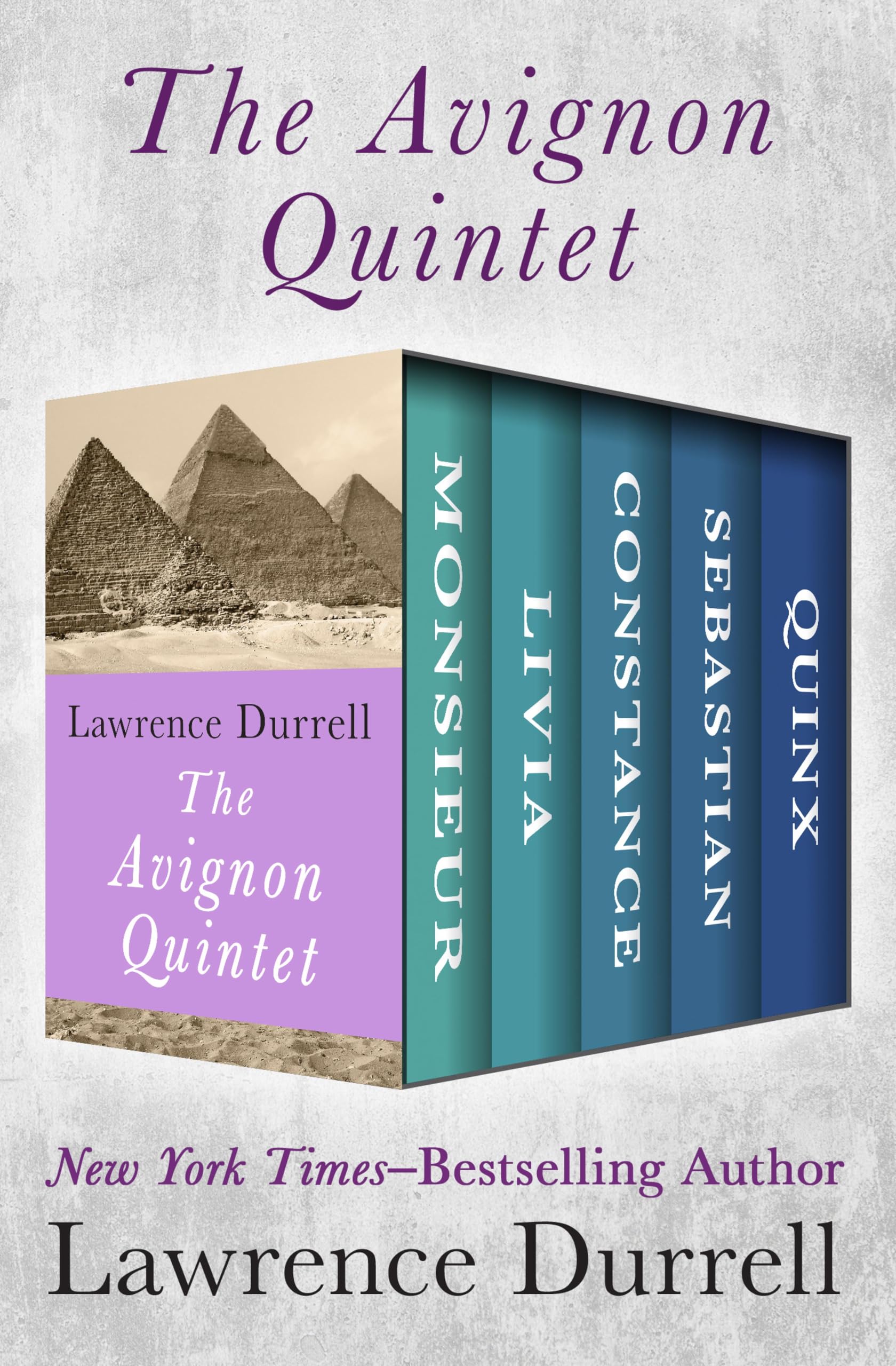
The Avignon Quintet: Monsieur, Livia, Constance, Sebastian, and Quinx - Kindle edition by Durrell, Lawrence. Download it once and read it on your Kindle device, PC, phones or tablets. Use features like bookmarks, note taking and highlighting while reading The Avignon Quintet: Monsieur, Livia, Constance, Sebastian, and Quinx. Review: double plus good - Durrell is a magnificent writer and this novel (novels) shows the mature development of a talent that gave us the Alexandria Quartet - an incredible level of writing that should be experienced by everyone who loves modern literature. Review: GNOSTICS, TRINITIES, TEMPLARS, MADNESS AND MORE - "Monsieur," The first chapter of this quintet by Lawrence Durrell is narrated by Bruce Drexel, a physician who is on a southbound night train from Paris to Provance sadly responding to a telegram that his best friend Piers de Nogaret has suddenly died. Piers and his sister Sylvie (whom Bruce married when she was carrying their child, a stillborn) were a triad, a "three-cornered love, ill-starred." The three always spent their summer leaves together in Avignon at Verfeuille, a crumbling de Nogaret chateau on an estate inherited by Piers and Sylvie. At the present, Sylvie is in a nearby asylum where she is an in-and out-patient. Bruce's sister, Pia, has recently left her tortured novelist husband, Robin Sutcliffe, who is writing a novel based on the threesome. His curiosity is peaked perhaps because Bruce does not elaborate on the "trinity" relationship. Robin is also editing a scathing history of the Templars by his historian friend Toby who is doing research in Avignon. Following the teachings of Akkad, the leader of a sect of desert gnostics, Piers had taken their anti-Christian view. In Piers' room Bruce finds a map in the shape of a huge snake that Piers had been drawing about his recent life. Among many articles scattered around, Bruce finds drugs and smudges of dark red lipstick on cigarette butts (Sylvie didn't smoke). Had the infamous Sabine been to visit? Piers' body was placed, according to his wishes, in the family crypt in a quiet ceremony at night with the local priest banned from the site. When Bruce demands to see the body, he finds Pier's head is missing! Inquiry discloses that it was removed so a death mask could be made. Who ordered this and where is the head now? This is a murder mystery of the highest level. I gave up looking up words I didn't know, or I never would have finished. Lawrence Durrell, famous for his Alexandria Quartet, has followed with more intensity but maybe not more lucidity.


| ASIN | B0085IMY6W |
| Accessibility | Learn more |
| Best Sellers Rank | #65,997 in Kindle Store ( See Top 100 in Kindle Store ) #76 in Classic British & Irish Fiction #317 in Classic Literary Fiction #563 in Saga Fiction |
| Customer Reviews | 4.2 4.2 out of 5 stars (50) |
| Enhanced typesetting | Enabled |
| File size | 5.7 MB |
| ISBN-13 | 978-1453266458 |
| Language | English |
| Page Flip | Enabled |
| Print length | 1380 pages |
| Publication date | June 12, 2012 |
| Publisher | Open Road Media |
| Screen Reader | Supported |
| Word Wise | Enabled |
| X-Ray | Not Enabled |
K**R
double plus good
Durrell is a magnificent writer and this novel (novels) shows the mature development of a talent that gave us the Alexandria Quartet - an incredible level of writing that should be experienced by everyone who loves modern literature.
M**M
GNOSTICS, TRINITIES, TEMPLARS, MADNESS AND MORE
"Monsieur," The first chapter of this quintet by Lawrence Durrell is narrated by Bruce Drexel, a physician who is on a southbound night train from Paris to Provance sadly responding to a telegram that his best friend Piers de Nogaret has suddenly died. Piers and his sister Sylvie (whom Bruce married when she was carrying their child, a stillborn) were a triad, a "three-cornered love, ill-starred." The three always spent their summer leaves together in Avignon at Verfeuille, a crumbling de Nogaret chateau on an estate inherited by Piers and Sylvie. At the present, Sylvie is in a nearby asylum where she is an in-and out-patient. Bruce's sister, Pia, has recently left her tortured novelist husband, Robin Sutcliffe, who is writing a novel based on the threesome. His curiosity is peaked perhaps because Bruce does not elaborate on the "trinity" relationship. Robin is also editing a scathing history of the Templars by his historian friend Toby who is doing research in Avignon. Following the teachings of Akkad, the leader of a sect of desert gnostics, Piers had taken their anti-Christian view. In Piers' room Bruce finds a map in the shape of a huge snake that Piers had been drawing about his recent life. Among many articles scattered around, Bruce finds drugs and smudges of dark red lipstick on cigarette butts (Sylvie didn't smoke). Had the infamous Sabine been to visit? Piers' body was placed, according to his wishes, in the family crypt in a quiet ceremony at night with the local priest banned from the site. When Bruce demands to see the body, he finds Pier's head is missing! Inquiry discloses that it was removed so a death mask could be made. Who ordered this and where is the head now? This is a murder mystery of the highest level. I gave up looking up words I didn't know, or I never would have finished. Lawrence Durrell, famous for his Alexandria Quartet, has followed with more intensity but maybe not more lucidity.
O**N
I didn't want it to end
It is difficult to write about The Avignon Quintet. I told my wife I wanted to write a review of the interrelated novels without mentioning The Alexandria Quartet because every review I ever read of the Quintet started by comparing the later Durrell unfavorably to that masterpiece written in his youth. I have not gotten through the first paragraph of my review and already I have mentioned the earlier work. The Alexandria Quartet sucks the energy from any attempt to talk about Durell. I am going to just accept it and plow forward. When I finally began reading The Avignon Quintet, what came back was the voice. It had been a decade since reading Durrell but the voice was as familiar to me as if I had read him yesterday. Durrell is at his finest in narration. He can tell a story. The story doesn't need a beginning or a middle or an end. His voice makes everything a story -- a romantic story, an amazing story, a timeless story. The Avignon Quintet has so much to recommend it. I made a list of the elements I ran across. Templars, gnostics, handsome princes, asylums, madness -- so much madness --, Freudians, southern France, Egypt, ancient tombs, castles, exotica, erotica, incest, ghosts, gypsies, even more gypsies, ascetics, spies, Nazis, secret societies, bordellos, feasts, Nubian lesbians, assassins disguised as nuns, literary doppelgangers, convents, hidden treasure, suicide, and art -- oh so much art. H. Rider Haggard had nothing on Durrell when it came to the elements of adventure, but the voice -- that voice -- is so different that adventure is smoothed out and polished to a highly civilized sheen by educated English characters -- whether English by birth or not -- quietly and with great self-reflection resisting modernity. tried to think of other multivolume novels with which to compare the Avignon Quintet. Perhaps if Proust had written Raiders of the Lost Ark. Proust elevated the mundane. Durrell normalizes the outrageous. Or would it that Anthony Powell had, instead of writing Dance to the Music of Time, chucked his sense of humor and written The Castle of Otranto in five volumes. But these comparisons are not helpful. Like Proust and Powell, Durrell stands alone. I think it is because of the voice. Durrell called the novels a quincunx -- the five-pointed shape used for fives on dice -- and I read that the five novels were not even labeled a quintet until after his death. I didn't care about this and read them in the order they were written. They tell the tale of a group of people who spend a summer in a run-down mansion in Avignon. Some of those people are real, and some are characters in a novel written by one of the real characters. But after a while, the meta didn't matter to me. Fiction and reality meld into one. World War II happens and those people are thrown to the winds of fate and we follow them. Some grow, some die, some go mad, and those that live through the war end up returning to Avignon. I cared about the characters in the Quintet. After thirteen hundred pages, I will miss them. It is a long story, but for me, not long enough.
J**C
Puzzle and puzzling
I think of myself as well-read; there isn't a lot I read that I don't follow completely...….except this quintet. The author's vocabulary is enormous; he uses words I must confess to not having ever seen before, lots and lots of them. He writes beautifully, and in the first book his description of Christmas is the most engaging I have ever read, really beautifully done. On another side the story slips from one narrator to another and from one time frame to another. I heard somebody on TV say the other night that something was beyond his pay grade. I guess these books are beyond mine. I stretch to give 3 stars because I considered the stories a journey into melancholia, with too much "mind intercourse" (cleaned that up; the other word begins with an "F"). It's hard to get to the point altho maybe that is the point.
M**S
Durrell at his quiet best
This monster book -- five books, all inter-related -- is a quiet masterpiece (or a cornerstone). Durrell is at his best when he is telling story; unfortunately, when his "boys" get drunk and yammer they sound like drunken schoolboys at an inferior college ... but Durrell catches himself soon enough and gets back to the story. His women are strong and believable -- he got it from his Mom, I'll wager. His male characters are strange. The thread of gnosticism that runs through the books is intriguing, as is the view, from the South of France, of the Second World War, is unlike anything I've ever read.
V**Y
Delivered in excellent condition quickly
Trustpilot
3 weeks ago
4 days ago