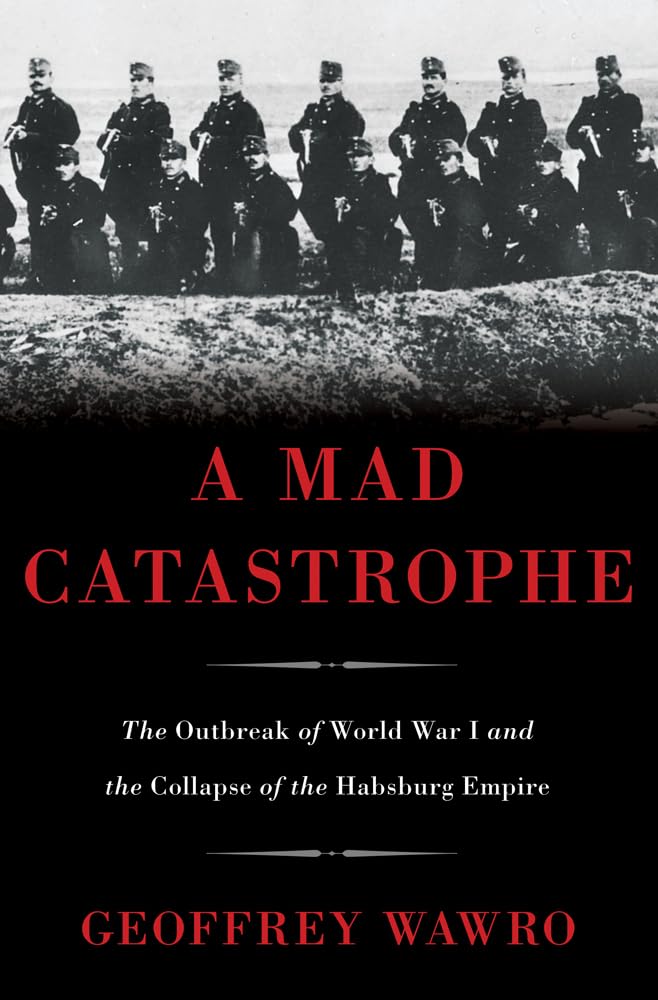
A Mad Catastrophe: The Outbreak of World War I and the Collapse of the Habsburg Empire
G**L
Excellent book on WW1...
This year - 2014 - is the 100th year anniversary of the start of the Great War. (WW1) There have been many books written about the war - from political, geographic, societal, and even religious aspects - but Geoffrey Wawro's new book, "A Mad Catastrophe: The Outbreak of World War 1 and the Collapse of the Habsburg Empire", is one of the best I've read. Like many authors, he takes a relatively small part of the overall conflict - in this case the Austro-Hungarian Empire - and writes an excellent book.The Austro-Hungarian Empire by 1900 had seen better days. Joining with Hungary under very uneven terms in 1867 - the Hungarians came out ahead of the Austrians and the other nationalities crowded under the flag - had led to an almost totally dysfunctional government, ruled jointly from Vienna and Budapest. The empire - competing with the Ottoman Empire for the title "Sick Man of Europe" - was a conflagration of differing ethnic peoples, ranging from Catholic Poles in Galicia, to Muslims in the south, and Jews spread throughout. Many languages were spoken within the empire and there was no cohesive government. There was also no cohesive military system, either. The armies did not have up-to-date equipment and organisation within the army was dismal. The officer corps was basically badly paid and moving up the ranks was difficult. The army was really a relic from the 1860's and was not prepared to fight 20th century wars. Of course, they were very little different from Russia and other European countries - other than Germany and France - who had made little preparation to fight. However, Austro-Hungary had a very small base on whom to call to fight, unlike Russia, who had millions potential soldiers.Geoffrey Wawro examines the Austro-Hungarian Empire in both military and political terms. He does a good job of framing both the times and the problems of those times. He takes a careful look at the people who made up the government and military in the early 1900's and traces the problems then back in time to the mid-to-late 1800's. What business the Empire had in committing itself and armies to the German side is explained in detail. Also explained are the battles of 1914 with Serbia and Russia, all of which were dismal disasters for the Empire.I found both Wawro's writing and use of maps very good. I was reading the hardback but the book is available in Kindle. In general I avoid Kindle copies of histories because I find that maps and pictures don't usually translate well to the screen. No matter how you read it - print or Kindle - this excellent book shouldn't be missed by the armchair historians it was aimed for.
C**R
Masterful Military Analysis but Lacked Balance
I became a fan of Greg Wawro after reading his military history, the Austro-Prussian War. Like that book, A Mad Catastrophe is meticulously researched and makes for fascinating reading for those of us, like myself, that love history and particularly military history. The sad fate of the Austro-Hungarian army in 1914 is explained in detail and includes, in Wawro's opinion, many sources. My criticism of the book is that it is not a balanced portrayal of Austria-Hungary vis a vis the other great powers of Europe, nor was the blundering and mistakes of its military commander unique. Conrad von Hotzendorf was in good company in 1914.The illusion that armies must attack at all costs, that the offensive was the crucial, essential ingredient to military success in 1914 was hardly confined to Conrad or Austria. The exact same philosophy and it disastrous consequences were embraced by France's Joffre, Italy's Cadorna and many other commanders The British headlong, mass attacks against entrenched infantry with machine guns and artillery in the Battle of the Somme which resulted in over 600,000 casualties took place in 1916. You would think an "advanced" power like Britain and its commander, Haig, would have learned by then not to do this. Austria was not unique at all in failing to initially recognize the futility of mass shock tactics by infantry in the industrial age by any measure, but you would never understand that by reading this book. Likewise, the shell and ammunition shortages that plagued the logistics of the Imperial army were also experienced by Britain, Russia and the other great powers and for the same reasons. Nobody expected a war to last more than a few months and had not prepared accordingly.Wawro is highly critical of the society and politics of the Empire, attributing the "rot" within to its defeats in the field. Again, the critique has merit, certainly, but compared to what? The tsarist regime in Russia? The Ottoman Empire in Turkey? The Italian monarchy? The thing that distinguished Austria from so many of the other great powers was its low investment in its military establishment and its near half century of peace since its defeat in 1866. It also had many aggressive enemies willing to attack it for the sole purpose of tearing off provinces and territory to satisfy their own ambition. Wawro glosses over the fact that the Serbian regime in 1914 was riddled with fanatical imperialists with the declared goal of annexing Austrian Bosnia, Croatia and Dalmatia to create a greater Serbian state, whether they liked it or not and by force if need be. Serbia provoked the war by committing a terrorist act that no sovereign country would ever allow to go unanswered. Austria was not goaded into war by Germany but viewed its situation in 1914 like any other nation would and felt it had to respond to a threat to survive. Christopher Clark's fairly new book, The Sleepwalkers, explores all this in detail and gives a far more balanced account of the causes and origins of the war that you will not get here.Austria-Hungary was a unique, cosmopolitan Empire unlike any in Europe in that no single national group made up anything close to a majority. The faults of the Emperor and the Empire were mainly that they were too lenient with the more fanatical leaders of some of the minorities, but with the accession of Franz Ferdinand, how things might have changed. In the meantime, Austrian and Hungarian society blossomed, producing some of the best artists, composers, medicine, economists, psychologists and philosophers in European history. What came after, when the Empire collapsed after the war makes the troubles and problems with which the kaiser and his cabinets grappled in the years before the war look tame by comparison.I commend the book from a military history point of view as the best I have ever read in explaining the military campaigns of the opening year of the war in the East. I will read any book by Greg Wawro who is unquestionably one of our best military historians today. I just wish that this book had a bit more perspective and balance.
M**K
An Excellent work on a little known theatre
Having already absorbed and loved Mr. Wawro's books on the Austro-Prussian and Franco-Prussian wars i was extremely excited and anxious to receive and read his latest book. I was not disappointed. A Mad Catastrophe is a compelling foray into the little known opening battles of Galicia, (Austria vs Russia) and the Austro-Serbian fronts. Too little has been covered on these massive campaigns and Mr Wawro has helped fill a gap in WWI literature. This is a superb tome, brilliantly if acidly written about and empire on the brink simply biting off more than it could chew, suffering catastrophic early defeats and ending WWI in essential vassalage to Germany. The early battles in Serbia, at Komarow, Lemberg, and Rawa Russka are thrillingly retold. All of Austria's initial follies are excellently retold. It truly was a marvel that the empire survived to the end of the war. Thanks of course for that, largely went to German assistance and eventual takeover of the Austrian war effort. One really does sympathize with the badly led ill equipped Austrian soldier, polyglot and long suffering under a tottering yet ancient and once magnificent empire. One feels also for the equally poorly equipped Serbs and Russians. They were heroes all, fighting, dying, and surviving in conditions we could never hope to understand today in our age of materialism. What sacrifice all these soldiers endured, at the cost of collapse of both the Austrian and Russian Empires. What a tragic, little known tale, brilliantly written by Mr. Wawro. Wonderful
Trustpilot
3 days ago
4 days ago