We remain fully operational. Our teams are working around the clock to ensure your deliveries continue safely.

DOWNLOAD THE APP


Customer Services
Copyright © 2025 Desertcart Holdings Limited
DOWNLOAD THE APP
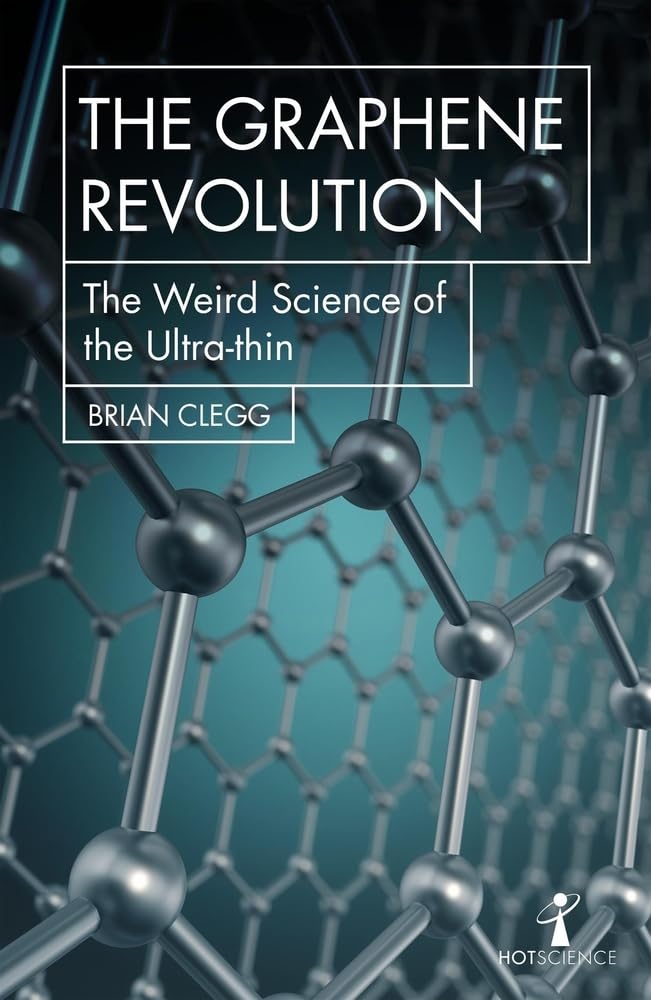
📖 Dive into the ultra-thin revolution before everyone else does!
The Graphene Revolution by Brian Clegg is a highly rated popular science book that demystifies the extraordinary properties and applications of graphene and other ultra-thin materials. With a 4.6-star average from 143 reviews, it offers a concise yet comprehensive look at the physics and chemistry behind these materials, their serendipitous discovery, and their transformative engineering uses. Available with next-day UK dispatch and free shipping on qualified orders.
| Best Sellers Rank | #1,363,277 in Books ( See Top 100 in Books ) #90 in Solid-State Physics (Books) #347 in Electromagnetism (Books) |
| Customer Reviews | 4.6 out of 5 stars 143 Reviews |
A**S
Excellent scientific work
This is a well-written and informative book that reveals the numerous physical and chemical properties of ultra-thin materials such as graphene as well as the numerous engineering applications in which the ultra-thin materials are being utilized. This book is a great read.
J**N
Very good popular science writing with no wasted time
I read a paperback by Brian Clegg years ago on mathematical infinity which was really good. Now, we have this new book on graphene and it's amazing properties; he discusses how it was discovered by chance by a couple of physicists at the University of Manchester almost on a lark. Clegg does a good job of explaining the physics and chemistry of graphene and other massively large flat molecules and the amazing applications they can and could be used for in short compass. My only complaint is that it needs more illustrations. Highly recommended.
M**Y
Nice introduction to the topic
It is my third book by Brian Clegg (first one was on Dark matter, second one on Gravitational waves). As in previous books, the author did good job in delivering difficult topic in simple words. I appreciate that Mr. Clegg keeps on presenting latest scientific discoveries to wide public. Lets now look what you can find in the book. Firstly, the author provides reader with overview of structure of matter and very basic of quantum physics. Those are necessary for understanding of graphene. Then the auhtor discusses history of graphene discovery and finally, he presents application of the graphene, ranging from electronics to strong materials and molecular sieves for water desalization. Despite predominantly positive feeling from the book, I have to show few examples of inaccuracies I found during the reading: a) Explanantion how a diode works: "However, if the circuit is connected other way, the excess electrons on the n-side repel any furhers electrons, so current won't flow". Actually, in this case a positive voltage is connected to n-side. As a result, electrons are drained from the diode and depleted area between p-side and n-side of the diode becomes larger. So there is no excess of electrons but their lack. b) "one of the benefits of capacitor's ability to lose DC is to filter out unwanted noise and leave the pure wave behind". In fact noise has usually high frequency. As frequency increases, a capacitor's impedance decreases and those high frequencies can be filtered out. c) "graphene supecapacitors would allow electric cars to be recharged in minutes, so we can look forward to greener transport" I know that everything has to be green nowadays and I agree that we have to protect our planet. However, the author's proposal of using supercapacitors has many technical difficulties, mainly very high electric current would be needed for such rapid recharging (hundreds, maybe thousands, Amperes) and you have to rebuild a grid to cope with such hihg currents firstly.
J**D
Benefits of graphene
Infornative about graphene. Selling product to females (pads) that has graphene strip. Wanted to know more about it
Trustpilot
1 month ago
4 days ago