We remain fully operational. Our teams are working around the clock to ensure your deliveries continue safely.

DOWNLOAD THE APP


Customer Services
Copyright © 2025 Desertcart Holdings Limited
DOWNLOAD THE APP
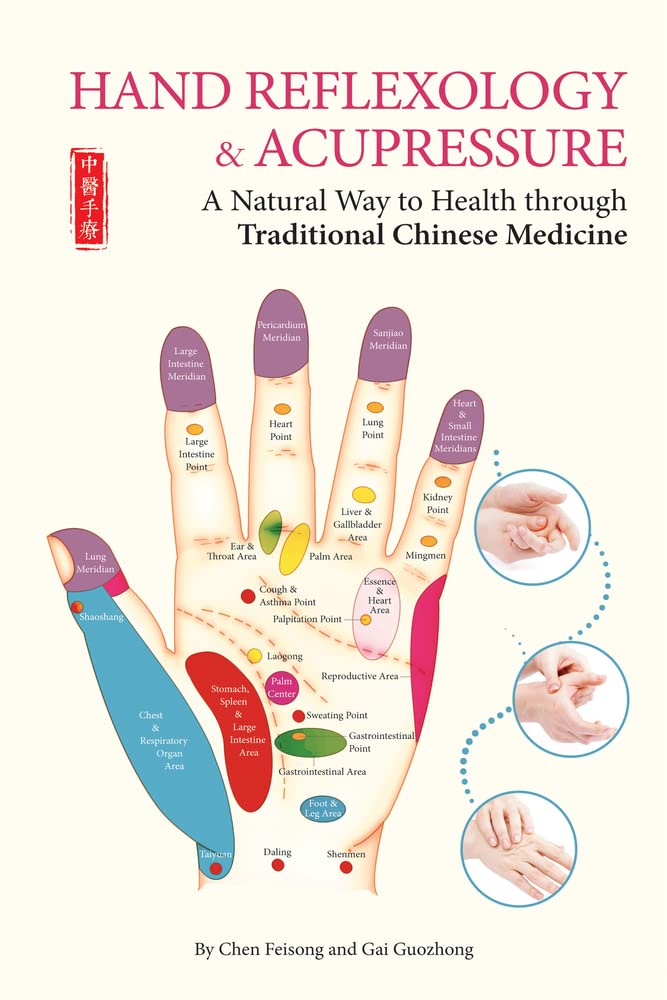
Hand Reflexology & Acupressure: A Natural Way to Health through Traditional Chinese Medicine [Chen, Feisong] on desertcart.com. *FREE* shipping on qualifying offers. Hand Reflexology & Acupressure: A Natural Way to Health through Traditional Chinese Medicine Review: Excellent--I was pleasantly surprised - After struggling for years with chronic migraines and vertigo, I found this book at my local library while looking for acupressure books on a lark (it was the only acupressure book they had, so I couldn't fail to notice it). Although it focuses on the hands, it does include a few acupressure points for the head in the migraine section. All of the methods in the book that I tried produced really good results. As best I can explain it, the techniques exploit the connection between the nerves and the brain by overstimulating the nerves in the hands with certain pressures, and that overstimulation causes the brain to function in a more elevated state, kind of like how when you pay hyper-close attention to holding a pencil while learning to write, you learn to write better and faster because your brain is so turned on. This then causes the brain, and consequently the body, to try harder in this elevated state to achieve proper functioning, and with repeated use can retrain your body to health. Another reviewer disliked the diagrams and said the pressure points were not illustrated well--I completely disagree. This book was written by professionals who were trying to make the information accessible to layfolk like homemakers so they can help themselves and their families (as stated in the introduction), and so the diagrams are simple rather than hyper-complicated like what you'd find in a medical textbook. It works better that way for us normal people because hand sizes and proportions vary so much from children to adults that just experimenting with a decent idea of where the pressure point is and watching for what works is invariably more practical. This requires self-experimentation before you use it on anyone else because it really helps to "feel" it to know if you're getting it right. I highly recommend this book as complementary medicine that can be really beneficial when combined with dietary, herbal, lifestyle, and exercise treatments. (The reflexology parts of the book I haven't used as much, but what I tried reminded me of yoga--it focuses on holding the body in a posture that improves proper alignment and function; I recommend that, too.) **Update: The copy I got has a printing error in it where some content is repeated several times. After page 40, it loops back to 33 and continues normally until page 48, where it loops back to 41 and continues through the end of the book without error. I just folded the looped pages inward into the book and creased them (rather than tear them out for fear of damaging the binding) because that made it easier to go from page 40 straight to page 41 with no errors on either side of those pages.** Review: Very good for fresh ideas. In Western reflexology, different, conflicting maps are used, which does not inspire confidence. Since I use TCM as a basis for diagnosing, I was very pleased to find a book combining hand reflexology with TCM mapping, as TCM body point mapping is consistent, detailed, and, in my opinion, far more advanced than anyone else. The book is very well laid out and addresses some issues that are rarely acknowledged in other health literature. As for complaints about the diagrams not being specific, you can look up more detailed pictures of any point online if needed. The diagrams are quite sufficient to get you in the right region. Typically you will feel a sore point where pressure is needed anyway, so having specific diagrams are not needed, plus they are impossible to draw clearly. Most of us don't know the names of all bones and tendons, and specific diagrams of acupressure points include such details. You're better off feeling in the general region for a sore point and let your body be your guide. I definitely recommend this book for anyone who is interested in some fresh ideas of treatments they can use on the go. The advantage of working with hands is they are readily available, and the therapy does not feel invasive to the receiver, unlike many other acupressure points. This book is very professional in presentation, it's compact, and very packable. Having been caught unprepared with medical emergencies abroad, I plan to take this book with me on my next journey. Extremely pleased with these authors and really appreciate their efforts. :)
| Best Sellers Rank | #924,787 in Books ( See Top 100 in Books ) #409 in Acupuncture & Acupressure (Books) #443 in Massage (Books) #4,373 in Mental & Spiritual Healing |
| Customer Reviews | 4.2 4.2 out of 5 stars (52) |
| Dimensions | 5.5 x 0.3 x 8.25 inches |
| ISBN-10 | 1602201625 |
| ISBN-13 | 978-1602201620 |
| Item Weight | 6.4 ounces |
| Language | English |
| Print length | 144 pages |
| Publication date | September 24, 2019 |
| Publisher | Shanghai Press |
J**S
Excellent--I was pleasantly surprised
After struggling for years with chronic migraines and vertigo, I found this book at my local library while looking for acupressure books on a lark (it was the only acupressure book they had, so I couldn't fail to notice it). Although it focuses on the hands, it does include a few acupressure points for the head in the migraine section. All of the methods in the book that I tried produced really good results. As best I can explain it, the techniques exploit the connection between the nerves and the brain by overstimulating the nerves in the hands with certain pressures, and that overstimulation causes the brain to function in a more elevated state, kind of like how when you pay hyper-close attention to holding a pencil while learning to write, you learn to write better and faster because your brain is so turned on. This then causes the brain, and consequently the body, to try harder in this elevated state to achieve proper functioning, and with repeated use can retrain your body to health. Another reviewer disliked the diagrams and said the pressure points were not illustrated well--I completely disagree. This book was written by professionals who were trying to make the information accessible to layfolk like homemakers so they can help themselves and their families (as stated in the introduction), and so the diagrams are simple rather than hyper-complicated like what you'd find in a medical textbook. It works better that way for us normal people because hand sizes and proportions vary so much from children to adults that just experimenting with a decent idea of where the pressure point is and watching for what works is invariably more practical. This requires self-experimentation before you use it on anyone else because it really helps to "feel" it to know if you're getting it right. I highly recommend this book as complementary medicine that can be really beneficial when combined with dietary, herbal, lifestyle, and exercise treatments. (The reflexology parts of the book I haven't used as much, but what I tried reminded me of yoga--it focuses on holding the body in a posture that improves proper alignment and function; I recommend that, too.) **Update: The copy I got has a printing error in it where some content is repeated several times. After page 40, it loops back to 33 and continues normally until page 48, where it loops back to 41 and continues through the end of the book without error. I just folded the looped pages inward into the book and creased them (rather than tear them out for fear of damaging the binding) because that made it easier to go from page 40 straight to page 41 with no errors on either side of those pages.**
K**R
Very good for fresh ideas. In Western reflexology, different, conflicting maps are used, which does not inspire confidence. Since I use TCM as a basis for diagnosing, I was very pleased to find a book combining hand reflexology with TCM mapping, as TCM body point mapping is consistent, detailed, and, in my opinion, far more advanced than anyone else. The book is very well laid out and addresses some issues that are rarely acknowledged in other health literature. As for complaints about the diagrams not being specific, you can look up more detailed pictures of any point online if needed. The diagrams are quite sufficient to get you in the right region. Typically you will feel a sore point where pressure is needed anyway, so having specific diagrams are not needed, plus they are impossible to draw clearly. Most of us don't know the names of all bones and tendons, and specific diagrams of acupressure points include such details. You're better off feeling in the general region for a sore point and let your body be your guide. I definitely recommend this book for anyone who is interested in some fresh ideas of treatments they can use on the go. The advantage of working with hands is they are readily available, and the therapy does not feel invasive to the receiver, unlike many other acupressure points. This book is very professional in presentation, it's compact, and very packable. Having been caught unprepared with medical emergencies abroad, I plan to take this book with me on my next journey. Extremely pleased with these authors and really appreciate their efforts. :)
A**N
Really wanted to like this book but the diagrams are just too small and unclear, no anatomical landmarks / underlying structures are shown. It’s all just a bit too vague. Shame as it could have been really good with a bit more work and printing in a larger format.
Trustpilot
3 weeks ago
3 weeks ago