Buy anything from 5,000+ international stores. One checkout price. No surprise fees. Join 2M+ shoppers on Desertcart.
Desertcart purchases this item on your behalf and handles shipping, customs, and support to Hungary.
๐ Discover the UniverseโOne Star at a Time!
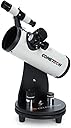
The Celestron 76mm Cometron FirstScope is a compact and portable tabletop Dobsonian telescope designed for beginners. Weighing just 2 pounds, it features a 76mm objective lens and a 300mm focal length, providing a wide field of view ideal for observing celestial objects. With a simple no-tool setup and included finderscope, this telescope is perfect for on-the-go stargazing. Plus, it comes with a bonus astronomy software package to enhance your cosmic journey.


| ASIN | B00DV6SBRO |
| Best Sellers Rank | #7,611 in Camera & Photo Products ( See Top 100 in Camera & Photo Products ) #486 in Telescope Refractors |
| Brand | Celestron |
| Built-In Media | Finderscope and 2 Kellner eyepieces |
| Coating | Multi-Coated |
| Customer Reviews | 4.1 out of 5 stars 323 Reviews |
| Exit Pupil Diameter | 19.24 Millimeters |
| Eye Piece Lens Description | Kellner |
| Field Of View | 1.78 Degrees |
| Finderscope | Reflex |
| Focal Length Description | 300 millimeters |
| Focus Type | Manual Focus |
| Global Trade Identification Number | 00050234210232 |
| Item Dimensions D x W x H | 13"D x 10"W x 10"H |
| Item Weight | 2 Pounds |
| Manufacturer | Celestron |
| Manufacturer Part Number | 21023-CGL |
| Model Name | 21023 |
| Model Number | 21023-CGL |
| Mount | Altazimuth Mount |
| Objective Lens Diameter | 76 Millimeters |
| Optical Tube Length | 70 Millimeters |
| Optical-Tube Length | 70 Millimeters |
| Power Source | Battery Powered |
| Telescope Mount Description | Altazimuth Mount |
| UPC | 050234210232 962392012170 |
| Warranty Description | 2 years |
| Zoom Ratio | 2:1 |
E**T
IMPORTANT! You will not see Jupiter as large as in the pictures of the "vanilla" FirstScope.
IMPORTANT! You will not see Jupiter as large as in the pictures of the "vanilla" FirstScope. This Cometron version comes with different eyepieces than the Celestron FirstScope with the names of astronomers on it (the "vanilla" FirstScope). The Cometron verrsion comes with 20mm and 10mm eyepieces, yielding 15x and 30x magnification, respectively. The "vanilla" version comes with 20mm and 4mm eyepieces, yielding 15x and 75x magnification. You can still see Jupiter and its moons with the Cometron version, but they look like stars. Despite the lack of extreme magnification (which frankly will look blurry with such a small scope), this scope is a wonderful device! I've used it every clear night since it arrived (about three weeks ago), and I am never disappointed. The included finder scope is a bit of a pain to zero in properly, as it is manual and not an electronic red dot scope, but it works well after some effort. The moon is wonderful, as is seeing star clusters which are invisible to the naked eye. I have not gone out to a dark sky location yet, but I am sure this scope will only impress me even more.
A**R
A good absolute beginner's telescope with compromises
I was originally interested in getting into astronomy as a kid, but never did get a telescope. About two months ago, we were cleaning out the house of a recently deceased family member when we found a telescope. I went home and tried it out. However, since it was a Tasco, I wasn't getting good views at all. I decided to do something to dip my toe into astronomy, if you will, by buying this scope, since it is so inexpensive (notice I didn't say cheap). I got it in a reasonable amount of time (Amazon Prime is like that) and opened up the box. Celestron includes two eyepieces, a 20 MM and 10 MM. I believe them to be of Kellner design. While they're not Plossls, they are better than the cheap Huygens design eyepieces you get with a Tasco. They'll do fine for looking at the Moon and certain planets. Overall construction quality of the scope is solid; the plastics aren't glossy and cheap. The tabletop stand it comes on is probably a medium-density composite board with laminate over it. Again, solid; not cheap. However, that is not to say that this is a 100% fully-featured Newtonian telescope. Newtonians, because of their design, require that the two mirrors in the telescope occasionally be aligned properly, in a process called collimation. On the FirstScope, this is a bit of a challenge. For starters, no collimation cap or eyepiece is included in the box. I ended up purchasing one anyways, because I felt I'd need it for something else later on. When it comes to the actual adjustment part of the collimation process, you'll find it's more difficult on this telescope than more expensive models for the reason that the primary mirror (that's the one at the sealed end of the telescope) is not adjustable. The mirror is concave and set into the plastic cap by adhesive. On more expensive models, you'll usually see thumb screws for adjusting it. The secondary mirror (the one by the focuser that bounces light back into your eye) is adjustable, but it is held into place by one long screw instead of a spider. Again, this makes it harder to adjust. Ultimately, I got things to work, but it's something I wish I had known before. Your options as it relates to supporting this telescope are limited unless you can work out a platform mounted to a tripod. I find myself using the trunk lid of my car. It's not a great solution, but it is what it is. This telescope is probably best used for the Moon and planets. Being in a light-polluted larger city (and, as of the writing of this post, in the middle of a very cold Midwestern winter), I haven't had a chance to go and try out for more distant objects. It's possible to see some of the broader details on the Moon and see Jupiter and his larger moons with the provided eyepieces. I just purchased a Barlow eyepiece from a local store, so I'll update with what I see then. Overall, if you're asking if astronomy is for you, and you don't want to drop righteous bucks on a scope just to answer that question, you might be smart to order one of these. I'm enjoying the hobby and plan on purchasing a much more expensive scope soon to see what else is out in the heavens.
M**G
The Most Adorable Newtonian Telescope
The telecope is pretty small. So, it's definitely a tabletop telescope. The alt-az Dobsonian-type mount is very easy to use. The 3-inch aperture diameter is good for a beginner's telescope, and for the low price. It comes with a decent finderscope and two Kellner eyepieces: 20 mm (15x) and 10 mm (30x). You can see the moon's craters even with the lower-power eyepiece. I tried to use a separate 3x Barlow lens, but I couldn't see anything. Perhaps it's a focal-length issue. Overall, I recommend this telescope. It makes for a better child's X'mas present than a similarly priced refractor.
J**J
Great for beginners
Better than expected for the price. I am not big into astronomy, and this was a gift for my young boy. It is a lot easier for him than a tripod. much sturdier and he is able to see without needing some sort of stool to get high enough. I am very glad I went with this one. He loves and uses it more than I expected.
A**A
Came opened and missing parts
Like the title says, bought this as a present and is already opened, has finger print marks all over it and missing parts.
M**9
You get what you pay for.
I got mine used on Amazon for $35 shipped. Maybe it was returned for being bad. You decide if you want to pay $60 new and see what percentage are good. The 10mm eyepiece, which has a K on it supposedly for Kelner, looks to be a Huygen, with a 30ยฐ apparent field of view. Huygens are not terrible. At low power, they are more than wide enough to fit the moon, and find it in this case. Their resolution at their edges drops off much more than Kelner's and especially Plossl's. The finder has a baffle right behind the objective, which reduces the aperture to 16mm. The finder's eyepiece seems to be a Huygen. Very narrow field of view. Edit: I discovered the lens cover unscrews off, and you can push the baffle back to halfway, where it should be, then screw it all back together. So that part is fixed now. The focuser tube points to the side of the secondary but is loose enough you can wedge it to center by inserting a tooth pick. I think it is missing two slider pads. Folded paper might also do the trick. I think some clear tapes might have more friction than others. The secondary mirror is not aimed at the center of the primary, so you do need to know how to adjust the 3 screws to get it aimed. I opened the tube to center dot the primary. I also have a cheshire collimation eyepiece with crosshairs. It was not too hard to adjust, though it ran out of range. Maybe the focuser being off is what made me think the secondary needed more adjustment. The primary does not have adjustment screws per se, but you can losen the 3 attachment screws and wiggle it enough and then tighten them back down. f4 is not very forgiving on any misalignment. The base is good. I may have got my money's worth just because of the base, which I can use in another scope. It is not tall enough to use without a table, unless little kids like to get down on the ground, which many do. I focused on myself in the mirror from the other side of the room. The resolution is noticeably off. I can see more detail in my $30 7x monocular. The Cometron can focus even closer, so that is not the issue. The issue is I did not get the mirrors aligned enough, which has a big penalty at f4. I have to insert two focuser pads before I can align them better. I really wish I could recommend you a better scope. I've looked through many, and you will encounter trade offs, such as cost and weight. More power means harder to aim. Many say the $110 Orion SkyScanner is much better. It is a 100mm aperture table dob, also f4, but maybe better aligned from the factory. Many cheap refractors have wobbly mounts. I doubt a 6 year old could easily more around my Celestron Powerseeker 114mm, which has great optics for only $70 shipped. I had to make a few modifications to it to have any real fun. Many people recommend binoculars for newbies. They are inexpensive and small and let you learn the sky with a wide view. However, they do not zoom in on planets. In a light polluted city, you will prefer the magnification of a telescope for the moon. A mounted scope scan share views between people, whereas binoculars show different views to different people who don't know where it was aimed last. For the low price, you get what you pay for.
Y**1
Jupiter's 4 moons and Orion Nebula M42
This is my first telescope and it lets me see saturn and Jupiter. It is fun and very light to take anywhere you want. I bring it to my oversea travel to look at Orion nebula in Penang (Second photo). To make it easy to pack, I replace the dobsonian base with a camera tripod and relocate the finder view. I used iPhone 6 and saturnCam app to capture the Jupiter and its 4 moons. I have also see Saturn but it is only a blob in an oval shape with 10mm eyepiece. I use SpiralCam app to photo the Orion Nebula.
A**R
Views of saturn
Great starter scope for kids. Out of the box my favorite eyepiece is the 10mm Kellner. I bought the Celestron 94308 observers accessory kit and by using the blue planetary filter on the 10mm kellner with the 2x Barlow you can see Saturn just below the moon. Switch to the 6mm Plossl eyepiece with the blue filter and the 2x Barlow and you can see Saturn at the size of an eraser head with enough clarity to see the space between the rings and the planet. For the moon the 10mm kellner with the 2x Barlow and moon filter works best. You can very easily see individual craters and canyons. We sit in a city of 50k at 5000 feet.
Trustpilot
5 days ago
3 weeks ago