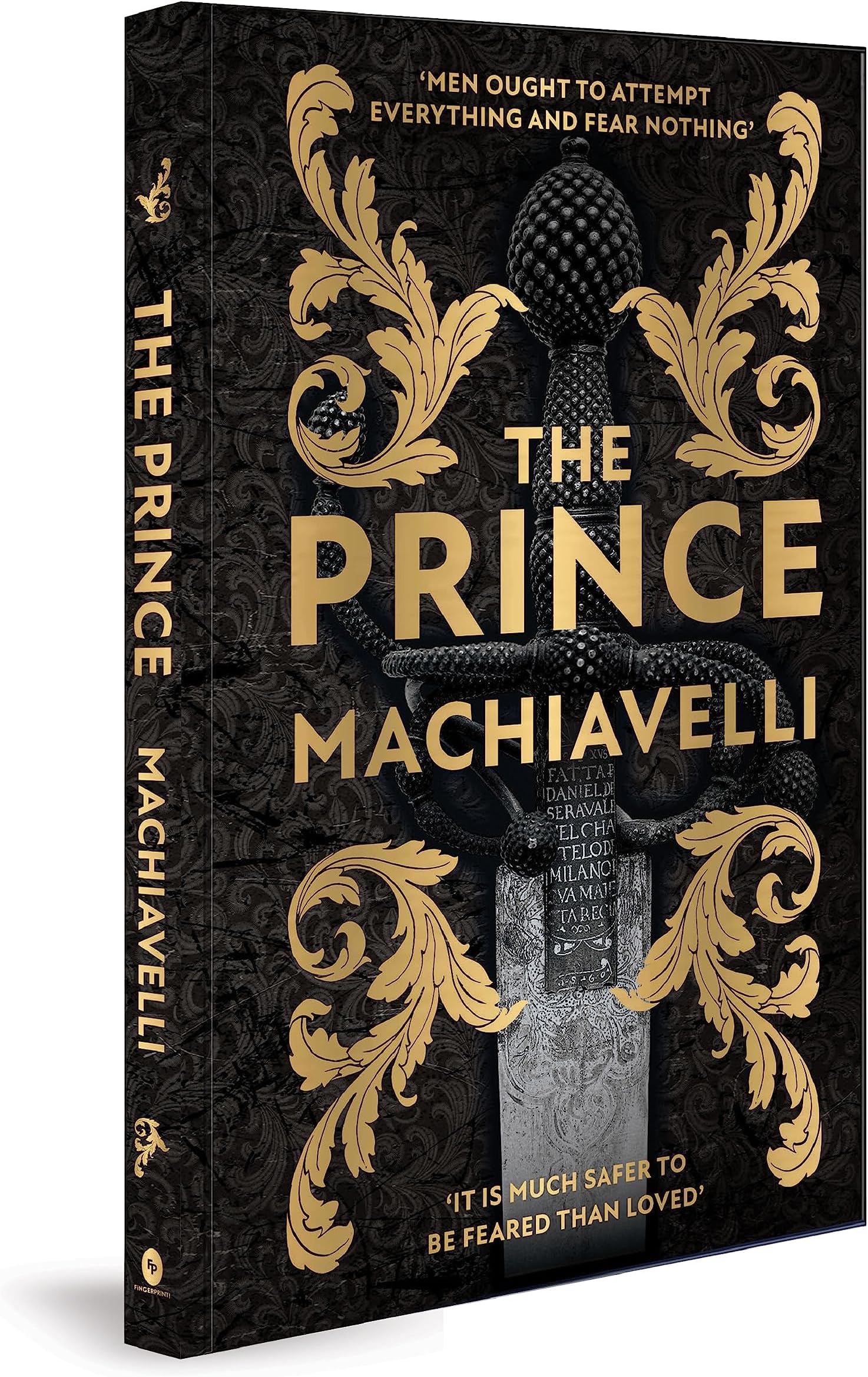
Prince (Deluxe Hardbound Edition), The (Fingerprint Classics)
Desertcart purchases this item on your behalf and handles shipping, customs, and support to Hungary.
Description
A guide for rulers. A mirror of ambition. A masterpiece that changed the way the world understands power. Written in the early 16th century, The Prince remains one of the most influential works in political thought. In this bold and provocative treatise, Machiavelli strips away ideals and exposes the raw mechanics of leadership, strategy, and control. With razor-sharp pragmatism, he explores what it takes to win and maintain power, whether through wisdom, manipulation, or force. Engage with Machiavelli's pragmatic analysis of political power. Delve into the principles of effective leadership and statecraft. Reflect on Machiavelli's bold and controversial advice to rulers. Explore the timeless themes of ambition, morality, and the pursuit of power. A valuable resource for students, scholars, and anyone interested in the study of politics and leadership. Perfect For Students of political science, philosophy, and history Leaders, managers, and entrepreneurs seeking strategic insight Readers of Sun Tzu, Robert Greene, or Aristotle Anyone fascinated by ambition, influence, and the anatomy of power


Specifications
| Dimensions | 5.81 x 0.54 x 8.88 inches |
| Isbn 10 | 9354406688 |
| Isbn 13 | 978-9354406683 |
| Item Weight | 9.9 ounces |
| Language | English |
| Print Length | 176 pages |
| Publication Date | December 10, 2022 |
| Publisher | Fingerprint |
Reviews
User
Must-Read
This deluxe hardbound edition of The Prince from Fingerprint Classics is absolutely beautiful. The hardcover with golden text is elegant and eye-catching, and the pages are sturdy and high quality. The text is clear and very readable, making it easy to engage with Machiavelli’s ideas. The physical craftsmanship of this edition makes it a joy to hold and display.Machiavelli’s work is as thought-provoking today as it was centuries ago. The book explores power, leadership, and strategy in a straightforward and insightful way, offering lessons that remain relevant. The examples are historical but easy to follow, and the writing is concise and sharp. This edition presents the content perfectly and is a must-have for anyone interested in political thought or classic literature. Five out of five stars.
User
The virtues of Machiavelli
In the course of my political science training, I studied at great length the modern idea of realpolitik. In that study I came to realise that it was somewhat incomplete, without the companionship of The Prince, by Niccolo Machiavelli, a Florentine governmental official in the late fifteenth and early sixteenth centuries. The Prince is an oft quoted, oft mis-quoted work, used as the philosophical underpinning for much of what is considered both pragmatic and wrong in politics today. To describe someone as being Machiavellian is to attribute to the person ruthless ambition, craftiness and merciless political tactics. Being believed to be Machiavellian is generally politically incorrect. Being Machiavellian, alas, can often be politically expedient.Machiavelli based his work in The Prince upon his basic understanding of human nature. He held that people are motivated by fear and envy, by novelty, by desire for wealth, power and security, and by a hatred of restriction. In the Italy in which he was writing, democracy was an un-implemented Greek philosophical idea, not a political structure with a history of success; thus, one person's power usually involved the limitation of another person's power in an autocratic way.Machiavelli did not see this as a permanent or natural state of being -- in fact, he felt that, during his age, human nature had been corrupted and reduced from a loftier nobility achieved during the golden ages of Greece and Rome. He decided that it was the corrupting influence of Christianity that had reduced human nature, by its exaltation of meekness, humility, and otherworldliness.Machiavelli has a great admiration for the possible and potential, but finds himself inexorably drawn to the practical, dealing with situations as they are, thus becoming an early champion of realpolitik carried forward into this century by the likes of Kissinger, Thatcher, Nixon, and countless others. One of the innovations of Machiavelli's thought was the recognition that the prince, the leader of the city/state/empire/etc., was nonetheless a human being, and subject to all the human limitations and desires with which all contend.Because the average prince (like the average person) is likely to be focussed upon his own interests, a prince's private interests are generally in opposition to those of his subjects. Fortunate is the kingdom ruled by a virtuous prince, virtue here not defined by Christian or religious tenets, but rather the civic virtue of being able to pursue his own interests without conflicting those of his subjects.Virtue is that which increases power; vice is that which decreases power. These follow Machiavelli's assumptions about human nature. Machiavelli rejected the Platonic idea of a division between what a prince does and what a prince ought to do. The two principle instruments of the prince are force and propaganda, and the prince, in order to increase power (virtue) ought to employ force completely and ruthlessly, and propaganda wisely, backed up by force. Of course, for Machiavelli, the chief propaganda vehicle is that of religion.Whoever reads Roman history attentively will see in how great a degree religion served in the command of the armies, in uniting the people and keeping them well conducted, and in covering the wicked with shame.Machiavelli has been credited with giving ruthless strategies (the example of a new political ruler killing the deposed ruler and the ruler's family to prevent usurpation and plotting is well known) -- it is hard to enact many in current politics in a literal way, but many of his strategies can still be seen in electioneering at every level, in national and international relations, and even in corporate and family internal 'politics'. In fact, I have found fewer more Machiavellian types than in church politics!Of course, these people would be considered 'virtuous' in Machiavellian terms -- doing what is necessary to increase power and authority.The title of this piece -- the virtues of Machiavelli, must be considered in this frame; certainly in no way virtuous by current standards, but then, it shows, not all have the same standards. Be careful of the words you use -- they may have differing definitions.Perhaps if Machiavelli had lived a bit later, and been informed by the general rise of science as a rational underpinning to the world, he might have been able to accept less of a degree of randomness in the universe. Perhaps he would have modified his views. Perhaps not -- after all, the realpolitikers of this age are aware of the scientific framework of the universe, and still pursue their courses.This is an important work, intriguing in many respects. Far shorter than the average classical or medieval philosophical tome, and more accessible by current readers because of a greater familiarity with politics than, say, metaphysics or epistemology, this work yields benefits and insights to all who read, mark, inwardly digest, and critically examine the precepts.
User
Machiavelli's classic, now for Kindle
This review is of the (currently free) Kindle edition of The Prince.As others have stated at much greater length and with far greater eloquence, this is one of the most important books of political thought and philosophy ever written, and a truly timeless classic. As such, the fact that it's available for free on Kindle makes this a terrific deal, worth every single penny and many more. All the usual conveniences of Kindle applies here: very fast to download via Whispernet, the handiness of being able to annotate and highlight important passages, bookmarking pages you want to reference again later, etc. The slickness of the Kindle format and capabilities plus the inherit worthiness of the book itself easily nets 4 stars.It's been about forever since I last read The Prince, plus I don't really know anything about Italian, so I'm not really fit to talk about the quality of the translation. Suffice it to say that it's a fairly easy book to read and make sense of, but again I can't speak to how true this particular edition is to its source material.Unfortunately, there are a few problems with this edition of The Prince that need to be mentioned, and which in the end detract a little from the overall score. The first and biggest is in the formatting of the book. In short, it looks like a plain-text notepad file converted into a Kindle book; there's no navigable Table of Contents or chapter breaks as with most commercial Kindle books, and the book itself flows from the title page almost directly into the background about Machiavelli and then from there straight into The Prince itself, with scarcely a break in the text to mark the transition. For someone well versed in The Prince this probably isn't much of an issue, but for the more casual reader it's a little distracting and may confuse some. The other problem is more one of personal preference, which is that there's no annotations alongside the text to put specific lines into context. Again, for someone well versed in Machiavelli's life and the real-world examples he uses throughout The Prince, this probably isn't a significant issue. For more casual readers, having a little context for the examples he uses would be helpful from time to time.In the end, you get what you pay for, and as the above-reviewed version of The Prince was free, I can't complain too much. It's brilliant, it's relevant, and it's very convenient to have on my Kindle. What more do you want for the price?
User
EXCELLENT AND BEAUTIFUL BOOK!
Beautiful Book!!!Very Historic and Excellent Advice.The only minor issue is the pages are Gilded, and stuck together.All pages were easily separated with No damage to the book.
User
Good book for the price
"The Prince" is a great work of writing. It has a great zeal for history buffs and anyone interested in the realm of power.A consideration on my part would be to be careful which edition you receive. The book here on the website claims to have 164 pages and published by Simon & Brown 2011, the ISBN 1613821719 and the one I received over the mail has 106 pages and was published by St. Martin's Press, NY 1997 with an ISBN 0-14-044752-0. A 14 year difference, hence my reason for giving 3 stars instead of 5.The book is a historical account of strategic maneuvers through Northern Italy in order for rulers to dominate neighboring provinces. Machiavelli himself is displayed as a wise power player, preaching the importance of making bold decisions and always thinking ahead. Readers are also taken into the unconventional mind of Machiavelli and his insight into a darker domain of human psychology. Machiavelli argues that maneuvers have to be insidious and masked in darkness. The book claims that the "qualities traditionally considered as 'virtuous', in the Christian or feudal senses, were not virtuous at all in a prince."(pg xxvi) Claiming that double-cross, deceit, and an overwhelming desire for more are traits all good "princes" must posses in order to be successful in the contest of power.The book is organized as a practical, "how-to" guide which makes it extremely useful. Although many of us here on Amazon might not be contemplating the complete take over of foreign nations, the teachings of the book can be used by ordinary people to secure their place in the workplace by organizing employees in a structure suited to your needs- "How a prince should organize his militia" (pg47), or whether a situation needs either your harshness or benevolence- "Cruelty and compassion; and whether it is better to be loved than feared, or the reverse" (pg 53).For myself, Machiavelli's insight into "how far human affairs are governed by fortune, and how fortune can be opposed"(pg 79) was a good insight on how circumstances shape human minds. An example would be the spoiled good life of one man vs. the cohesive rise of another. A good prince does not treat both in the same manner. An admirable lesson to take from the book is the idea of creating opportunities, no matter what our circumstances are.All in all, the book is easy to read and insightful on the responsibility of anyone creating power for themselves.
User
Observations matter
Very illuminating. Recommend if your done with the bs of the people.
User
A Delightful Read -- Reads Like Modern Poetry
After having read this delightful translation of The Prince, I want to return to one of my favorite cities in Italy -- Florence.I don't know the Italian language except that I love hearing operas sung in Italian. (I studied a little Spanish in my younger days.)This book is delightful to read for numerous reasons, among the primary ones are the author's instructive notes and translation that renders Machiavelli writing poetic and readily accessible -- it reads like contemporary writing with Italian operatic pageantry, marvel and excitement, which I believe accurately reflects Machiavelli's Renaissance Florence. Professor William J. Connell delivers the goods: "Machiavelli's language is more immediate and much less abstract and 'impersonal' than commonly believed."By today's standards, the lessons captured by Machiavelli in The Price are not earth-shattering and seem almost over-simplified. Yet, they will likely continue to resonate for centuries to come because Machiavelli captured the essence of human instincts, needs, desires and aspirations. Politics and governance involve harnessing all available resources through human beings. And in warfare, the United States and allied forces realized the efficacy of winning the "hearts and minds" of the local people in Iraq and Afghanistan, which Machiavelli teaches in The Price.In Chapter 19, Machiavelli instructs: "the price should think . . . to avoid those things that could make him hateful and contemptible, and whenever he will avoid this thing, he will have fulfilled his duties and he will not find any peril at all in the other infamies. It makes him hateful . . . if he is rapacious and the usurper of the property and women of his subjects, from which he should abstain. And whenever he does not take away property or honor from the generality of men they live content."In Chapter 21, we get a lesson on (modern) Economics 101 from Niccolo Machiavelli:"A prince must also show himself a lover of the virtues by giving hospitality to virtuous men, and he must honor those who are excellent in an art. Next, he must encourage his citizens to be able quietly to practice their trades, in commerce, in agriculture and in every other human occupation, so that one man is not afraid to improve his properties for fear they will be taken from him, and another is not afraid to open a business for fear of taxes. . . .[A]t the appropriate times of the year he should keep his people occupied with feast-days and spectacles. And because every city is divided into guilds and wards, he should take account of those collectives, meet with them sometimes, and offer himself as an example of humanity and munificence, while nonetheless always keeping firm his dignity's majesty[.]"Machiavelli observes: "And men as a whole judge more with their eyes than their hands, because everyone is permitted to see, but few are permitted to touch. (Ch. 18.)Machiavelli cautions: "For even if you have fortresses, if the people hold you in hatred, the fortresses do not save you, since outsiders who will help them are never lacking for the people once they have taken up arms." (Ch. 20.)Professor Connell makes Machiavelli (and Italy's history) come alive; his translations make The Price accessible and delightful to read. This work is a book in its own right and I expect it will remain accessible to many future generations of readers. This book is certainly timeless.
User
Great for gifting, questionable for reading. Know your recipient
I bought this to gift to someone, not for myself. It arrived in a standard Amazon box, shrink-wrapped inside. The hardcover feels decent, and the paper is okay, but don't expect high GSM stock.The gold accents look nice and make it a solid gift. However, they can also look a bit flashy. You need to know the person you are giving it to. If they like flashy things, this is perfect. If they prefer a minimalist look, you might want to skip it.Honestly, it's even better for someone who won't read it and will just use it as a shelf decoration 😄. It's the kind of book that looks great on a display shelf.8/10 as a gift. Maybe not the best choice if you wanted to actually read the content yourself. Just make sure the receiver fits the style before you buy.
User
Surprisingly relevant
Amazing that the arguments still hold up, logic hasn't changed over the centuries.Machiavelli has an unfair reputation based primarily on "It's better to be feared than loved" if you have to choose. But he is clear that you should not be hated. Who is feared but not hated? A competent and powerful leader. Love of a leader he says is unreliable, they may stop loving you the next week, or the next, and if they ever do you are done, but being "feared" but not hated is more reliable. Especially in 16th century Italy.
User
Still relevant today
Good edition. Having heard a lot about the book finally read it and it is still very relevant to the modern world
User
perfect condition
perfect condition
User
story
amazing
User
Nice one.
You already know how good this book is....
Common Questions
Trustpilot