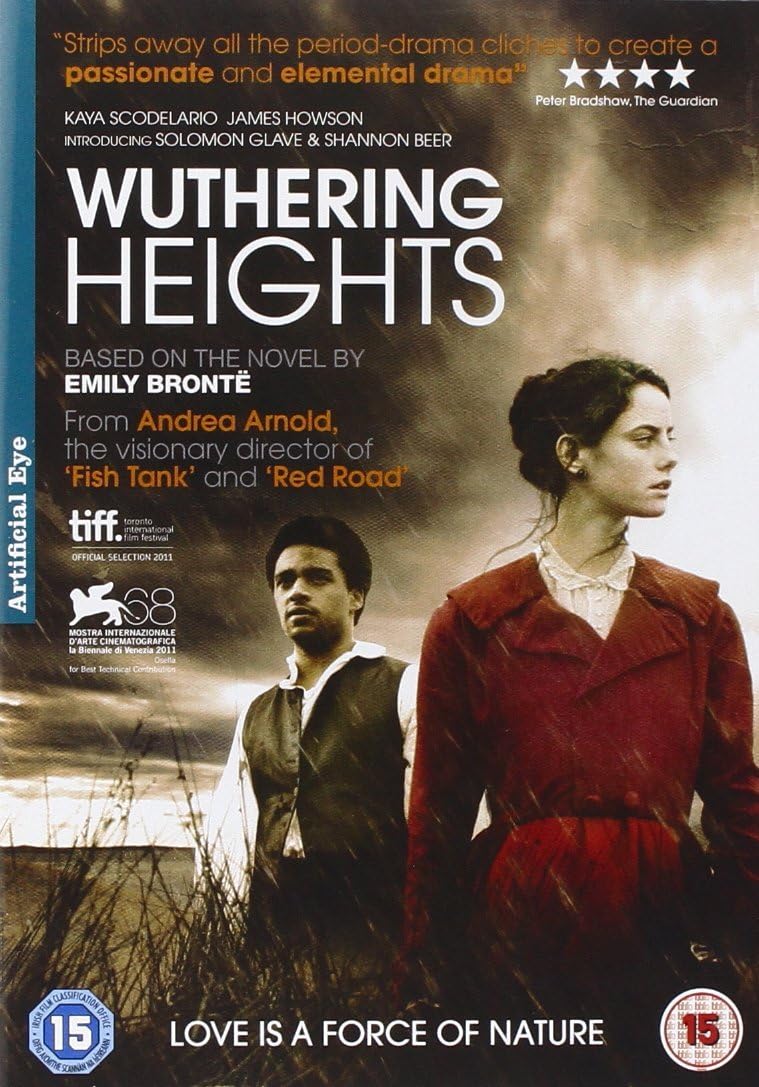

Wuthering Heights (2011)
Product ID: 56530272
Buy anything from 5,000+ international stores. One checkout price. No surprise fees. Join 2M+ shoppers on Desertcart.
Desertcart purchases this item on your behalf and handles shipping, customs, and support to Hungary.
Wuthering Heights is Academy Award®-winning writer-director Andrea Arnold's third feature following the BAFTA® award winning, Fish Tank and Cannes Jury Prize winning Red Road. Based on the novel by Emily Brontë and adapted for the screen by Andrea Arnold and Olivia Hetreed, Wuthering Heights stars newcomer James Howson as Heathcliff and Kaya Scodelario (Skins) as Cathy alongside Steve Evets (Joseph), Oliver Milburn (Mr Linton), and Nicola Burley (Isabella Linton) and introducing Shannon Beer and Solomon Glave playing the young Cathy and Heathcliff. A Yorkshire hill farmer on a visit to Liverpool finds a homeless boy on the streets. He takes him home to live as part of his family on the isolated Yorkshire moors where the boy forges an obsessive relationship with the farmer s daughter. Review: Harsh yet stunning realism - This is the definitive marmite of all films; you'll either love it or hate it, invariably for the same reasons. It is crucial that you view this film with an open mind. If you're 100% tied-down to the classic style of heritage film such as Howard's End (1992) then this is not for you. This is not to say that the two genres cannot go hand-in-hand, as the BBC's Pride & Prejudice of 95 will ever be my favourite TV mini-series and yet I was blown away by this adaptation of Wuthering Heights. Adaptation is the key-word here, as to release yet another word-for-word depiction of Bronte's novel would be pointless. What draws me to Arnold's vision is the immense feeling of realism. When you look at the themes presented by the novel then it's easy to see why Arnold withdrew the romanticism for gritty pessimism. Unresolved and unobtained love is indeed 1 part actual contact and conversation to infinite parts reflective depression, seeking out beauty in a bleak surrounding. The cinematography enhances this feel with abrasive handheld camerwork drained of colour with plenty of close-ups, and yet the picture quality remains notably stunning. The lack of dialogue paves way for a greater appreciation of this; I found it highly refreshing to adhere to the notion of 'what's not said had deeper meaning'. The lack of music accompaniment, and the accentuation of natural acoustics further heightens the sense of realism. I didn't fully notice this until the Mumford & Sons track at the end which somehow works beautifully. I completely disagree with those saying that casting a black Heathcliff is just a poor attempt at originality. Arnold has narratively adapted him into a black character rather than just a black actor, so he is often addressed (usually discriminatively) in context to his race. In my opinion Bronte didn't explore the nature and treatment of Heathcliff's race enough after stating him as 'dark-skinned', as such a trait in the mid-19th century Yorkshire moors would I feel be a more frequented topic. I would and have recommended this film to others as I believe it to be a superb raw depiction of misery brought about by doomed love. A vital adaptation unbound by era. Review: Gripping new adaptation of a perennial classic - I had not been too thrilled with director Andrea Arnold's coming of age drama Fish Tank, although it had some good moments, and also introduced me to Bobby Womack's lovely California Dreamin' song, mainly because I don't care for kitchen sink realism movies. But the good reviews and striking screencaps for her film of Wuthering Heights prompted me to plonk down a measly 6 quid (part of a 3 BD's for 18 sale). Emily Bronte's novel is a classic of Gothic romance and has been adapted several times for the screen. The typical strategy for most of these adaptations has been to put stars in the roles of Heathcliff and Catherine, and hurry over their childhood relationship to the adult phase where the stars can come in. In contrast, Arnold's film casts relative newcomers and places a lot of importance on tracing the early friendship of the two characters when they were in their teens. This forms a strong basis for their near animal attachment to each other, despite all the social complications in their companionship. Also, she makes spectacular use of locations, bringing alive the wild brooding air of the setting. Interestingly she chooses to film in the 4:3 ratio. While initially, this seems an odd choice for a film with a heavy outdoorsy element, her focus is on creating a claustrophobic frame, which heightens the intensity of the emotions. When H&C go riding, the editing constantly cuts to close-ups of their faces, Heathcliff breathing in the scent of her hair, their legs against the horse's side. Even purely from a visual standpoint, this is one of the most gorgeous films I have seen in recent years. AE's blu-ray delivers a transfer that's nothing short of stunning. The outdoor scenes especially boast a gob-smacking beauty that you normally only see in the prestigious BBC nature programs. The soundtrack is interesting in that it doesn't feature any musical score, very rare for a period film, relying on natural sound to provide the atmospherics. The lossless stereo track I heard provided an immersive experience. There is also a DTS-HD 5.1 track for the surround-fans. There are no extras other than a photo gallery (I believe the US release has a video essay from a film critic). All things considered, a terrific experience for me.




| ASIN | B006328QWI |
| Actors | Amy Wren, James Howson, Kaya Scodelario, Nichola Burley, Oliver Milburn |
| Aspect Ratio | 4:3 - 1.33:1 |
| Customer reviews | 4.0 4.0 out of 5 stars (302) |
| Director | Andrea Arnold |
| Is discontinued by manufacturer | No |
| Language | English (Dolby Digital 2.0), English (Dolby Digital 5.1) |
| Manufacturer reference | 5021866582306 |
| Media Format | Colour, Digital Sound, Full Screen, PAL |
| Number of discs | 1 |
| Producers | Douglas Rae, Kevin Loader, Robert Bernstein |
| Product Dimensions | 1.9 x 13.7 x 19.1 cm; 70 g |
| Release date | 26 Mar. 2012 |
| Run time | 2 hours and 3 minutes |
| Studio | Artificial Eye |
| Subtitles: | English |
| Writers | Olivia Hetreed |
F**S
Harsh yet stunning realism
This is the definitive marmite of all films; you'll either love it or hate it, invariably for the same reasons. It is crucial that you view this film with an open mind. If you're 100% tied-down to the classic style of heritage film such as Howard's End (1992) then this is not for you. This is not to say that the two genres cannot go hand-in-hand, as the BBC's Pride & Prejudice of 95 will ever be my favourite TV mini-series and yet I was blown away by this adaptation of Wuthering Heights. Adaptation is the key-word here, as to release yet another word-for-word depiction of Bronte's novel would be pointless. What draws me to Arnold's vision is the immense feeling of realism. When you look at the themes presented by the novel then it's easy to see why Arnold withdrew the romanticism for gritty pessimism. Unresolved and unobtained love is indeed 1 part actual contact and conversation to infinite parts reflective depression, seeking out beauty in a bleak surrounding. The cinematography enhances this feel with abrasive handheld camerwork drained of colour with plenty of close-ups, and yet the picture quality remains notably stunning. The lack of dialogue paves way for a greater appreciation of this; I found it highly refreshing to adhere to the notion of 'what's not said had deeper meaning'. The lack of music accompaniment, and the accentuation of natural acoustics further heightens the sense of realism. I didn't fully notice this until the Mumford & Sons track at the end which somehow works beautifully. I completely disagree with those saying that casting a black Heathcliff is just a poor attempt at originality. Arnold has narratively adapted him into a black character rather than just a black actor, so he is often addressed (usually discriminatively) in context to his race. In my opinion Bronte didn't explore the nature and treatment of Heathcliff's race enough after stating him as 'dark-skinned', as such a trait in the mid-19th century Yorkshire moors would I feel be a more frequented topic. I would and have recommended this film to others as I believe it to be a superb raw depiction of misery brought about by doomed love. A vital adaptation unbound by era.
S**U
Gripping new adaptation of a perennial classic
I had not been too thrilled with director Andrea Arnold's coming of age drama Fish Tank, although it had some good moments, and also introduced me to Bobby Womack's lovely California Dreamin' song, mainly because I don't care for kitchen sink realism movies. But the good reviews and striking screencaps for her film of Wuthering Heights prompted me to plonk down a measly 6 quid (part of a 3 BD's for 18 sale). Emily Bronte's novel is a classic of Gothic romance and has been adapted several times for the screen. The typical strategy for most of these adaptations has been to put stars in the roles of Heathcliff and Catherine, and hurry over their childhood relationship to the adult phase where the stars can come in. In contrast, Arnold's film casts relative newcomers and places a lot of importance on tracing the early friendship of the two characters when they were in their teens. This forms a strong basis for their near animal attachment to each other, despite all the social complications in their companionship. Also, she makes spectacular use of locations, bringing alive the wild brooding air of the setting. Interestingly she chooses to film in the 4:3 ratio. While initially, this seems an odd choice for a film with a heavy outdoorsy element, her focus is on creating a claustrophobic frame, which heightens the intensity of the emotions. When H&C go riding, the editing constantly cuts to close-ups of their faces, Heathcliff breathing in the scent of her hair, their legs against the horse's side. Even purely from a visual standpoint, this is one of the most gorgeous films I have seen in recent years. AE's blu-ray delivers a transfer that's nothing short of stunning. The outdoor scenes especially boast a gob-smacking beauty that you normally only see in the prestigious BBC nature programs. The soundtrack is interesting in that it doesn't feature any musical score, very rare for a period film, relying on natural sound to provide the atmospherics. The lossless stereo track I heard provided an immersive experience. There is also a DTS-HD 5.1 track for the surround-fans. There are no extras other than a photo gallery (I believe the US release has a video essay from a film critic). All things considered, a terrific experience for me.
E**N
Auf der Geschichte, die Emily Brontës Roman erzählt, lasten mittlerweile zentnerschwere Kitscherwartungen zahlreicher LeserInnengenerationen. Für Verfilmungen bedeuten diese Erwartungen: Porzellanartig erstarrte Figuren schreiten durch malerische Landschaften und teilen einander in fein gedrechselten Sätzen ihre inneren Zustände mit. Die beiden Hauptfiguren sind zu schmachtenden Blicken und – im expressiven Ernstfall – zu kurzatmig vorgetragenen Liebesschwüren verdammt. Kurzum: Rosamunde Pilcher in windiger Umgebung. So in etwa haben es einst Laurence Olivier und Merle Oberon in der Hollywoodverfilmung (1939) des ansonsten durchaus begabten William Wyler vorexerziert, und so ist es in vielen weiteren Verfilmungen geblieben (Jacques Rivettes Adaption von 1985 sei hier ausdrücklich ausgenommen). Andrea Arnold macht sich entschlossen daran, den Schutt der Kitscherwartungen beiseite zu räumen, der den Zugang zum Herzen des Romans verstellt. Die Regisseurin hat für ihre vorherigen Spielfilme „Red Road“ (2006) und „Fish Tank“ (2009) viel Kritikerlob eingeheimst und zuvor bereits für „Wasp“ (2003) den Oscar für den besten Kurzfilm erhalten. Ihr jüngster Spielfilm, »American Honey«, erhielt beim Filmfestival in Cannes 2016 den Preis der Jury. Doch zurück zu »Wuthering Heights«: Bereits einige grundlegende formale Vorentscheidungen lassen erkennen, wie wenig Arnold bereit ist, den ausgetretenen Pfaden zu folgen. Sie weigert sich, der Konvention zu folgen, der zufolge man eine romantische Geschichte in eine (vermeintlich) romantische Landschaft einzubetten habe: Arnold wählt das heute weithin unübliche 4:3-Format, das die Figuren und ihr Verhalten fokussiert und die Umgebung oftmals nur andeutet. Aus dem gleichen Grund verzichtet die Regisseurin auf Plansequenzen und Kranbewegungen. Der Zuschauer ist in der Regel dicht bei den Figuren, ähnlich wie in den Filmen der Dardenne-Brüder. Wenn der Blick auf die Landschaft fällt, dann ist es der Blick der Figuren. Für sie enthält die Weite der nur dünn besiedelten Gegend kein Freiheitsversprechen, sondern eher die Drohung mangelnder Lebensmöglichkeiten. Arnold erzählt eine Geschichte unter gottesfürchtigen Bauern, die am Rande des Existenzminimums wirtschaften. Sie tut das mit einer Selbstverständlichkeit, die keine Sozialromantik aufkommen lässt. Dreck ist hier nicht dekorativ, sondern einfach nur dreckig. Andrea Arnolds »Wuthering Heights« ist ein brillanter Film und nicht zuletzt auch ein wohltuender Tritt in die Weichteile aller KitschfabrikantInnen dieser Welt.
V**O
il DVD in oggetto è di ottima fattura e funziona egregiamente sono soddisfatto e contento così spero in futuro buonagiornata Roberto
S**.
Produit conforme, livraison dans le délai. Je n'ai pas encore eu le temps de visionner.
E**A
Da sempre amante del romanzo di Emily Brontë, ho cercato e guardato tutte le trasposizioni cinematografiche/televisive disponibili. Mi sono sempre astenuta dall'acquistare questa in quanto avevo letto numerose recensioni sfavorevoli. Poi la curiosità ha vinto e l'ho comprata. È senza dubbio la peggior versione che abbia mai guardato. In primo luogo vorrei sapere per quale motivo alcuni registi si prendono il disturbo di mettere in scena Wuthering Heights tralasciando del tutto la seconda parte del romanzo. Wuthering Heights è innanzitutto la storia di una vendetta. Una vendetta così implacabile da estendersi anche sugli innocenti discendenti degli Earnshaw e dei Linton. Quando Heathcliff, dopo 18 anni di crudeltà verso i suoi "nemici", si rende conto della inutilità dei suoi sforzi, rinuncia e perde infine la voglia di vivere. Rimuovere del tutto questa parte significa togliere all'intero racconto il suo significato. In secondo luogo, in questo film ci sono numerose inesattezze e infedeltà al romanzo. Non mi soffermerò sull'Heathcliff di colore, quando in tutto il romanzo viene spesso apostrofato come "gypsy", quindi si presume che dovesse essere di etnia Romani, quindi nè caucasico nè di colore. Heathcliff è un outsider rispetto alla società inglese dove approda, quindi l'etnia non è così rilevante. Tuttavia l'attore che lo interpreta non mostra passioni: nè amore, nè odio, mantenendo sempre la medesima espressione. La follia di Catherine è solo accennata, tutto si compie in pochi attimi et voilà, lei muore senza che si capisca che diavolo le sia successo e soprattutto che fine ha fatto la figlia che portava in grembo (che presumibilmente muore con lei prima di essere partorita, eliminandola convenientemente come personaggio). Edgar Linton, che nel romanzo è piacevole e affascinante, nonchè un marito amorevole, anche se -purtroppo per lui- privo del fascino esotico e della passione di Heathcliff, viene qui rappresentato come goffo, insignificante e quasi ridicolo. Ben si comprendono quindi le lacrime di pentimento di Catherine quando Heathcliff le rimprovera il matrimonio... cosicchè diventa plausibile immaginare che sia morta per stizza. Nelly Dean, personaggio fondamentale nonchè principale narratrice della vicenda, è qui una qualsiasi cameriera, senza alcuna influenza sugli avvenimenti. A parte meritano una speciale menzione: parolacce gratuite e anacronistiche; una scena di nudità del tutto fuori luogo (la salma del defunto Mr. Earnshaw che viene lavata alla presenza della figlia preadolescente...); l'indimenticabile "OK..." con cui la povera Isabella accetta di fuggire con il suo eroe; numerose riprese effettuate in una oscurità pressochè totale, cosicchè non si capisce cosa stia succedendo; l'uso della camera a mano, così traballante da far venire il mal di testa: e infine la focalizzazione ossessiva su insetti e steli di erba, come in un filmino amatoriale girato in giardino. Se la regista desiderava girare un film su personaggi antipatici che vivevano in una sudicia fattoria nella brughiera era liberissima di farlo. Solo che un titolo differente, qualsiasi altro titolo, sarebbe stato piú appropriato di "Wuthering Heights".
C**.
Wer das Buch kennt (und liebt) weiss, der 2. Teil fehlt komplett und so ergibt die Geschichte wirklichvgar keinen Sinn! Vergesst den Film, der zwar schöne Naturaufnahmen hat, lest das Buch!
Trustpilot
2 days ago
1 month ago