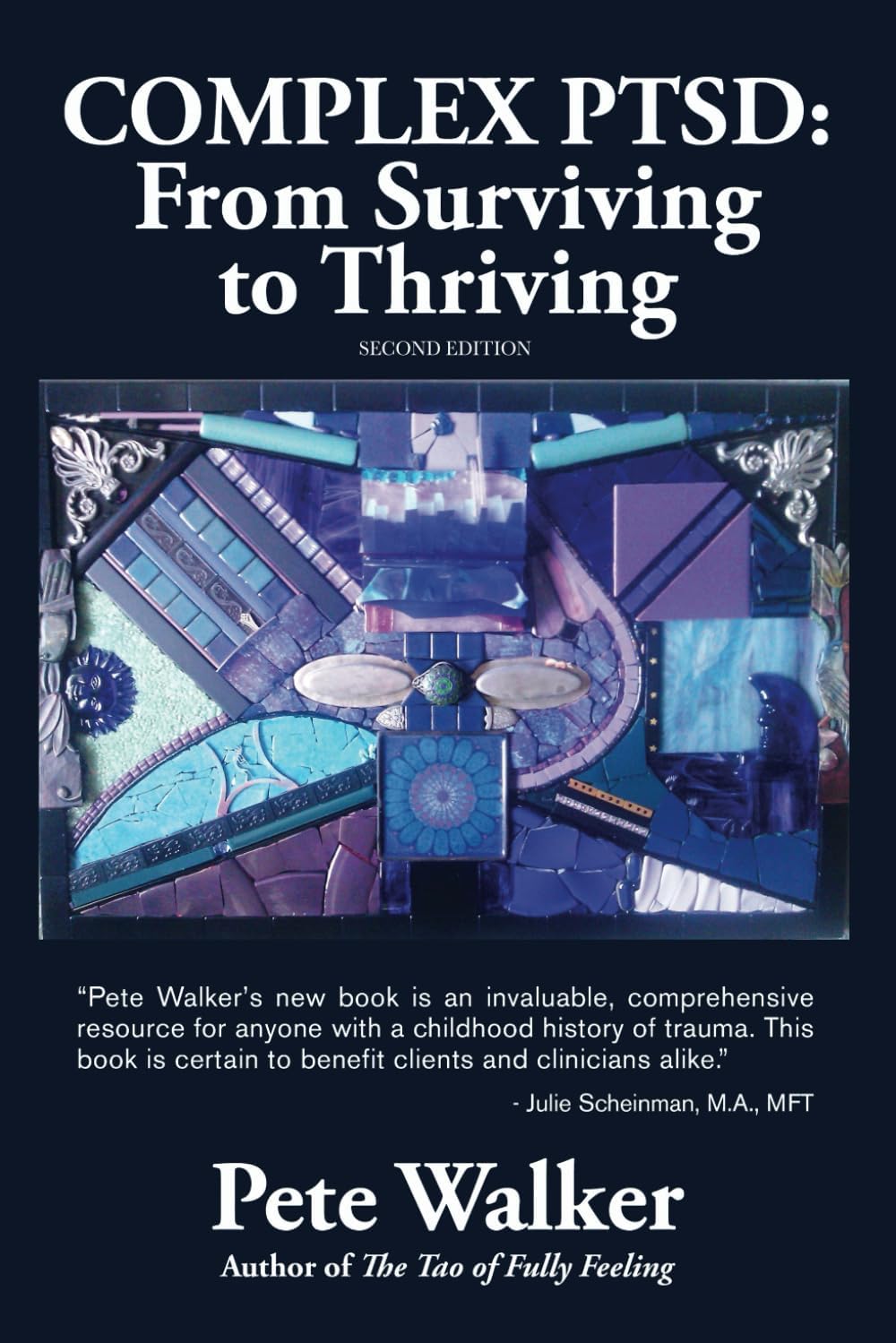
Complex PTSD: From Surviving to Thriving: A Guide and Map for Recovering from Childhood Trauma
Product ID: 4524843
🌱Growth-Focused Strategies
📖Comprehensive Guide
🧠Trauma-Informed Insights
Buy anything from 5,000+ international stores. One checkout price. No surprise fees. Join 2M+ shoppers on Desertcart.
Desertcart purchases this item on your behalf and handles shipping, customs, and support to Hungary.
🌟 Unlock Your Potential: Thrive Beyond Trauma!
This guide offers a comprehensive roadmap for individuals recovering from childhood trauma, providing expert insights, practical tools, and a supportive community to foster healing and personal growth.
| Best Sellers Rank | #1,472 in Books ( See Top 100 in Books ) #3 in Post-Traumatic Stress #101 in Self-Help (Books) |
| Customer Reviews | 4.8 out of 5 stars 11,603 Reviews |
A**3
CPTSD Healing START HERE!
Stop scrolling and listen up. Do not even purchase another CPTSD book until you have read this one. Trust me, I have spent THOUSANDS, yes, thousands, of dollars on trauma healing resources related to CPTSD and its hellish symptoms but this one is *BY FAR* the best. It's the kind of book where you highlight almost every single sentence on every single page. Here's why: 1.) Emergency Preparedness. Unfortunately, the way in which I learned about my CPTSD diagnosis was through a massive emotional flashback. In 2021 I decided to leave a marriage full of the same religious, psychological, emotional, and physical abuse that I was raised in. During this process, old trauma was triggered in a way I had never experienced before. For months I had been living in constant hyperarousal. I felt like a panicky and frantic child. The slightest sounds and movements would throw me into full blown panic attacks. I was insecure, anxious, impulsive, and afraid. I couldn't sleep or eat. I am only 5' and normally weigh 115 lbs and lost 20 lbs in 2 months. I was irritable, couldn't concentrate on my job, and felt constantly on guard. None of this was good considering I own my own six figure business and am a mom to three little kids. I kept digging and researching and everything I found was kind of similar but didn't really describe whatever it was I was experiencing. I had even bought another famous book on CPTSD looking for answers and it held none. But, 6 months later, I found this book. Pete Walker begins the book by saying something along the lines of, "if you are experiencing such-and-such symptoms, skip to page _____," so I did. My mind was blown, tears were falling down my face because I finally had a name to what it was I had been experiencing for 6 entire months now! It was an emotional flashback. Emotional flashback's are interesting because they do not have the visual element that is present in PTSD flashbacks and they can last for a long time. Mine ended up lasting 6 months and the only reason it stopped was because of this book. Sadly, until I read Pete's book, I had no idea what was happening. I just kept telling my friends who were helping me, "this isn't me. This isn't me. Something is wrong." I knew I wasn't myself, I just didn't know why. Now I'm here 8 months later trying to play catch up on all the areas of my life that suffered while I was in my emotional flashback. I wish I had found this book sooner. There is so much power in being able to name what you are experiencing and this book helped me do that. 2.) Path to healing. When you first find out you have CPTSD its overwhelming to know where to begin your healing journey. The first book about CPTSD that I bought was a workbook, it was okay, but it was NOTHING compared to this book. Had I found this book sooner, I wouldn't have even bought the other one. Other famous CPTSD authors lay out the the different options for CPTSD healing (CBT, DBT, EMDR, Somatic, Internal Family Systems, Inner Child work, etc.), but Pete takes it a step further and tells you exactly where to start. Which is a massive relief because the last thing you want to do when your CPTSD has been activated is spend hours attempting to research opinions from people who don't even know what it is you're going through. The best part is, if you're distrustful or curious like me, Pete even explains why he puts certain steps before others. . 3.) Lists. No one has time to read an entire chapter when their (or someone they love's) nervous system has been thrown into hypo- or hyper-arousal and they need to figure out what triggered them and why. Which is why Pete's easy to remember and easy to find checklists are literal lifesavers. 4.) Pete Walker knows his stuff because he is a survivor himself. As a child I was told that I was a punishment from God on my mother. This statement was only the beginning of a deep seeded core belief I had that I was innately, permanently broken. Pete's book and the memories and experiences he describes didn't feel triggering to me but healing. It felt like for the first time in my life I could acknowledge that I was normal. I wasn't broken. Nothing was wrong with me. This book is validating and enlightening. A true salve for the traumatized soul. There are a million other reasons as to why this book is the best of the best, but, I digress. Just trust me and the other 6,000 people leaving reviews here and BUY THIS BOOK NOW!
L**Y
I recommend this book - very helpful!
What I liked: 1) This is the best book I've read in a very long time. Despite some inaccuracies, it unmasks and reveals the horrifying truth of severe and widespread childhood abuse in so-called modern Western culture. Too bad evolution doesn't require humans prove that they will be good enough parents before they're able to have children. 2) Pete Walker shows that finally, someone understands. Somebody gets it, and can write about it in a way which makes it possible for other people to get it. It is a tremendous relief to read this book. It provides validation for the suffering of the silent children inside those of us who were abandoned, abused, and neglected our entire childhoods by all the adults around us. No, we are not "too this, too that, and too much the other thing." We are exactly the right quantities of various traits that we needed to be, in order to survive. I've lived a very long time with the trauma inflicted on my undeveloped, defenseless nervous system. I'm still wired as though I'm trapped in the horrifying war zone of my childhood. How do I rewire my nervous system? How do I go from surviving to thriving? This book promises to provide a map and guide to help me recover. I hope by the time I finish reading it, I will understand what the map says and know how to use it as a guide to where I'm trying to go. 3) Pete Walker not only understands cptsd, but he also has deep compassion for those who suffer with cptsd. 4) Walker has a lot of good recommendations and suggestions. My complaint with some of them is the missing details of *how* to follow through with them. Part of this may be that I've had few or no models to demonstrate exactly how to go through healthy grieving and healthy anger. Part of this may be because I haven't read the whole book yet. I've used many cognitive tools over many years to perform the thought deconstruction and replacement healing process. I need concrete, step-by-step instructions for the emotional part of the healing process. What I didn't like: 1) The book has too many links to itself within the book. (See chapter XXX for YYY) This became distracting after a while. 2) Repetitive and wordy 3) Author sometimes gets things wrong, but the wrong parts are buried in a lot of really right parts. This makes it harder to recognize when the author has gone overboard, gotten too enthusiastic with his own theories and conclusions. Not everything rings true, and when strong language is used to describe something which doesn't ring true, I find myself re-reading the section and adding notes. Each person who has cptsd has a different flavor of it, so some of his descriptions and assertions are not accurate. 4) I can't buy the audio version of the book without subscribing to a "free trial" of audible. ___ For people who weren't abandoned, abused, and neglected, this book will probably seem like a gross exaggeration, a lot of whining, and undeserving vilifying of parents. For those who read this book and came away with that impression, I have two pieces of advice: 1. Count your blessings that you were raised by parents who nurtured you, cared about your well-being, and consistently showed you they cared without ripping the rug out from under your feet to punish you on random occasions at their whim. Your parents let you know you mattered, and they actually played an active role in your growing up to become a healthy, mature adult. 2. Try to have understanding and compassion for people who had "not good enough" parenting. We really do exist. Believe that it happened, happens, and will continue to happen. Just because you can't see it doesn't mean it isn't real. Be aware that it may have happened to the person sitting next to you.
L**I
A detailed guidebook on CPTSD that survivors can surely relate to
I am a reader that has been diagnosed with C-PTSD. What attracted me to this book is not only the authors professional knowledge on the subject but also the fact that they themselves are a survivor. They describe the situations, triggers and torment that those with C-PTSD have had to endure throughout their lives using a carefully worded yet accurate description of difficult challenges that are most common for those suffering, what those challenges could look like during childhood and how it transforms and shapes the survivors in adulthood. The author maintains a sincerity throughout the book and does not try to promise that one will heal tomorrow or next week using their techniques. They use an honest and open tone and let the reader know what they can expect moving forward, and set a realistic expectation for the reader letting them know this is a long term journey where patience and self compassion is highly encouraged. This is my personal experience: this book definitely made me break down crying several times. I felt for the first time in my life that I was heard and understood. There’s a a lot of areas where they explain different healing practices and stops and it’s a ton of information that I feel is covered. While battling my own CPTSD and trying to continue down my journey to recovery, this was the one book out of many that actually stuck and helped me to make the first step after months of being stagnant and alienating myself. It was recommended to me by someone who also suffers from C-PTSD who urged me into reading it and now that I have, I absolutely recommend it to anyone facing this challenge in their life as well, who may not know where to start or where they can find more information and resources regarding their diagnosis. This was an amazingly helpful source on the subject overall.
L**O
Eye opening and incredibly validating
This book truly made a difference for me. It helped me better understand my upbringing and gave me clarity on some of the struggles I’ve carried from childhood. The way it explains complex emotions and patterns is so clear, validating, and insightful. I found myself recognizing pieces of my own story throughout, which made me feel less alone and more understood. It also offers helpful perspectives on how to process and work through those experiences, not just identify them. This was a powerful and meaningful read for me, and I would highly recommend it to anyone on a healing journey.
L**R
The book is gold, despite poor editing
Pete Walker's book has pros and cons, and I'll briefly summarise my own point of view on each. However, the insight and understanding of the author (gained through personal experience) and his practically applicable advice for the journey to recovery far outweigh any complaints I may have. Consequently - a full 5 stars!!! CONS: My first peeve is that the structure of the book's layout needs a lot of work. It should be possible, from a brief glance at the table of contents, to gain insight into the author's approach to the topic and his/her thought processes. In other words, the table of contents should give me a good framework in which to place the valuable information I learn. But that isn't the case. Subheadings are long or full of unrecognizable words that lack meaning to the layperson. My second peeve is that the book lacks an index. And, since the table of contents isn't particularly illuminating, the lack of an index would make it very difficult to locate a particular point in the book again. My third peeve is that, in the body of the book, the author unnecessarily uses words and phrases that are inaccessible to the layperson. I don't mind the use of terminology that accurately describes a particular concept. But, in a textbook to be used for healing, I question the unnecessary use of flowery language or big words. For example, and I quote: "The survivor, who is seeking a healthy relationship with the emotional being, will strive to accept the existential fact that the human feeling nature is often contradictory and frequently vacillates between opposite polarities of feeling experiences." In essence, I think Mr Walker was trying to say that it's not realistic to expect that you will always feel positive and upbeat, and that it's normal for humans to feel the full spectrum of human emotions, including negative feelings. So, why not simply say so? PROS: However, having dealt with the cons, let's get to the good stuff. To compensate for the aforementioned shortcomings of the book, from the outset, I summarized the book on computer, as I worked through it. And, in my view, the content is really pure gold! For a person suffering from complex trauma, if you really analyse the book's contents, you'll benefit as follows: * You'll feel that Mr Walker "gets you" and understands the problems you've experienced throughout your life. * You'll understand why interpersonal relationships have always been difficult for you, and why you feel different to other people, and, often, isolated and empty inside. * You'll realize that many of the physical symptoms from which you suffer can probably be attributed to complex trauma, and why that is the case. * You'll learn about the coping mechanisms you've automatically used in response to deep emotional pain, namely the 4 Fs - fight, flight, freeze and/or fawn. * You'll have an extensive list of the effects of complex trauma on the child, leading to problems throughout his/her life. * You'll be equipped with practical info on how to go about the healing process, using a multi-pronged approach. There are recommendations for self-help (invaluable!) as well as advice on obtaining help from others. IMPORTANT: This book is not about self-pity or pandering to the self. It's about setting the record straight, getting closure (in your own mind and heart, since it's unlikely that the perpetrators would be willing to do what it takes to give you closure), and repairing the deep damage done to a child (or adult) by people s/he should have been able to trust. The book would be valuable to anyone who suffers from the effects of complex trauma, whether the cause was sexual abuse, emotional abuse, verbal abuse or physical abuse. It's also clear that recovery is a process, improvement may be gradual and involve setbacks, and there is thus a need to be patient. But the results are worth striving for!
P**Y
Good read
The info is great. Had to get past the grammatical, spelling and editing errors. I think it was self-published, so I tried to give him a pass. Otherwise a great book with good insight.
B**W
This is the book you want - not the other one with the same title
This book was foundational in my understanding and acceptance of my CPTST diagnosis. I bought it years before I actually had the capacity to read it. I didn’t believe my diagnosis, I couldn’t grasp it, it didn’t make sense. After a first session of therapeutic ketamine therapy, suddenly it made sense and I went home to read the book cover to cover. My life has changed immensely since that time. This is literally the only book you need on the topic of CPTSD. If you don’t have the time or finances for any other resources, invest in this one. I hope you have the same experience I did, which is to say I felt seen for the first time in my life. It was extra extraordinary, and extraordinarily helpful. Please be aware that an unscrupulous author has recently (as of August 2025) written a book with exactly the same title on the topic of CPTSD. That is not the book you want. This is the only one you need.
C**R
Best Self-Help Book for COTSD
Best book ever! Got me 100% sober, gave me rational ideas for coping : now working out with a trainer 3xs a week, tried a massage, might adopt a dog in the future, etc. I’m not even done reading the book and my life has changed so much already. I’m dramatically less afraid and am not living in the fear. I got on here to buy the workbook, but thought I’d leave a review. My therapist recommended this book specifically.
B**.
Buy with caution
Very low quality publishing. Returned.
V**N
Buena compra
Llego en buena forma al lugar de entrega, fue un regalo de navidad hacia un familiar y quedó encantado, lo recomiendo👏
D**I
The best book on CPTSD I have ever read!
This is the best book on childhood trauma I have ever read. For the first time in my life, I understand what is going on with me and why. This has brought me an immense sense of relief and self compassion. I now have the courage to see my past with clarity, understanding and wisdom. I don't feel broken or strange any more. I especially appreciated the author's authenticity and level of disclosure, as well as his kind and gentle approach. The book is full of practical tools to guide anyone interested to go beyond their current limitations and achieve a new level of freedom and growth. I highly recommend it!
A**D
Narcissistic(parents or any other than parents) cause cPTSD.
I never thought and understand whats wrong with me, even successful in many fields of life. Something was always missing, always go back to my lousy bad habits. Always go back to my abusive friends and family members but always defeated. Now i know, on my way to fight back this time with knowledge of self.
P**N
Lebensrettend
Jahrzehnte bin ich rumgelaufen, ohne zu verstehen, was eigentlich mit mir los ist; Ratsuche bei "Profis" hat alles nur noch schlimmer gemacht, bis ich überzeugt war, ein hoffnungsloser Fall zu sein. Dann las ich dieses Buch: noch nie im Leben habe ich mich so verstanden gefühlt! Verständlich und psychologisch fundiert erklärt Pete Walker das Problem und gibt praktischen, wirklich nützlichen und gut anwendbaren Rat, wie man nicht nur gerade so überleben, sondern wirklich ins Leben finden und sich darin entwickeln kann: mit immer weniger Angst, Scham und Depression. Dies ist ohne Übertreibung ein lebensrettendes Buch.
Trustpilot
3 weeks ago
4 days ago