Buy anything from 5,000+ international stores. One checkout price. No surprise fees. Join 2M+ shoppers on Desertcart.
Desertcart purchases this item on your behalf and handles shipping, customs, and support to Hungary.
๐ Unlock the secrets of capital and power before the world catches on!
Capital in the Twenty-First Century by Thomas Piketty is a landmark economic analysis that uses extensive historical data and fundamental equations to reveal how wealth concentration grows over time, driving inequality. It argues for a progressive global tax on capital to restore economic balance, making it a must-read for professionals seeking to understand and influence the future of global economic policy.


| Best Sellers Rank | #17,155 in Books ( See Top 100 in Books ) #12 in International Economics (Books) #14 in Theory of Economics #27 in Economic History (Books) |
| Customer Reviews | 4.5 out of 5 stars 5,741 Reviews |
F**H
Piketty's book intoduces a large volume of data about global income and wealth for a more rational discussion of inequality
In his introduction to this book, Piketty states, โWhen the rate of return on capital exceeds the rate of growth of output and income, as it did in the nineteenth century and seems quite likely to do again in the twenty-first, capitalism automatically generates arbitrary and unsustainable inequalities that radically undermine the meritocratic values on which democratic societies are based.โ He further states that โIntellectual and political debate about the distribution of wealth has long been based on an abundance of prejudice and a paucity of fact.โ He then addresses this paucity with the presentation and analysis of the results the project he led to acquire an enormous volume of historical data about global income and wealth. In the introduction, he briefly reviews the contributions but also the errors of earlier debate without data. These included Malthusโs concern with overpopulation and the need to end all welfare, Ricardoโs principle of scarcity with population and production growing as land becomes increasingly scarce, and Marxโs principle of infinite accumulation with the industrial revolution leading to no limit on the accumulation of capital (which did not consider coming social democracy, technological progress, and how to organize society without private capital). The Kuznets Curve of 1955 introduced data from US tax returns and Kuznetsโs own estimates of national income to conclude that inequality increased in the early phase but declined in the later phases of industrialization. Unfortunately, this curve greatly understated the roles of the World Wars and violent economic and political shocks that led to the reduction in inequality between 1914 and 1945 and failed to explain the rising inequality after 1970. Piketty seeks to contribute โto the debate about the best way to organize societyโฆto achieve a just social orderโฆ.achieved effectively under rule of lawโฆsubject to democratic debate.โ He states he has โno interest in denouncing inequality or capitalism per seโฆas long as they are justified.โ He worked briefly in the US and found the work of US economists unconvincing. โThere had been no significant effort to collect historical data on the dynamics of inequality since Kuznets, yet the profession continued to churn out purely theoretical results without even knowing (the) facts.โ He found that โthe discipline of economics has yet to get over its childish passion for mathematics and the purely theoretical and often highly ideological speculation.โ Subsequently, he returned to France and set out to collect the missing data. He gathered data in two main categories: 1) inequality in distribution of income and 2) inequality in the distribution of wealth and the relation of wealth to income. For income, he built the World Top Incomes Database (WTID), which is based on the joint work of some thirty researchers around the world. This data series begins in each country when an income tax was established (usually 1910-1920 but as early as the 1880s in Japan and Germany). For wealth his sources included estate tax returns (usually dating back to the 1920s, but in a few cases as far back as the French Revolution), the relative contributions of inherited wealth and savings, and measures of the total stock of national wealth. In collecting as complete and consistent a set of historical sources as possible, he had two advantages over previous authorsโa longer historical perspective (now including data from the 2000s) and advances in computer technology. Piketty reports two major conclusions from his study. โThe first is that one should be wary of any economic determinism in regard to inequalities of wealth and income (that they emerge according to immutable natural laws). The history of the distribution of wealth has always been deeply political and it cannot be reduced to purely economic mechanisms. In particular, the reduction of inequalityโฆbetween 1910 and 1950 was above all a consequence of war and of policies adopted to cope with the shocks of war.โ โThe resurgence of inequality after 1980 is due largely to political shiftsโฆespecially in regard to taxation and finance. The history of inequality is shaped by the wayโฆactors view what is justโฆas well as the relative power of those actors.โ The second conclusion is โthat the dynamics of wealth distribution reveal powerful mechanisms pushing alternately toward convergence (equality) and divergence (inequality)โฆ.There is no natural, spontaneous process to prevent destabilizing ineqalitarian forces from prevailing permanently.โ โOver a long period of time, the main force in favor of greater equality (convergence) has been the diffusion of knowledge and skills.โ Other proposed forces for greater equality, such as advanced technology creating a need for greater skills or class warfare giving way to less divisive generational warfare as the population ages, appear to be largely illusory. โNo matter how potent a force the diffusion of knowledge and skills may be, it can nevertheless be thwarted and overwhelmed by powerful forces pushingโฆtoward greater inequality (divergence).โ With respect to income, the spectacular increase in inequality from labor income, particularly in the US and UK, largely reflects the recent marked separation of the top managers of large firms from the rest of the population, not because of increased productivity, but because they can set their own remuneration. This separation is amplified by marginal tax rates that actually decrease for the highest incomes. Capital income from large fortunes also contributes to income inequality but may be understated due to hidden off-shore accounts and by producing only the relatively small portion of income needed for expenses while the rest remains within the fortune. (Fig. I.1 shows income inequality in the US from 1910 to 2010.) With respect to wealth, inequality (divergence) is increased when the rate of return on capital significantly exceeds the growth rate of the economy (r > g) as it did until the nineteenth century and is likely to in the twenty-first century. โUnder such conditions it is inevitable that inherited wealth will dominate wealth amassed from a lifetimeโs labor by a wide marginโ and lead to extreme inequality. This increasing inequality of wealth is greatly amplified by structural factors leading to higher rates of increase for the largest fortunes that are no longer related to whatever entrepreneurial activities were at the onset of their origin. (Fig. I.2 shows wealth inequality in Europe from 1870 to 2010.) This analysis also shows a major shift in the main components of wealth from land, slaves (in the US), and colonies (in Europe) to domestic capital and housing. Historically, the rate of return on capital was 4.5-5% from antiquity to 1913, fell to 1.5% by 1950, and is rising again to 4% or more by 2012 and beyond. During the same period, the global rate of growth was close to zero before the industrial revolution, rose to 1.5% by 1913 and to 3.5% in the mid to late twentieth century (due to catch-up after World War II and in the developing world), and is now falling and projected to be 1-1.5% in the twenty-first century. Thus the unusual fall of the return on capital (r) below growth (g) in the mid twentieth century was associated with a temporary reduction in the rate of increasing inequality. (Fig 10.10 shows a comparison of the return on capital [r] to growth [g] from antiquity to 2100.) This review barely scratches the surface of the core contribution of this book, which is the enormous volume of data and analysis it provides. The numerical information is presented in a very well developed series of 97 illustrations and 18 tables. This information is used as support for extensive analysis and discussion of the many aspects of historical, present, and likely future inequality that often contradict positions related to ideology and simplistic models. An excellent 22 page overview of โA Social State for the Twenty-First Centuryโ is provided at the beginning of the fourth and final part of the book. This is followed by โRethinking the Progressive Income Tax,โ โThe Question of the Public Debt,โ the authorโs preference for โA Global Tax on Capital,โ and finally, the conclusion. The conclusion reiterates that the principal destabilizing force leading to ever-increasing inequality is a return on capital (r) significantly higher than the rate of growth of income and output (g) for long periods of time. Hence wealth accumulated in the past grows more rapidly than output and wages, and the entrepreneur inevitably tends to become a rentier no longer of use in promoting growth. A progressive annual tax on capital would be the right solution to this problem, although it would require a high level of international cooperation. Piketty objects to the expression โeconomic scienceโ which implies little to do with the logic of politics or culture in conclusions about inequality. He prefers the expression โpolitical economyโ which considers economics as a sub discipline of the social sciences, alongside history, sociology, anthropology, and political science. He insists that economic and political changes are inextricably entwined and must be studied together. This review is supplemented by a relatively random selection of multiple comments and assertions from the book: โThe nature of capital has changed: it once was mainly land but has become primarily housing plus industrial and financial assets.โ โCapitalโฆis always risk-oriented and entrepreneurial, at least at its inception; yet it always tends to transform itself into rents as it accumulatesโฆ.โ With respect to global inequality, the industrial revolution led to growth of Europe and Americaโs share of global output to two to three times their share of population. This share is now rapidly decreasing due to higher growth in developing economies in the โcatch-upโ phase than in mature economies. Europe and Americaโs share of global production of goods and services rose from about 30-35% in 1700 to 70-80% from 1900 to 1980, fell to 50% by 2010, and may go as low as 20-30% later in the twenty-first century. European and American national inequality rose to record heights in 1910, decreased markedly by the 1940s due to the world wars and Great Depression, then began a rapid return to high levels after the 1970s, particularly in the US. The share of national income for the top 10% in Europe was over 45% in 1910, under 25% in 1970, and about 30% in 2010. In the US it was over 40% in 1910, under 30% in 1970, and nearly 50% in 2010. โNumerous studies mention a significant increase in the share of national income in the rich countries going to profits and capital after 1970, along with the concomitant decrease in the share going to wages and labor.โ In the past several decades, the share of national income for the top 0.1% increased from 2 to 10% in the US, from 1.5 to 2.5% in France and Japan, and from 1 to 2% in Sweden. โIt is important to note the considerable transfer of US national incomeโon the order of 15 pointsโfrom the poorest 90% to the richest 10% since 1980โโ 5 to 7 times greater than the 2 to 3 points in Europe and Japan. โThe vast majority (60 to 70%)โฆof the top 0.1% of the income hierarchy in 2000-2010 consists of top managers. By comparison, athletes, actors, and artists of all kinds make up less than 5% of this group.โ โAt the very highest levels salaries are set by the executives themselves or by corporate compensation committees whose members usually earn comparable salariesโฆ.โ โIt is when sales and profits increase for external reasons that executive pay rises most rapidly. This is particularly clear in the case of US corporationsโฆpay for luck.โ Global inequality of wealth in the early 2010s is comparable to that of Europe in 1900-1919. The top 0.1% own nearly 20%, the top 1% about 50%, the top 10% between 80 and 90%, and the bottom half less than 5%. The share of national wealth ownership in Europe for the top 10% and top 1% was 90% and over 50% in 1910, 60% and 20% in 1970, and about 63% and 24% in 2010. During this time, the share for the 50th to the 90th percentile increased from 5% to 40%, creating a middle class, but the share for the bottom 50% remained at 5%. In the US, shares for the top 10% and top 1% were about 80% and 45% in 1910, 64% and 30% in 1970, and about 70% and 34% in 2010โwith a much more rapid increase after 1970 than in Europe, reaching 70% and 34% versus 63% and 24% by 2010 (while the bottom half claim just 2%). Inherited wealth is estimated to account for 60-70% of the largest fortunes worldwide. This figure is lower than the 80-90% reached during the belle Epoque, but trending strongly toward a return to that level. Forbes magazine divides billionaires into three groupsโpure heirs, heirs who subsequently grow their wealth, and pure entrepreneurs, with each of these groups representing about a third of the total. Due to increased life expectancy, the average age of heirs at the age of inheritance has increased from thirty in the nineteenth century to fifty in the twenty-first century, although with larger inheritances. Today, transmission of capital by gift is nearly as important as transmission by inheritance. This change counters increased life expectancy and accounts for almost half of the present inheritance flows. โNo matter how justified inequalities of wealth may be initially, fortunes can grow and perpetuate themselves beyond all reasonable limits and beyond any possible rational justification in terms of social utility.โ Large fortunes experience increasing rates of growth related to size alone independent of their originsโ 10% from $15-30 billion, about 9% from $1-15 billion, about 8% from$500 million to $1 billion, about 7% from $100-500 million, and about 6% below $100 million for university endowments. From 1990 to 2010, the fortune of Bill Gates, the Microsoft genius, grew from $4 billion to $50 billion, while that of Liliane Bettencourt, a cosmetics heiress who never worked a day in her life, grew at a similar rate from $2 billion to $25 billion. In 2013, sovereign wealth funds were worth $5.3 trillion ($3.2 trillion from petroleum exporting states and 2.1 trillion from nonpetroleum states like China, Hong Kong, and Singapore), similar to the total of $5.4 trillion for Forbes billionaires. Together, these sources account for 3% of global wealth. Large amounts of unreported financial assets are held in tax havensโapproximately 10% according to the negative global balance of payments (more money leaves countries than enters them). In the US, parentsโ income has become an almost perfect predictor of university accessโaverage income of parents of Harvard students is currently about $450,000. โBroadly speaking, the US and British policies of economic liberalization (after 1980)โฆneither increased growth nor decreased it.โ The US economy was much more innovative in 1950-1970 than in 1990-2010โฆ.Productivity growth was nearly twice as high in the former period as in the latter. In most countries taxes have (or will soon) become regressive at the top of the income hierarchy.โ The optimal tax rate in the developed countries is probably above 80%. One of the most important reforms (is) to establish a unified retirement scheme based on individual accounts with equal rights for everyone, no matter how complex oneโs career path. Debt often becomes a backhanded form of redistribution of wealth from the poor to the rich (who as a general rule ought to be paying taxes rather than lending). Inflation is at best a very imperfect substitute for a progressive tax on capital. It is hard to control, and much of the desired effect disappears once it becomes embedded in expectations. Defining the meaning of inequality and justifying the position of the winners is a matter of vital importance, and one can expect to see all sorts of misrepresentations of the facts in service of the cause. No hypocrisy is too great when economic and financial elites are obliged to defend their interestsโand that includes economists, who currently occupy an enviable place the US income hierarchy. โModern meritocratic society, especially in the United States, is much harder on the losers, because it seeks to justify domination on the grounds of justice, virtue, and merit, to say nothing of the insufficient productivity of those at the bottom.โ The history of the progressive tax over the course of the twentieth century suggests that the risk of a drift toward oligarchy is real and gives little reason for optimism about where the United States is headed.
A**N
indepth view of the distribution of profits to labour and capital through time with focus on France and US
First off I'd like to state that the data that the author has compiled is very impressive and provides the reader with a new way to look at both the stock and flow of wealth of society and its distribution. It is unique and comprehensive and for this aspect of the book it is landmark and hopefully will improve and refine our thinking about capital and inequality going forward. The conclusions of the author i think are very suspect and not nearly as insightful as the analysis, but they are where the author's politics come out and are a relatively smaller portion of the book. The need to move beyond looking at crude measures of inequality like the Gini coefficient and distribution of profits between labour and capital was much needed and the author was able to, through meticulous analysis look at the entire distribution of wealth through society by looking at the bottom 50%, top 10% top 1% and top .1% when possible both from a labour and capital perspective. The dataset is not global, though the author was able to partially reconstruct a broad range of countries, but includes the US, France, UK, Germany aspects of Japan and the Scandinavian countries with a focus on the US and France. The book is split into 4 part. The first three parts are both an introduction to the economics as well the accompanying economic analysis of the accompanying datasets. The first part - income and capital start out by defining the basics of what the author will discuss throughout the book namely income, capital and how the output of society is distributed and how that has changed over time. National accounting is discussed, the capital stock and its properties are introduced as well as some key identities that will be used throughout regarding the share of income going to capital which is determined by the return of capital and the size of the capital stock relative to annual output. The author also discusses growth over time documenting global growth rates over time and introduces to the unfamiliar reader the consequences of how small changes in growth compounded can lead to large cumulative changes. The author discusses demographic trends globally through time and some of the dynamics of them (which are largely unpredictable). The author also discusses how growth and demographics can influence the capital intensity of the economy. The author also discusses how the sectors of the economy and output have changed over time with agriculture and its share of both labour and capital much lower but the service sector replacing it and how manufacturing intensity and capital replaced agricultural through the industrial revolution as well. He also discusses modern concerns about growth by discussing Robert Gordon's recent paper on the end of growth and whether techonological innovation has run much of its course, he is relatively optimistic but nonetheless foresees growth following a bell curve for which we are at a peak which will decline but to much higher levels than centuries in the past. The author also discusses inflation and monetary policy and how it has changed over time. The second part of the book is called the dynamiocs of the capital/income ratio. It is about precisely that with the author starting out by using novels to introduce the reader to society in the past. In particular the author refers repeatedly to Balzac and at times to Jane Austen to remind the reader what society was like in the 19th century. The core of the data set starts to become apparant in the second section with the author documenting the capital/income ratio over time in Britain peaking at 7x in 1700 falling to 2x post the first world war. The author includes the same information for france as well. The author discusses how foreign capital was important in the 19th and early 20th centuries during the colonial period and discusses the role of government debt and how it does not change national wealth just the distribution of wealth within the population. The author includes the value of national wealth through time by showing both public assets and public debt over time. The author discusses economic theory and how Ricardian equivalence is strictly only true of economies have a representative agent, which they do not hence the principal should be considered suspect. The author discusses the capital stock through the world wars and how it changed dramatically during the 20th century, though the capital stock has had a recent resurgence as economic policy has drifted back toward free market capitalism. The author then moves to look at the New World and in particular the US and repeats the analysis there as well (though the author starts with Germany as well). In the US the capital stock was more stable (it wasnt a colonial power which was a large part of the capital stock of the UK and to a lesse extent France). Canada is also analyzed as another data point. The author also discusses regional differences by including the differences between the South and the North and the repurcussions of Slavery to the capital/income ratio. The south had a much higher capital/income ratio as much of its human capital was effectively consdered part of the capital stock. The author shows the distribution of capital over time in the US from 1770 to today as well as spot distribution of wealth data points for UK and France. The author starts to discuss the dynamics of the capital/income ratio through his second law of capitalism, namely the ratio is equal to savings/growth. This is the result of the differentiam equation that leads to steady state rather than an identity which holds true at any given point of time. The author then moves into discussing the capital stock over the last 40 years and how its been on a resurgent trend that has been catalyzed by the s/g relationship as well as privatizations. The author discusses the components of savings, the resurgence of the value of capital and where the capital/income ratio is going. The author moves on to the Capital/labor split and its evolution through the 21st century. In particular with the resurgence of growth in the capital stock the trend towards growing labor share in the 20th century has reversed itself and we are heading towards the 19th century. There are regional differences with countries like the US being counterexamples with the rise of the supermanager. The third part of the book is The structure of inequality. This is where the value of the books data set gets particularly apparant. The author discusses how the labor share of income has changed over time for the various portions of the population, in particular for the top 10 and top 1%. He discusses how the ownership of the capital stock has become less concentrated and there has been an emerging middle class of owners of capital. The author discusses how different countries have had different evolutions between there ownerships of capital and how the labour share of income is divided with the US having a more distributed capital base but a much more concentrated labour share distribution. The author discusses the "merit" of the distribution of labor income and how there is a conflict of interest now for supermanagers and the growth in the supermanager has coincided with the decline in the progressivity of the income tax. The author discusses the flow of income through inheritance and analyses the dynamics of this flow based on the ownership of the capital stock by age group and mortality rates. This form of analysis is definitely an important addition and goes against conventional wisdom of aging populations spending their savings on lifestyle maintenance. I would be very interested to know how this process is evolving in Japan and Italy for example. The author also discusses inequality at the global level and how there are increasing returns to scale in capital (this is definitely not a fact and much evidence is to the contrary but an empirical observation made by the author on a few examples). The author also looks at the growing share of wealth of the top centile and billionaires in particular. He discusses how Bill Gates and the Bettencourt family have had the same return on their capital over time despite one being self made and the other inherited reinforcing his thesis that growing capital has its own momentum based on the fact that if the return on capital is greather than the growth rate capital continues to accumulate to those who have it- a central point throughout the book. The 4th part is Regulating Capital in the 21st century. It is the authors partial solutions to the growing inequality that we see that is due to inherint dynamics and unrelated to the merits of an individuals labour contribution or the foresight of those investing in the future capital stock. It discusses ideas like rethinking progressive tax, increasing the top income bracket to 80% to diffuse the rent seeking behaviour of the super manager. It includes ideas on taxing capital, in particular a graduating tax on capital to both make sure people are using the capital stock efficiently as well as counteracting the benefits of the economies of scale the author has been pointing out. Lastly the author focuses on the pressing problem of public debt with a focus on Europe. The data the author has compiled has allowed him to look at the distribution of wealth in much of the Western world through a more refined lense. It is full of important insight and a true developement that takes us to a level with much more granular detail than what typically is focused on. For that reason the book is a must read and is definitely a 5* book. The policy recommendations i put far less value on. The author is focused on the distribution of wealth and the solutions he proposes are designed to get those more in line with politically what he believes is a more fair distribution, thus they are focused on optimizing a distributional outcome. Recommending confiscating capital to pay down national debt is an example of a solution to a problem without considering the consequences of the action on the future dynamics of the economic system. Though the solution might seem fair, it is also insane as funding the flow of capital stock would totally change. Discussing a policy that could have better dealt with preventing the ex ante buildup of national debt is better than discussing one that ex post unwinds it far more dramatically. In addition ideas like just taxing capital at higher rates depending on one's capital base is highly questionable. Imagine each year if an entrepreneur has to give up 5-10% of his equity of his company (as capital has migrated from land to financial capital this is precisely what will be required) then the world would be very different and I am a skeptic it would be a more utopian society. Generation transfer is far more dangerous than capital accumulation through a lifetime and the author's policy perscriptions are political and one gets a sense he is stepping outside his comfort zone of impacting wealth inequality and into impacting economic growth, which is another big factor in decreasing economic inequality. There are many things that are scary- in the UK the top 5 families own more than the bottom 20% with 2 of those 5 are ancestors of those who owned the fields which London was built on. Between the 2 facts above I worry far more about the fact that 2 are from ancient landowning families, a form of capital stock that does not depreciate than the former, which is worrisome, but a more granular analysis of the asset base and its properties would be required. Achieving better distribution of wealth is not about just taxing capital more (though that should be a part of it). We need better policies, this is a start in how to look at the problem more clearly. The solutions are food for thought, but at this stage only that- as the author states, economics is not a science it is a social science and democratic deliberation is necessary to help us decide what policies society believes in. This helps provide better tools to answer some of the questions we have to ask ourselves about why the asset base is owned as it is and how does that fit with our beliefs in how society should be organized considering all dimensions like individual merit, equality of opportunity, sanctity of contract for providing the right base incentives etc...
S**M
A solid, well-researched work destined to become a classic of our time.
I have been moved to review this book here partly to counter the embarrassingly ignorant, ideologically-motivated comments of many of the other reviewers on this page, who appear to be acting as trolls and astro-turfers, and to support the comments and recommendations made by the more thoughtful reviewers. First of all, contrary to the rants of those who wish to denounce any criticism of capitalism, Thomas Piketty is not a Marxist of any kind; a fact that ought to be obvious to anyone who has any background in Marx or who has read the author's own introduction. Piketty has no intrinsic issue with capitalism per se, nor even with inequality. In fact, personally, as someone who is more fundamentally opposed to both capitalism and inequality on principle, I regard Piketty's qualified acceptance of capitalism and inequality as constituting a theoretical weakness, in that his proposed remedies seem not only too modest but, lacking a system of democratic global governance, actually politically unfeasible. In terms of analysis however, Piketty's moderate social-liberalism actually imbues the work with an invaluable sense of objectivity that a similar work by a committed socialist would not be perceived to have. Quite simply, Piketty has no axe to grind and this work is the result of rigorous, thorough, methodologically-sound research based on a quite staggering wealth of data. This is, therefore, a very important work, certainly destined to be as referenced and quoted in the social sciences as John Rawls' "A Theory of Justice". The sheer scope of the work, its clear, methodical presentation and clearly explained methodology make this work very user-friendly and an absolute treasure as a reference work for social scientists. Capital in the 21st Century is an excellent book and deserves as wide an audience as possible. I have given it 4 stars because I am unsatisfied with Piketty's rather weak policy recommendations for the reasons I state above. Nonetheless, as a source of data and as a guide to interpreting capitalism in the 21st Century, this work is quite simply phenomenal. Arguably, this may well be the most important work on capitalism since Karl Polanyi's "The Great Transformation" (1944). My advice; don't hesitate- buy it, read it, discuss it. Anyone without a pig-headed flat-earther's insistence on believing in capitalist fairy-tales is bound to find serious food for thought here.
J**G
I'm an engineer, not an economist. Read this book for a better understanding of your world.
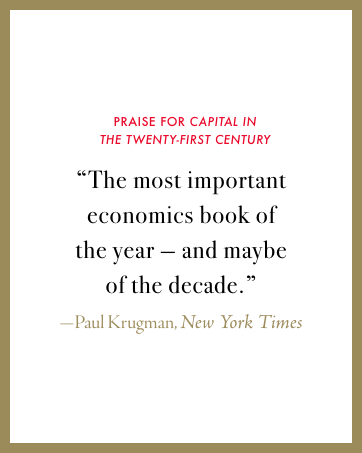
Thomas Piketty's book, "Capital in the Twenty First Century," has been resoundingly endorsed by Nobel Prize winning economist Paul Krugman. Since the reactionaries were freaking out, I couldn't resist reading it and finding out for myself what the hoopla was all about. The reason for the reactionary freak out is explained below. Anyone who has bothered to read this book must admit that the writer is rigorous in his analyses and my impression was the writer eschews prejudgment. Piketty provides exhaustive data throughout in a fascinating historical analysis of capital and the inevitable pitfalls of indecent inequality of wealth ("...the `first globalization of finance and trade (1870-1914) is in many ways similar to the `second globalization' which has been underway since the 1970's." and, "...capitalism automatically generates arbitrary and unsustainable inequalities that radically undermine the meritocratic values on which democratic societies are based.") There were reasons for the financial shocks and the world wars of the 20th century, and if we're not paying attention... Piketty notes that, "Economists are all too often preoccupied with petty mathematical problems of interest only to themselves." Nevertheless, the essential economic equations and trend analyses are sufficiently addressed and easily understandable by all. He notes that economics should be considered a branch of social science, i.e., "...politics is ubiquitous and...economic and political changes are inextricably intertwined and must be studies together." If nothing else, the reader is warned, "...all citizens should take a serious interest in money, its measurement, the facts surrounding it, and its history. Those who have a lot of it [money] never fail to defend their interests. Refusing to deal with numbers rarely serves the interests of the least well-off." So why are reactionaries freaking out over this book? Piketty concludes that national debt can only be reduced by: repudiation (bad), inflation (horrible), austerity (really horrible), or a progressive tax on capital (reasonable). Further, he recommends that the only reasonable way to address indecent wealth inequality is a progressive global tax on wealth, which in turn requires global transparency of accounts and an end to foreign tax havens; he goes on to say none of these measures will be easy, but does offer practical suggestions. Clearly, the plutocrats would panic over popularization of such a suggestion, and it only takes a word or two from them to spin up their PACs and puppet organizations (I won't name names) into blindly trashing these rational suggestions. Thus the one-star reviews from those who haven't read the book. Other specifics of note: * His rational explanation of what central banks do and why they are necessary is excellent and should be understood by all. * His discussion of past and recent European economic issues, the creation the Euro, and administration by the ECB and European Committee should be of great interest to most Americans. * The fact that income taxes were not invented by Woodrow Wilson and had been used successfully in Europe for many decades before that is probably news to most Americans. * The real reasons why the gold standard had to be abandoned and is no longer feasible should be better understood by many. * His explanation of what "rentiers" are (i.e. those with sufficient wealth to live off dividends, rents, and other financial instruments) is something that should be better understood by all. At some point, wealth takes on a life of it's own whenever r>g and this and what amounts to regressive taxation at the top of the pyramid, are the driving force behind income inequality. * His explanation of the recent phenomenon of "super managers" who demand salaries in the tens of millions (the ones that piss everyone off), and how it was a result of the conservative revolution of the 1980s' is something that should be understood by all. Though it's a tough slog for me, but I highly recommend this book be read be all. I recommend someone write a "Reader's Digest" version that could reference the original, since the average reader may struggle with it.
A**W
A Gold Mine
This is a tremendous book! It is a great start to understanding the current state of our global economy. The central argument being for the global taxation of wealth to restore a world that is becoming less egalitarian by each decade. Piketty uses two equations, known as "The Fundamental Laws of Capitalism," and a girth of historical data to arrive at his point. The equations are: a = r * B where r = rate of return; B = the capital/income ratio; a = the share of income from capital in the economy and B = s/g where B = the capital/income ratio; s = the savings rate; g = growth rate of the economy These two laws are inter-related. Equation 2, states that the lower the growth of the economy, the more power is exerted by inherited capital because via equation 1, it will generate a larger share of income in the economy. Growth in world output up until the 17th century was nonexistent. Therefore, throughout much of human history there were very rigid social class structures that prevented people from accumulating wealth over their life and in due process passing on a better life to their children. Piketty cites Jane Austen novels here as evidence that the central characters of her novel thought it more worthwhile to marry into wealth than to work for it, for no matter how hard one worked or in what sort of profession, it was impossible to generate the type of lifestyle the wealthy enjoyed. The entire dynamic of wealth changed during 19th century at the advent of the industrial revolution. Suddenly, growth in world output went up to 1.5%. Society was more dynamic. Social class was more fluid. However, the structural forces that breed inequality in society did not change, for the nature of capital did not change. According to the author, over the long run, the capital/income ratio will continue to increase because capital can be reinvested and over time will generate a higher return than income. On the eve of WWI, the value of capital/income in Europe and America was a hair under 7. This was the marking of a rare point in history. For the brief 30-year period of war and instability that followed, the value of capital did not increase faster than that of income. On the contrary, it shrank relative to income. It is as if an external shock restored a social equilibrium. The capital/income ratio reached a low point of a hair over 2 in the early 1950s. The baby boomers that followed were born into what might be considered the most equal society in the history of civilization. They were given a rare opportunity to truly live the โAmerican Dreamโ and (now me talking) believe that they are entitled to everything they earned. Unfortunately, their kids were not born into a similar opportunity. The capital/income ratio has steadily crept up since the 1950s and now stands at around 5.5 in Europe and 4.5 in the U.S. These statistics mask some of the already inegalitarian societies like Italy where the ratio is closer to 7. What is further the problem is that world output, which grew on average of 3% in the 20th century, is falling. The author does not believe that this trend will reverse because historically, about half of growth in world output is generated by the growth in population and the other half through actual progress in technology and productivity. With demographics set to shrink in the coming decades, it seems unlikely that we will be able to sustain the 3% growth in world output in the future. Thomas Pikettyโs solution is a global tax on capital. To purge society from systemic convergence toward inequality, you must eliminate the upper hand that capital affords to the beneficiaries of inherited wealth. I completely buy his argument here. The wealthy do have access to better wealth managers and investment vehicles that ordinary people like myself just do not. Ultimately however, what truly matters, and what is truly difficult to analyze, is whether society would be better off with such a tax. As the author states himself, half of the people in our country have zero savings. This relative proportion has been uniform throughout history. However, these same people today can live, materially speaking, much richer lives than the wealthy predecessors discussed in Jane Austen novels. The purchasing power parity has increased like seven-fold over the last few centuries, this all thanks to in great deal to the innovation and efficient allocation of resources over the past few years. Perhaps this picture would have been different with a global tax on capital. It would have been interesting to see what Pikettyโs thoughts would be on how this sort of tax would affect entrepreneurship, if the risk taker knew that as soon as they sold their business they would be met with a yearly tax on their wealth. I think the bigger question that is left unanswered in the book is who would ultimately receive the proceeds from such a tax and for what purpose would it be used? Would society be truly better off if the government could tax capital and spend more as opposed to the vast amount of institutional funds and PE shops which for the most part allocate capital on the behalf of the wealthy? Regardless of whether you agree with the politics of the book, you should read it, if not for the data alone. The author poses a serious question in this book and provides a well thought out solutions. I might not be completely convinced of his thesis just yet, but I am much more knowledgeable about the the nature of capital/income split. This was a great and sobering starting point. Cheers!
G**S
CAPITAL IN THE 21st CENTURY- THE BOOK IS GREAT BUT THE NEWS IS NOT GOOD!
It is somewhat astonishing that Thomas Piketty's CAPITAL in the 21st Century remains at the very top of the New York Times Best Seller List! Not intending to be condescending, this is not an easy read even for the most ardent observers of the national and world economy. The first 250 pages, filled with exhaustive research over a 250 year period, complete with charts and graphs, is a test of anyone's concentration. You may need to read many pages more than once! The good news is that once through this sophisticated and advanced course in economics, the reader will come to an understanding of the inexorable march of an economic matrix that appears to be leading to a dysfunctional environment for the capitalistic system as we have known in America for over 300 years. Ironically, there is currently a billboard on the south bound FDR Drive in New York City that reads," The French Aristocracy Didn't Hear It Coming Either! " images Piketty does not set out to be an alarmist but rather to lay out what he believes is the most definitive research ever completed on the subject of inequality and the distribution of wealth in America and Europe, dating back to the seventeenth century. Admittedly, Piketty qualifies some of the early collection of data as anecdotal but at the same time has sought out all-available recorded records to track the distribution of wealth over three centuries. What is most troubling in the Piketty thesis is his substantiation of a mathematical paradigm that left unchecked , places the concentration of wealth worldwide and particularly in the United States on an unstoppable course of disastrous inequality. Not an exciting prospect. Piketty: " If the growing concentration of income from labor that has been observed in the United States over the last few decades were to continue, the bottom 50% could earn just half as much in total compensation as the top 10% by 2030." In the United States, the most recent survey by the Federal Reserve, indicates that the top decile own 72 percent of America's wealth, of which the bottom half claim just 2% . These figures clearly delineate the plight of the dwindling middle class. If the top ten percent and the bottom 2 percent control 74 percent of all wealth in America, that leaves only 26% for everyone else! Fundamental to Piketty's thesis is that a predicted economic annual growth rate in America of 1.5 percent or less will force a greater concentration of wealth among the top decile because based upon a rate of return there will be no incentive to invest risk capital back into the economy. The top ten percent can comfortably continue to invest capital at 4-5% ( with some hedge funds at 10-30%) and in essence keep these capital resources off the table in the hands of the super wealthy, further shrinking the middle class and decimating the lower class. He also predicts that as future generations of the wealthy mature, inherited wealth will be exclusively bequeathed, removing it from the general capitalistic economy, in the same manner as did the old European aristocracies. Thus, a new American Aristocracy fueled by inherited wealth? Piketty: " In my view, there is absolutely no doubt that the increase of inequality in the United States prior to 2007 contributed to the nation's financial instability. The reason is simple: One consequence of increasing inequality was virtual stagnation of the purchasing power of the lower and middle classes in the United States , which inevitably made it more likely that modest households would take on debt, especially since unscrupulous banks and financial intermediaries, freed from regulation and eager to earn good yields on the enormous savings injected into the system by the well-to-do, offered credit on increasingly generous terms." " If we consider the total growth of the U.S. economy in the thirty years prior to the crisis, we find that the richest appropriated three-quarters of the growth.The richest 1-percent absorbed 60 percent of the total increase of U.S. national income in this period. It is hard to imagine an economy and society that can continue functioning indefinitely with such extreme divergence between social groups." Capital In The Twenty First Century has raised considerably debate and the outright questioning of Piketty's research and formulas ( r>g ). However, if you take him for his word, the forecast is not comforting and for sure, don't look for many rave reviews from the financial establishment! Unfortunately, if you have sensed something wrong with the economy, Piketty offers great insight but little comfort! Capital in The 21st Century is well worth a major investment of time.
Y**R
OUTSTANDING, BUT MISREADING THE FUTURE
Avant-Garde Politician: Leaders for a New Epoch The author succinctly sums up his impressive achievement, stating "I have presented the current state of our historical knowledge concerning the dynamics of distribution of wealth and income since the eighteenth century, and I have attempted to draw from this knowledge whatever lessons can be drawn for the century ahead" (p. 571). I would not add a review to the many already published if they did not miss a critical error, namely "drawing lessons for the century ahead" largely with eyes glued to the past. The author, in line with many others, ignores the metamorphosis into which humanity is cascading, which constitutes a break with the continuity of history of the species that makes many lessons based on the past inapplicable to the emerging future. A main cause for this sleepwalking into the future is science and technology ignorance, which prevents appreciation of the radical transformations into which humanity is pushed, willing or unwilling so. Leaving aside secondary issues, such as the neglect of defense hardware in considering public capital, which in some countries significantly changes the public/private capital ratio, I focus on the mistaken outlooks on which the most important prescriptions are based. While mentioning by the way the possibility of an "entirely robotized economy" (p. 217), the novel realities in-the-making thanks to molecular engineering, synthetic and quantum biology, "human enhancement," artificial intelligence and so on are ignored. Nor are coming harsh transition crises taken into account, or the likelihood of a decisive global governance forced upon humanity by disasters, in part human-made --such as mass-killings by fanatics using viruses synthesized in kitchen laboratories. The author is wrong in postulating that "the possibility of deterioration of humanity's natural capital in the century ahead...is clearly the world's principle long-term worry" (p. 567). Much more dramatic dangers as well as opportunities are emerging from science and technology, requiring more imaginative thinking on radically novel challenges than in this book, which is very innovative - but often within rapidly becoming obsolete paradigms. Thus, contrary to presented economic assumptions and predictions, thanks to science and technology outputs may increase more than capital reproduces - thus that the future overcomes the past, rather than the past devouring the future (p. 571). Similarly doubtful are main statements on politics. It is true that "If democracy is someday to regain control of capitalism, it must start by recognizing that the concrete institutions in which democracy and capitalism are embodied need to be reinvented again and again" (p. 570). But the author leaves open the critical question who is going to do the reinventing. Similarly, while proposing "to create a Eurozone budgetary parliament" (p. 561) and "to construct a continental political authority capable of reasserting control over patrimonial capitalism" (p. 562), the author ignores the lack of will to do so by leaders and populations - who are likely to be increasingly pressed by much harsher stressors than even the worst of economic crises in the past. Similarly, the author ignores the need for a novel type of decisive global regime for dealing with increasingly serious global issues, a regime which cannot be based in the foreseeable future on "deliberative democracy" (a term frequently used in the book as if it were clear and obvious). The author is also be wrong on the fundament assumption that "good and evil" are ideas "about which every citizen is an expert" (p. 574) - which is an amazing illusion of a serious student of history, as the author surely is. The author realizes that "New forms of participation and governance remain to be invented" (p. 569), but seems to assume that these will be based on presently accepted Western-type democratic ideal values. However this is not assured.. Radical inventions in governance and the values on which they are based, as well as a new genre of political leaders, will be required to prevent hell on earth and assure the very survival of humanity (as discussed in my recent book). Some of the author's well-taken proposals, such as a global progressive capital tax which, inter alia, compresses inequalities, may be realized -- but not in the peaceful way he seems to envisage. Despite such problems, if I had the power to do so I would make this book obligatory reading for all politicians who presume to express opinions on "social justice," "equality" and so on. But I would prefer to do so with a revised version which fully takes into account the metamorphosis into which humanity is cascading, including its harsh crises and not necessarily pleasant political dimensions. Professor Yehezkel Dror The Hebrew University of Jerusalem
A**S
A Milestone in Economic Thought
This book deserves all the attention it has received, and also deserves the time and mental energy that a careful reading entails. First, the book deals a massive blow to the theory of free-market capitalism that has become a core belief of the capitalist elite, and of much of the economics profession. Secondly, it provides a straightforward theory of how capitalism really works. And thirdly, it proposes solutions to the rising inequality that stems from that process. Those solutions don't look politically possible now, but as the author emphasizes, economic developments have political consequences. Moreover, the point isn't really the precise remedies that Piketty proposes, but the fact that he opens the discussion. The idea of free market capitalism, over the past half century, has grown from a collection of theories espoused by Adam Smith et al into an economic and political ideology, reinforced by the collapse of the Soviet Union, and supported by the economic elite whose interests it has served. The idea that capitalism ultimately benefits all participants -- that "a rising tide lifts all boats" -- is a powerful one that has been accepted by many people whose boats remain unlifted. Much of that reflects that, in the US and Europe, almost everyone between 50 and 70 did grow up in a world where the tide did rise, and most boats rose with it, with income inequality falling drastically compared to pre-war levels. That improvement is very widely assumed to be the result of a capitalist economic system. This is the central "fact" that Piketty demolishes, showing that the 1945-75 period (the thirty glorious years, for the French) reflected economic recovery from the war and political decisions that levelled income distribution. Rather than the thirty glorious years being the base state, Piketty argues, they were an aberration from the underlying pattern of capitalism, which is that income inequality -- and far more important, wealth inequality -- tends to grow strongly over time. Most of the book is about the data that he uses to arrive at this conclusion, data that were NOT easy to obtain. Indeed, Piketty's achievement in constructing his data base is just as important as his conclusion. Heretofore, we have been discussing inequality almost exclusively as an income phenomenon: what Piketty brings into the discussion is the question of wealth. Not only does he bring it in, he makes it possible to measure it. (Note: most of the reasonable criticism of Piketty so far -- I don't think that yelling Markist! is reasonable criticism -- has focussed on the data. Piketty, in the book, warns over and over of possible data weaknesses, and has made his data available on line. There will be problems, there are always problems with data. But disagreeing with a few data assumptions does not invalidate the argument). Based on this data, Piketty arrives at his central argument -- that when the rate of return on capital (very broadly defined) exceeds the growth of national income, when r is greater than g, wealth will become more concentrated. In the 50's and 60's, when economies were speeding ahead at 3-5% based on recovery from the war (and from the Depression) and when inflation was low, r was not necessarily greater than g. Since then, however, growth in the advanced countries has slowed sharply, while the return on capital has remained at 5% or better. The result is an increasing concentration of wealth, and Piketty sees no reason why this should change (The US has a special aspect which Piketty examines -- the dramatic increase in income inequality, as high-end wages have soared relative to average wages. This is of interest, but the key point remain r>g To deal with this, Piketty proposes an international, progressive tax on wealth. That looks improbable at present, but, as he notes, a meaningful income tax looked pretty improbable a century ago. I don't think, however, that Piketty's proposed solution is critical -- what matters is the discussion he has brought to the fore. The essential point is that the state (really a group of states( is the only entity that can offset the concentration of wealth implicit in modern capitalism. Destroying capitalism doesn't work: consider the Soviet Union. But its benefits can be spread more widely by political means (taxes) while leaving the economic motor in place. Ultrahigh taxes, remember, do not seem to have deadened entrepreneurship from 1950 to 1975. This is not light reading, though it is remarkably free of economic jargon (as a former economist, I am an expert on that topic). But it is well worth the time and effort it demands. It is already playing a major role in the discussion on inequality and its political ramifications, and has certainly changed my thinking on the subject. This is a very major work.
A**R
Pesquisa histรณrica
A pesquisa envolve uma singular articulaรงรฃo de ampla base de dados coletadas em 20 paรญses com uma meticulosa anรกlise histรณrica dos fatos que estรฃo por trรกs destes dados. Tal combinaรงรฃo revela uma espantosa regularidade na inexorรกvel acumulaรงรฃo do Capital. Haja crise, haja crescimento, seja qual for a tecnologia, no Capitalismo, mostra-nos Piketty, a acumulaรงรฃo patrimonialista รฉ uma Lei, levando ร crescente desigualdade. Muito bem escrito, com recursos literรกrios, รฉ uma histรณria de fatos e dados para se pensar em como enfrentar o futuro menos desigual.
N**A
Capital in the Twenty-First Century by Thomas Piketty โ A Landmark in Economic Thought
Thomas Pikettyโs Capital in the Twenty-First Century is a groundbreaking and meticulously researched exploration of wealth, inequality, and the forces that shape economic structures. Blending historical analysis with modern data, Piketty offers one of the most compelling economic studies of our time, challenging long-held assumptions about capitalism and wealth accumulation. A Data-Driven Masterpiece What sets this book apart is Pikettyโs extensive use of historical data. Drawing from centuries of records across multiple countries, he presents a comprehensive picture of how wealth and income distribution have evolved. His findings reveal a central truth: when left unchecked, capitalism tends to concentrate wealth in the hands of the few, leading to rising inequality. Clear, Engaging, and Accessible Despite its depth, Capital in the Twenty-First Century is surprisingly readable. Piketty explains complex economic concepts in a way that is accessible to non-specialists, using clear language, real-world examples, and engaging narratives. His writing makes economic history come alive, showing how inequality has shaped societies over time. A Powerful Argument for Reform Piketty does not just diagnose the problemโhe also proposes solutions. He advocates for progressive taxation, wealth redistribution, and policies that promote economic fairness. His arguments are well-reasoned and backed by data, making a compelling case for rethinking modern economic systems. Verdict: Essential Reading for Understanding Inequality Capital in the Twenty-First Century is a must-read for anyone interested in economics, politics, and the future of global wealth distribution. It is an intellectual tour de force that challenges conventional wisdom and offers a powerful vision for a more equitable world. Whether you agree with Pikettyโs conclusions or not, his work is impossible to ignore.
D**E
and makes many claims that seem pretty undeniable (which may be the problem for those who ...
A thought-provoking book that is sure to be controversial simply because it questions some long-held and basic beliefs of many people in our economic system. In fact, reviews of this book are a little hard to sort through since they tend to be part book review, part reaction to having one's deep-seated beliefs questioned. If one can keep an open mind, though, this book comes at the right time, and makes many claims that seem pretty undeniable (which may be the problem for those who are being asked to rethink some basic assumptions). The greatest assumption being questioned is the long-held belief that capitalism eventually spreads wealth out over time ... Pikkety (and this seems pretty obvious in our current economy) suggest that, on the contrary, over time capitalism concentrates wealth in fewer and fewer hands. Even with some pretty obvious evidence that he is right (economic analysis is hardly necessary to see this to be true), many seem to bristle at the idea. The other basic idea that the author puts forward is that if economic growth is slower than capital growth, those accumulating capital will not reinvest money (and be the "job creators" that we always hear about) but will increasingly stash their capital wherever they can get the highest return ... seems like a totally reasonable claim to make, and we need to just look around us to see that this is happening. In fact, the most obvious example is that "bailed-out" banks have not been re-investing the billions they have been receiving through quantitative easing, but rather have been stashing the money in high interest investments in 3rd world countries. This rather massive volume has many more things to say, but these idea are the two that stand out for me. Needless to say, this book is a tough sell for those who wish to believe that capitalism is going to right itself if only those in charge would do the right things, that lowering taxes on corporations will lead to job creation, and that austerity programs are the answer to economic woes. If you already are seeing these things, or if you are open to considering some ideas that might challenge some long-held beliefs this book is a pretty good read. Take the parts that work for you, give a close examination to the rest. There's some thought-provoking stuff here, but there are also certainly things that will not sit well with those who are still expecting the capital to "trickle down" ... if Piketty is even half right, you're in for a long wait.
F**L
Good
A bit long, but mostly not a hard read
C**N
A book that should be truly suggested at schools and courses in economics and sociology
This book extensively provides data-support for a thesis describing cause of asymmetry of wealth in economy. Particularly, it introduces two simple laws that shows how, independently from political decision-making and when observed to a proper time-scale of decades (not years), countries undergoes same centralisation of wealth pattern. It is interesting because also it does not inquire on centralisation of wealth respect to salaries, but to centralisation of wealth respect to return of capital invested, that explains, simply spoken, the asymmetries of "relative poverty" respect to entrepreneurial landscape, not only "labour" landscape. What I like is that the book pose a legit question, on accessing effect of current capitalism, without assuming ethical or unethical values afore - a book that transparently shows the fingerprint of global economy and yields material for then addressing a governance of economy and seriously reflecting over risks of too much asymmetric societies, with historical examples. A negative aspect I found it is the way it is written - it is not an easy reading book, sometimes a bit "boring" in explanations not because of the examples, but for the way the description is arranged. Maybe because the writer is not English native, nor me, and the English type is academic but hinder a fluent narrative. However, because the topic is so amazing and the thesis so straightforward and powerful, I condone the linguistic challenge and give the information carried in this book a 5 stars!
Trustpilot
3 weeks ago
1 month ago