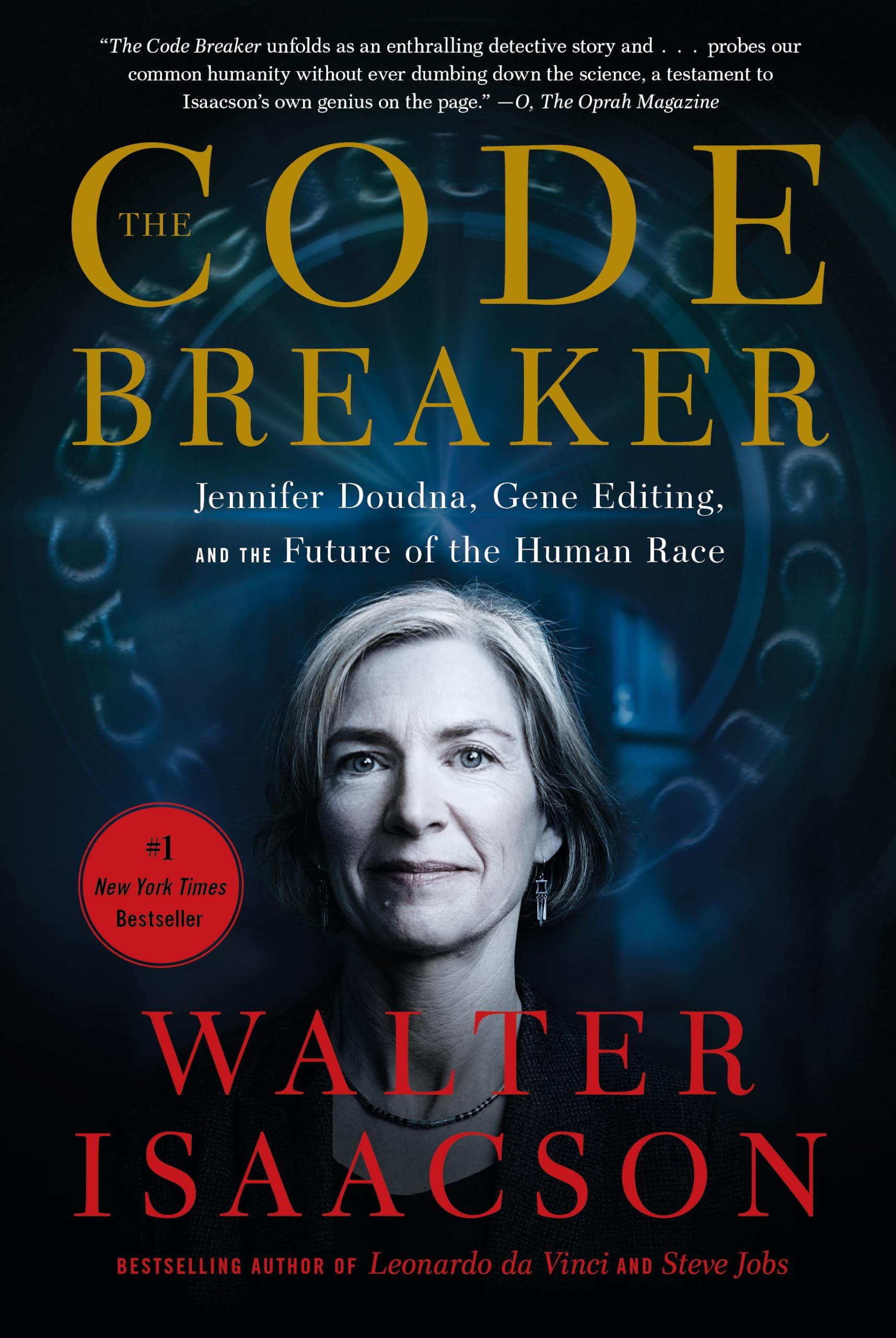
The Code Breaker: Jennifer Doudna, Gene Editing, and the Future of the Human ...
Product ID: 431754466
Desertcart purchases this item on your behalf and handles shipping, customs, and support to Hungary.
A Best Book of 2021 by Bloomberg BusinessWeek , Time , and The Washington Post The bestselling author of Leonardo da Vinci and Steve Jobs returns with a “compelling” ( The Washington Post ) account of how Nobel Prize winner Jennifer Doudna and her colleagues launched a revolution that will allow us to cure diseases, fend off viruses, and have healthier babies. When Jennifer Doudna was in sixth grade, she came home one day to find that her dad had left a paperback titled The Double Helix on her bed. She put it aside, thinking it was one of those detective tales she loved. When she read it on a rainy Saturday, she discovered she was right, in a way. As she sped through the pages, she became enthralled by the intense drama behind the competition to discover the code of life. Even though her high school counselor told her girls didn’t become scientists, she decided she would. Driven by a passion to understand how nature works and to turn discoveries into inventions, she would help to make what the book’s author, James Watson, told her was the most important biological advance since his codiscovery of the structure of DNA. She and her collaborators turned a curiosity of nature into an invention that will transform the human race: an easy-to-use tool that can edit DNA. Known as CRISPR, it opened a brave new world of medical miracles and moral questions. The development of CRISPR and the race to create vaccines for coronavirus will hasten our transition to the next great innovation revolution. The past half-century has been a digital age, based on the microchip, computer, and internet. Now we are entering a life-science revolution. Children who study digital coding will be joined by those who study genetic code. Should we use our new evolution-hacking powers to make us less susceptible to viruses? What a wonderful boon that would be! And what about preventing depression? Hmmm…Should we allow parents, if they can afford it, to enhance the height or muscles or IQ of their kids? After helping to discover CRISPR, Doudna became a leader in wrestling with these moral issues and, with her collaborator Emmanuelle Charpentier, won the Nobel Prize in 2020. Her story is an “enthralling detective story” ( Oprah Daily ) that involves the most profound wonders of nature, from the origins of life to the future of our species. Review: A Text That Even An English Major Can Appreciate - Though I gave this a 5-star review, It's not perfect. But for the sheer breadth and depth of information on Doudna and this topic, the book deserves full credit. Also, this book discusses complex scientific information with clarity and insight so that even an English major (word perp) can enjoy the discussion of the process and have their curiosity satisfied about gene editing, not an easy task -- but one that Isaacson does quite well. I also love the evolution of discovery that Isaacson describes, and I love that he introduces the reader to all those participating as he tells this story, Doudna's story. He also describes the brutal competition of scientists and researchers and the dynamic of collaboration in that community. But he notes the change that occurred during and after the pandemic. As a reader, I had a true sense of how all the pieces fit together after I read this book. Isaacson addresses the "elephant in the room" in detail by discussing the potential benefit and horror of gene editing for humankind. He does this in a way with provocative questions and answers that reveals a careful and methodical researcher who has a good understanding of what's at stake. He distinguishes between "treatment and enhancement" with precision. Last, I love how he inserts Doudna's actions, reactions, and dialogue into this story in which she is the lead protagonist. He does a careful job of uncovering uncomfortable issues that occurred along the way of discovery. I'm left with the impression that Jennifer Doudna is a singular ethical and brilliant research scientist who has paved and continues to pave the way for young scientists, especially young women, to change the world, even as she has. In discussing the different facets of collaboration, before and after Mar 2020, I love that he emphasizes the importance of a cross-discipline approach and how various perspectives and experiences contribute to discovery. My only two complaints (and these may seem overly critical) are that Isaacson seems to be overly accommodating to certain men in the book who had sexist tendencies or who were more rogue than research, but I think he does this to show extreme objectivity. Sometimes, though, his commentary was too opinionated and complimentary, to make up for being objective, when it was best to let the reader come to their own conclusions. I didn't need to be told how wonderful this person was even though they had just shown themselves or even though they had just said or did something unethical. The other complaint is that Isaacson describes so much about his own life and opinions that whenever I read them, I would develop a twitch. I wanted to say, "Dude, how do you give your opinion without giving your opinion?" That's Reporting 101. And he didn't really have to describe a person's physicality quite so much. Do we really need to know about someone's "chipmunk-cheeked round face"? But I forgive him and recommend this book 100%. One more thing, I love the he ends the book by describing a repaired exchange between Doudna and Charpentier. And I love that he gives full credit to Rosalind Franklin, and I love the spirit of hopefulness of what's possible for future generations that he leaves the reader with. Review: What Can RNA Do for You - “The Code Breaker: Jennifer Doudna, Gene Editing, and the Future of the Human Race” by Walter Isaacson takes its science seriously and dumbs down absolutely nothing. I am neither the smartest nor dumbest guy in the room, but I had never heard the term CRISPR before cracking this open. The gentleman at Starbucks asked me what I was reading. When I told him, he said, “Ooh! Fun with CRISPR!”. Who says the schools have failed? The first part of the book is about competition. Many people, including our hero Jennifer Doudna, knew the potential of gene editing and manipulation, but few could agree on who deserved the credit or made the most important discovery. Next, we meander into a portion about the ethics of gene manipulation in what seems to be a different, but still successful novel. In another’s hands, this could have been, as one reviewer put it, “too ambitious.” This book, however, is not Isaacson’s first rodeo, so he knows what to do here. Most will seek out this type of story in order to hear the ethical arguments that came up over the span of the last few decades. Isaacson, a veteran author of history, seems less concerned with establishing a narrative and more focused on demonstrating how the national argument meandered. The scientists involved constantly battled with their desire for credit and responsibility to societal ethics. Most could see both the power of technology and the need for limits. Most agreed that only life-threatening reasons required such a boost. We all draw the line differently. What qualifies as an “enhancement” instead of a “requirement” for life? The most emotionally resonant sections interview deaf and autistic adults who do not, under any uncertain terms, recognize their conditions as disabilities. Some wanted children that reflected their culture. These arguments show how differently we think as Americans. A specific population believes that it is immoral to genetically engineer, while a nearly equal amount feel that it is terrible not to if you prevent debilitating conditions. I wish that I did not have anxiety but the coping mechanisms have proven to me that I have more resilience than anticipated. The same goes for my eldest child but seeing them tackle their fears shows that they will persevere. Our opinions do not condemn those of others. Isaacson acknowledges a blurry line and slippery slope but does not condone those who think differently than he does. He brings together some of the most brilliant minds in science and shows that they all had different goals and visions for the potential of their discoveries. You will want to know more about them. Once we end at the Coronavirus mission, we know how we need to protect these minds.


| Best Sellers Rank | #24,738 in Books ( See Top 100 in Books ) #9 in Genetics (Books) #29 in Scientist Biographies #133 in Women's Biographies |
| Customer Reviews | 4.7 out of 5 stars 13,926 Reviews |
S**N
A Text That Even An English Major Can Appreciate
Though I gave this a 5-star review, It's not perfect. But for the sheer breadth and depth of information on Doudna and this topic, the book deserves full credit. Also, this book discusses complex scientific information with clarity and insight so that even an English major (word perp) can enjoy the discussion of the process and have their curiosity satisfied about gene editing, not an easy task -- but one that Isaacson does quite well. I also love the evolution of discovery that Isaacson describes, and I love that he introduces the reader to all those participating as he tells this story, Doudna's story. He also describes the brutal competition of scientists and researchers and the dynamic of collaboration in that community. But he notes the change that occurred during and after the pandemic. As a reader, I had a true sense of how all the pieces fit together after I read this book. Isaacson addresses the "elephant in the room" in detail by discussing the potential benefit and horror of gene editing for humankind. He does this in a way with provocative questions and answers that reveals a careful and methodical researcher who has a good understanding of what's at stake. He distinguishes between "treatment and enhancement" with precision. Last, I love how he inserts Doudna's actions, reactions, and dialogue into this story in which she is the lead protagonist. He does a careful job of uncovering uncomfortable issues that occurred along the way of discovery. I'm left with the impression that Jennifer Doudna is a singular ethical and brilliant research scientist who has paved and continues to pave the way for young scientists, especially young women, to change the world, even as she has. In discussing the different facets of collaboration, before and after Mar 2020, I love that he emphasizes the importance of a cross-discipline approach and how various perspectives and experiences contribute to discovery. My only two complaints (and these may seem overly critical) are that Isaacson seems to be overly accommodating to certain men in the book who had sexist tendencies or who were more rogue than research, but I think he does this to show extreme objectivity. Sometimes, though, his commentary was too opinionated and complimentary, to make up for being objective, when it was best to let the reader come to their own conclusions. I didn't need to be told how wonderful this person was even though they had just shown themselves or even though they had just said or did something unethical. The other complaint is that Isaacson describes so much about his own life and opinions that whenever I read them, I would develop a twitch. I wanted to say, "Dude, how do you give your opinion without giving your opinion?" That's Reporting 101. And he didn't really have to describe a person's physicality quite so much. Do we really need to know about someone's "chipmunk-cheeked round face"? But I forgive him and recommend this book 100%. One more thing, I love the he ends the book by describing a repaired exchange between Doudna and Charpentier. And I love that he gives full credit to Rosalind Franklin, and I love the spirit of hopefulness of what's possible for future generations that he leaves the reader with.
A**Y
What Can RNA Do for You
“The Code Breaker: Jennifer Doudna, Gene Editing, and the Future of the Human Race” by Walter Isaacson takes its science seriously and dumbs down absolutely nothing. I am neither the smartest nor dumbest guy in the room, but I had never heard the term CRISPR before cracking this open. The gentleman at Starbucks asked me what I was reading. When I told him, he said, “Ooh! Fun with CRISPR!”. Who says the schools have failed? The first part of the book is about competition. Many people, including our hero Jennifer Doudna, knew the potential of gene editing and manipulation, but few could agree on who deserved the credit or made the most important discovery. Next, we meander into a portion about the ethics of gene manipulation in what seems to be a different, but still successful novel. In another’s hands, this could have been, as one reviewer put it, “too ambitious.” This book, however, is not Isaacson’s first rodeo, so he knows what to do here. Most will seek out this type of story in order to hear the ethical arguments that came up over the span of the last few decades. Isaacson, a veteran author of history, seems less concerned with establishing a narrative and more focused on demonstrating how the national argument meandered. The scientists involved constantly battled with their desire for credit and responsibility to societal ethics. Most could see both the power of technology and the need for limits. Most agreed that only life-threatening reasons required such a boost. We all draw the line differently. What qualifies as an “enhancement” instead of a “requirement” for life? The most emotionally resonant sections interview deaf and autistic adults who do not, under any uncertain terms, recognize their conditions as disabilities. Some wanted children that reflected their culture. These arguments show how differently we think as Americans. A specific population believes that it is immoral to genetically engineer, while a nearly equal amount feel that it is terrible not to if you prevent debilitating conditions. I wish that I did not have anxiety but the coping mechanisms have proven to me that I have more resilience than anticipated. The same goes for my eldest child but seeing them tackle their fears shows that they will persevere. Our opinions do not condemn those of others. Isaacson acknowledges a blurry line and slippery slope but does not condone those who think differently than he does. He brings together some of the most brilliant minds in science and shows that they all had different goals and visions for the potential of their discoveries. You will want to know more about them. Once we end at the Coronavirus mission, we know how we need to protect these minds.
C**H
Good reading about groundbreaking science and scientists loosely packaged as an Isaacson biography
This is an important book, but it is not a typical Isaacson biography. As the subtitle admits, it is a broader story about the science and scientists of gene editing and their impact on the human race. Like Isaacson's "pure" biographies, it is well-written and solidly-researched. Unlike those books, this one provides vignettes of many of the other scientists who collaborated with and competed against the principal subject, Jennifer Doudna. In doing so, it provides valuable insights into how scientific discoveries move from basic science to applied science. It also shows the international scale of those contributions and competitions. Photographs sprinkled across the book humanize the subjects and reinforce their diversity. The book also demonstrates how academic science is merging with startup companies today. Those aspects alone make this book valuable reading in our current age. Isaacson does an admirable job of explaining the science to a broad range of readers, although there were times I would have appreciated some additional depth on the more important concepts. (There were also times when I felt he was providing too much detail on the peripheral players.) A less well known author might not have classified this book as a biography. To benefit from Isaacson's well-deserved reputation for his biographies, the book properly emphasizes Jennifer Doudna, who shared the 2020 Nobel Prize in Chemistry with her former collaborator and competitor, Emmanuelle Charpentier. Doudna is fascinating subject and a wonderful role model for anyone interested in science, especially girls and women. Because of the book's broader sweep, we learn less about Doudna than we might have in a typical biography, which was a disappointment. Although the breakthroughs the book describes will change the world, I was disappointed in Isaacson's treatment of two areas: First, while I appreciated his coverage of the moral and social justice questions surrounding human intervention in inheritable genetic traits, I found his personal views unnecessary and distracting. Second, I thought he shortchanged the additional invention needed to move gene editing forward. His cheerleading for Doudna and the other biotech scientists was appropriate and his demonstration of how easy gene hacking can be was a good warning for all of us. But much more will be required to make gene editing as safe and practical as it will need to be, particularly for edits that affect humanity's gene pools. Even a few more pages of foresight on those topics would have been appreciated. Overall, this is an important book that deserves reading. It's also a clever effort by a brilliant biographer to market a broader story under the guise of a more traditional biography.
M**7
Profound read
Great read. Get educated on crispr technology. Will change the future of healthcare and more. Profound read
S**Y
Fabulous
A treasure of facts and reflections on how CRISPR is taking us again into better health and deep reflection on what are we doing.
W**N
good personable summary
Whenever I see Walter Isaacson has a new book out, I think two things: it’s going to be a good book, and it’s going to occupy a lot of my free time. I enjoyed reading this book. I found it relatively easy to read even though it took me a few weeks. This is the only book of his I’ve ever finished. The book mainly focuses on Jennifer Doudna and the advent of gene editing with CRISPR technology. Major scientific advances are fueled by the collaboration of many different people, and not just one. She, however, seemed to be the biggest and most level-headed player, and as a result, shared the Nobel prize with Emmanuelle Charpentier. One of Isaacson’s previous books, The Innovators, took the approach on focusing on many different scientists, but it didn’t hold my attention for long. Focusing on Doudna made the topic more personable and enjoyable. The book also covered more current events rather than historical ones. I loved reading it. The science can be complex, but it felt like the author didn’t go any deeper than he needed to get the point across. He would also take the time to summarize the fundamentals discussed periodically. The book also gave insight into the legal intricacies of how they published their papers and were granted patents. The author also seemed to cover every ethical viewpoint and how the ethics evolved but with none of the stupid politics. I really enjoyed that. Although the focus was on Doudna, the author remained objective and did not take her side on everything. For example, she did not care much for her competitive rivals Eric Landers and Feng Zhang; however, Isaacson thought highly of them and made a point of explicitly saying so. Jennifer Doudna doesn’t really seem to have the same superhero status as some of Walter Isaacson’s other subjects like Albert Einstein, Benjamin Franklin, Leonardo DaVinci, and Steve Jobs. Or maybe she does. It was hard to keep up with this topic by trying to follow the news over the past few years because there has been so much garbage in the news that it was hard to get a good context on anything important. I found this book to be a good summary of everything that’s been happening in the field of CRISPR and gene editing over the past few years without the distractions. I highly recommend it.
G**A
a very human story of a remarkable person
I appreciated this telling of Dr. Doudna’s life (so far) because it set in context the scientific achievements of a scientific pioneer, and leaves you with awe regarding the biological processes involved, while telling the story in understandable ways. One cannot understand the power of the discoveries that Dr. Doudna made, supervised, and collaborated on without having at least a basic understanding of the science, challenges and personalities involved in the discoveries. But not everyone can write such a book. This is a well written book that was well worth the hours spent in engaging with the material, as well as reading the story. I would note that the book is at least somewhat technical, given that the subject is highly technical, so keep that in mind as you consider the read. Part of the skill of the author was to be able to tell the story, including the detail, in a way that remained readable all the way through.
M**N
Great book, dense book, necessary book
This is the inverse of a light read, both in content and message. But….this is Walter Isaacson, so it succeeds in all the ways I assume he wanted it to succeed. It is not a five star because some of you may disregard my use of the word dense, get increasingly annoyed about the need to go out to Wikipedia to supplement Isaacson’s explanations, and, sadly, put down the book. Read it. Enjoy it. Learn from it.
F**P
A fascinating topic, brilliantly told
Isaacson brings the science of gene editing to life with clarity and warmth. Complex concepts are explained in an accessible way, and he highlights the humanity of the scientists involved, touching on their rivalries and motivations but also really helping the reader get to know them. Perhaps surprisingly, it reads like a gripping story. This is a must-read. I was disappointed to reach the end. But it feels like only the beginning of genomics. This book does an excellent job of raising awareness and understanding of a hugely important technology. Yes the part of morality was a bit different from the overall story, as other reviewers have said. But it was thought provoking and these issues cannot be ignored.
A**W
Meisterhafte Biografie über eine wissenschaftliche Revolution!
Walter Isaacson beweist wieder einmal, dass er einfach herausragende Biografien schreiben kann. Das Buch ist von Anfang bis Ende spannend und hochinteressant geschrieben – absolut ohne unnötige Längen. Es bietet extrem wichtige Einblicke in die Entwicklung der CRISPR-Technologie und beleuchtet die Geschichte aus vielen unterschiedlichen Blickwinkeln. Volle 5 Sterne!
L**H
Très bon livre
Très bon livre
S**H
An exciting real-world story
Having spent nearly 40 years in an academic environment, I found this book truly impressive. The author communicates with remarkable clarity, making complex details accessible even to those unfamiliar with the subject.
T**R
Awesome!
This is such an insightful read. I am a huge fan of Walter Isacson's work, and this is a great read. It gives an overview on CRISPR technology and its use in gene editing. It is a groundbreaking technology that has been simplified to that many complex concepts are understanable to the reader. It throws light on the ethical dilemmas that arise as a result of this technoology. It has piqued my curiosity in the biotechnology field. It is certainly one of my favourite memoirs that I have read.
Trustpilot
5 days ago
3 weeks ago