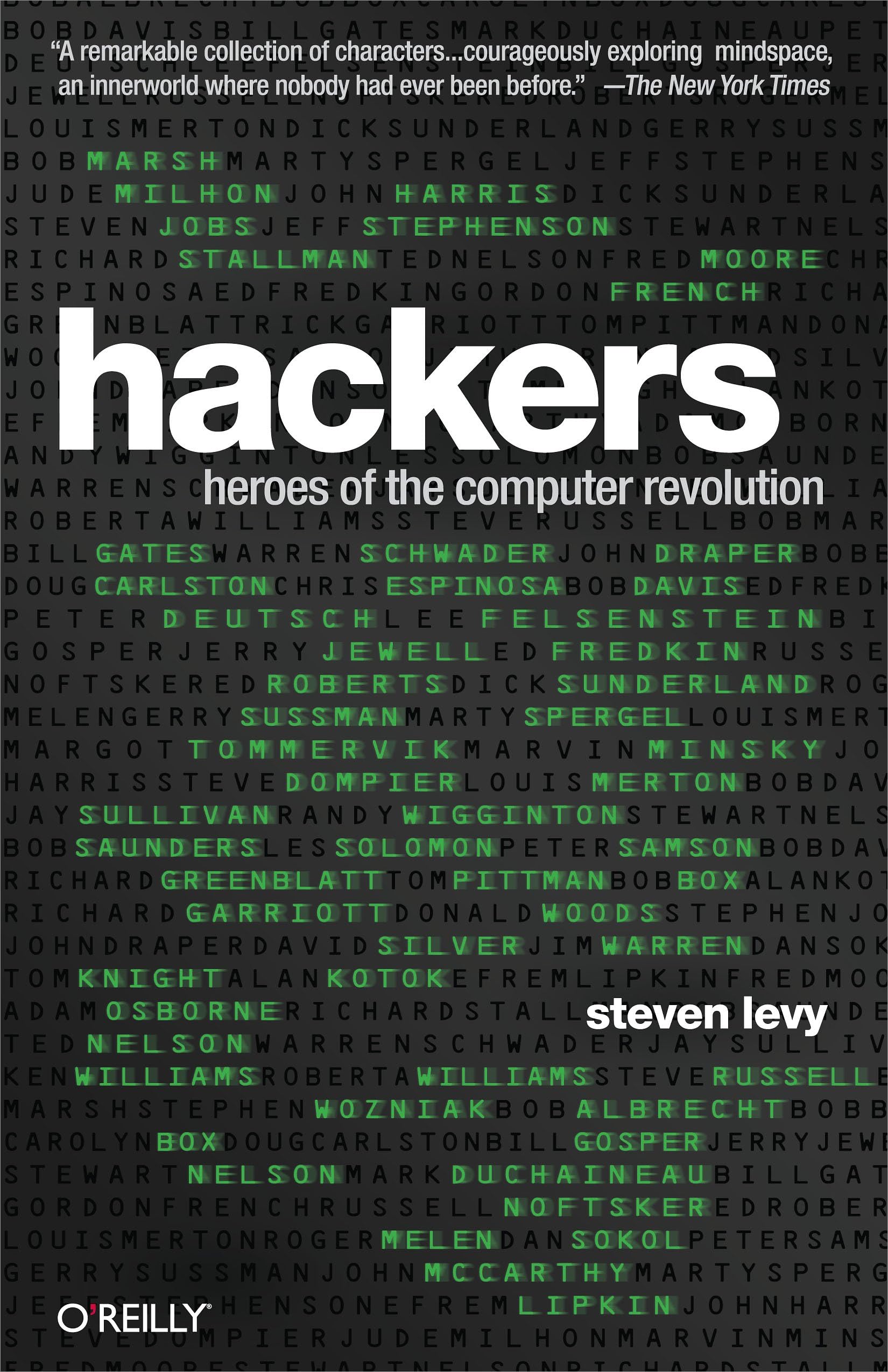
Hackers: Heroes of the Computer Revolution
Product ID: 4163003
👾Features Icons like Gates & Zuckerberg
📚25th Anniversary Edition
🖥️Covers 1950s-80s Computer Revolution
Desertcart purchases this item on your behalf and handles shipping, customs, and support to Hungary.
👨💻 Unlock the origins of innovation — where hacking became history!
This 25th anniversary edition of Steven Levy's classic chronicles the pioneering hackers from the 1950s to the 1980s who revolutionized computing. Featuring updated contributions from tech icons like Bill Gates and Mark Zuckerberg, it offers a compelling look at the hacker ethic and the birth of home computers, making it essential reading for anyone passionate about the roots of today’s digital world.




| Best Sellers Rank | #108,884 in Books ( See Top 100 in Books ) #16 in Computing Industry History #19 in Computer Hacking #100 in Software Development (Books) |
| Customer Reviews | 4.5 out of 5 stars 833 Reviews |
G**L
If you like computers, this book will tell you where they came from. A fun read!
Ok, I admit, I'm old. I actually remember most of the things talked about in this history of the computer age's genesis. Got my first home computer in 1982, a Timex Sinclair ZX81. 8K of ram and no keyboard, just a flat panel like on microwaves. Try typing in programming code on that! hah! Moved "up" to an Atari 800XL, which I hated and then to a Commodore 64, which I expected to hate, but loved. After that I reluctantly moved to a PC clone, although I wanted a $3600 Macintosh. Just couldn't afford it. At that point I got my first job as a self taught computer tech, in 1988. And I am still doing the same work now, although it's just about time to retire. So I've seen a lot over the years The rise of Microsoft, the surprising success of Apple, the fall of CP/M and about 50 different computer languages, such as Logo, Lisp, Fortran and Cobol. I saw the first computer expos, long before there was CES. People wandering around big halls, buying stacks of floppies and glossy computer mags. I played the games from Sierra (before it was Sierra Online) and Electronic Arts, (before it was "EA") and I was there when AOL became a monster app and spanked CompuServe. I had a BBS in 1990 that was one of the first to offer Internet email access. But it was all text as the WWW hadn't been invented yet! All these milestones and much more is covered in this book and I found it fascinating, even though I was never "in the In Crowd" where the Home Brew Computer Club was located. A really well done and informative look at how we got from $500 TI calculators to smart watches more powerful than the computers that put a man on the moon. Wowsers.
E**Ç
What would happen if hackers...
The only thing that is missing in this wonderful book is the UNIX era, which constitutes a story by itself. I was really disappointed to see that UNIX is mentioned in only one or two pages (and nothing is mentioned about UNIX and C hackers). Other than that, I think it paints a very vivid and humane picture of a very special period of the history of computing. I would also recommend it to people who are not technical so that they can understand the mindset and psychology of hackers better. The distinction between the styles of serious business computing and passionate, obsessive, creative and innovative hacking pushing the boundaries is also made very clear in the book. That distinction still exists today, even though the flagship of modern hacking GNU/Linux is becoming more and more of a business commodity rather than a risky playground for trying out really groundbreaking ideas. I also recommend the book to programmers, hackers and technical managers so that they know more about the past of their field. The roads taken and the roads not takes. I must admit that I learned much more about the history of Homebrew Computer Club and game hacking from this book, wish it contained more stories about Commodore, ZX Spectrum and Amiga. So grab some Chinese food, set up your hacking environment, put this book on your desk and give it a go! :)
J**Y
Great Book If You Have The Prerequisites
What do you think of then you think of the word hackers? It is one of those words that has morphed from a good to a bad connotation. This book is about the good guys; those who developed the original computers and software that made the home computer possible. This is not the immediate perception the buyer may have. If you just glance at the title and buy the book assuming it is about modern-day bad-guy hackers who use their genius for criminal purposes, you will be totally disappointed. This work is a 25-year anniversary edition, so the original writing was done by 1985. A hacker is by definition in this book someone who is passionate almost beyond physical and mental limits about something, in this case machines (specifically computers). One can feel the nascent stages of the eerie marriage of carbon-based intelligence and silicone-based intelligence that is now seen as a likely, even certain for some, probability. There are two requisites to enjoy this work as I did: 1.It will help immensely if you are a hacker, or at least a programmer, or perhaps even an experienced software user. Many of the acronyms are explained, but many are not (HTML, BASIC for example). Actually, to explain Hyper Text Markup Language or Beginner's All-purpose Symbolic Instruction Code and give examples is not in the province of this work. But it really does help to have done some HTML or other programming. (I have 25 years of programming experience, mostly in x-base.) 2.You will enjoy it much more if you were around for the personal computer revolution as I was. My first programming was on an Apple IIe. I remember Woz, Jobs, Gates and others of the 80's. That helps a lot in making the book meaningful and enjoyable. If you meet those requirements, you will enjoy this book, though it will not be one you just can't put down. At almost 500 pages, you have to take it in small chunks. If you know next to nothing about computers, but are a hacker at heart, you will probably like this book too. Just go on-line and look up things like CPU's, registers, accumulators, BASIC and other terms that may not be familiar. A great companion to this book would be: Cyber War, by Richard A Clarke. This work discusses the modern-day bad-guy hackers who have hacked into such things as major US power grids and even weapon systems. It is a very scary warning about the power of the computer and hackers to win a war with cyber weapons.
A**A
The Beginning of the Computer Age
It all started when I saw TRON: Legacy. I decided to delve into computer history to get a better understanding of the Grid. This book came up, and I was hooked. Once upon a time, 'hacker' solely meant someone who explored technology, whether it was the early computers, the ARPAnet, or the Bell system. College students at MIT. The Homebrew Computer Club in Silicon Valley. People who wrote their own programs. Back then, computers weren't as easy to use as they are today. Since you had to write your own programs, this meant the intended audience was rather small. Computers were seen as mysterious things, machines that couldn't possibly do things like calculate (one of the people covered in this book wrote a calculator problem for his college computer and used it for a math course. The teacher gave him an F, and the words "You used a computer! This <i>can't</i> be right!"), play chess,music, or be used by normal people. The story of how this started to change is a fascinating one. The ebook edition is VERY useful, as it has hyperlinks embedded in the text. You will find yourself bookmarking pages where topics such as LIFE, Arpanet, and the Altair 8800. Then you will find yourself looking them up online. All in all, this is a great starting point for computer history fans.
B**N
A must for computer enthusiasts and Computer Science Majors.
I was recommended this book by a colleague. I love it too. It is about the initial stages of the computer revolution, yet reads more like a collection of entertaining short stories. It is far from a dry read. Included in the front are short descriptions about people and devices mentioned or interviewed. If you're a software developer this actually explains why IDEs mark errors with red. If you're a gamer, you'll learn about the first video game. (It wasn't Pong). I haven't red the entire thing yet, but it's still a good read. External links give you further details and some are entertaining. The book may be titled hackers, but there isn't anything illegal or even ill-intented. It was about the pursuit for knowledge and efficiency. This is a must for serious software engineers and computer science. If for nothing else then leisurely reading. There is a fair amount of discussion of assembly language, which is seldom covered in even college classes, usually one class for a single assignment or chapter. Not much is explained in detail so the education level to understand the book completely is fairly high. There are a bunch of inside jokes, but I do think that an average college student could understand 90-95% of the book.
D**O
Great Read, Well Written.
In watching, The New Screen Savers, a video broadcast by the TWIT Leo LaPorte network, I heard that multiple on-line personalities had not just one copy but multiple copies of this book (new editions with added appendices updated where the 'heroes' are today in their careers and life). Although I believe it is now in its 25 year of publication, it was a great read. It is as much a philosophy of a 'way of life' and how the nerds of the world have had a tremendous impact on technology and how their 'hacking philosophy has in most cases led to an ethical and rewarding life (even if they choose to not sell their software). I well probably buy additional copies to share with one of my sons who is a mechanical and civil engineer and a nerd. It will be on optimistic read for him! By the way, I am a retire school band teacher, h.s. principal, and superintendent. I enjoyed it both as a nerd and as a former public organization CEO. Highly recommend. Levy did a great job researching and writing as well as updating recent editions! Thanks Steven!
E**A
Well, not quite heros in my book, but good friends
Steven's book has become a social phenomena in its own right. One moment, I am reading this book in the 80s and the next I am on a porch having a nice quiet conservation with Rick Greenblatt ("An honor to meet you"). Following that I'm on the Steering Committee for the Conference started by Stewart Brand. Stewart deserves a lot of credit, but Steven (whom I've met but don't know quite as well, since I am into high end computing not microcomputing but with some experience on Xerox workstations {life changing}). I shared an office with Jack Dennis the year prior while Jack was on sabbatical in California (we were both tea drinkers in a sea of coffee drinkers). I had not realized that he was into model trains. So I give copies of this book to East Coast friends trying to understand Santa Clara Valley. So I have lived a lot of the periphery of this book. The new edition has more chapter divisions from the first edition's three sections. Annually for the past 25+ years, several hundred geeks gather to continue the ideas in this book. The book has changed the world in subtle not well documented attempts: Cloud 9, Interval Research, Foo Camp, etc. The general non-computing public will never hear of these. Thousands of others in some know will lust for invitations to be "flies on the wall." Important things Steven got right missed by others: while the Apollo 17 story is all well and good, Steven picked up on the contrast between Northern and Southern California. Why did Lee's Homebrew Computer Club "succeed" while the Southern California Computer Society (SCCS) fail? This was an important lesson (I grew up in So Cal and attended the anniversary of the founding of Homebrew (HCC). More engineers up North and fewer better marketeers up North. It's a lesson from aerospace bureaucracy. Even Markoff's What the Dormouse Said: How the Sixties Counterculture Shaped the Personal Computer Industry book (good in it's own right) missed the chance to elaborate on this. This is missed by every analysis of Silicon Valley. It's even missing on wikipedia. A lot of water has passed under the bridge and this edition has 2 additional afterwards by Steven. Brand also had a short documentary (30 min) made PBS. Steven did miss 1..2 important points. Markoff has slightly more of the experimental drug culture. The one big subtopic local to the SF Bay area which was raised by the Conference of our same name are the small but significant percentage (typically cited at about 10% as a handle) of gay and Lesbian attendees working in the computer industry. They find political/jock-ular attempts to move the computer industry else where laughable for this reason (they would want me to note this). The culture of the MIT student selection process is also left out. Honor systems had a greater influence because of this. Steven is not a programmer. He's a journalist. He's got colleagues whom other former roommates of mine married. He did not expect this story to have the legs it has. He gets things mostly right, so read some of the other books besides his and John: Fire in the Valley: The Making of The Personal Computer (Second Edition) , Accidental Empires: How the Boys of Silicon Valley Make Their Millions, Battle Foreign Competition, and Still Can't Get a Date , Where Wizards Stay Up Late: The Origins Of The Internet , Nerds 2.0.1 , The Dream Machine: J.C.R. Licklider and the Revolution That Made Computing Personal , Triumph of the Nerds , Triumph of the Nerds , and likely many, many other books and dissertations. They are likely all flawed in some way or another. Bob Taylor thinks Mitch Waldthrop got history right in The Dream Machine. Some people equate Hackers (the book) to Kidder's The Soul of A New Machine . Kidder has 2..3 good points, but Data General and the MV/8000 are gone. Levy's book is head and shoulders Kidder's book. I would hate to see some Intro to computing class force students to read this book. It's not for every one, it's flawed, it's geeky. But Levy's book contains little gems that many people outside computing will never understand about hacker culture.
M**P
The definite history on computing, the untold story!
Excellent book.Insightful history on computing in US. Engaging journey through 3 generations of hackers. Starting with the TX-0 of MIT and ending with the Apple 2 in 1980's, it embodies the spirit, the personal losses and effort from a bevy of individuals who believed in a Utopian World. Those mages whose sense of perfection, keen acumen and persistence conceptualized the future faster for the newer generations. Sacrificing their lives for the common good of humanity, giving away their work for free, they stand as a stark contrast to the current generation whose morality is rooted in instant gratification. I hope Mr.Levy would cover the current advancements in a second book with more detail, rather than the appendix provided. This is the definite history. A must read for anyone in IT. I am grateful to have inherited this legacy.
A**M
Good but too short
Very enjoyable little book to read. But it stops just as it feels like it should be getting started! Guess I will need to find more books on computer history elsewhere. Kindle edition has some serious formatting issues.
S**E
Feels like reading a fantacy novel. Skip this one...
This book is about techies . Author has made it like a novel by adding too much poetic phrases. I read “iWoz”in three days straight. This one i dont think i ll be able to finish.
P**H
Required reading to understand the zeitgeist of the current "open source" movement.
I serendipitously picked this up to read at the beginning of a four month sabbatical during which I intended to do some reading and research into the "ethic" or "spirituality" of people developing software according to the the 'free' (as in speech) or 'open source' model. I could not have picked a better history of how the current open source got its start. It was not my intention to start with a bit of history, but it turned out to be just the right thing to do. Levy's description of "The Hacker Ethic" has helped direct thought and research ever since. I wondered why I did not read this book when it first came out, but in a sense I am glad I waited because I was able to read the updated words and it helped me with context in my sabbatical study.
S**L
Unterhaltsam und lehrreich für Software-Entwickler und -Manager
Jeder, der die ursprüngliche und echte Bedeutung von "Hacker" als fähige, trickreiche, innovative Programmierer kennt; der regelmäßig ganze Nächte mit seiner Maschine verschmilzt, weil er wissen wollte, wie man etwas noch besser machen kann; der muss dieses Buch kennen. Ganz klar. Levy schreibt eine äußerst unterhaltsame Geschichte, die Anfang der 1960er mit der Entdeckung eines (programmierbaren!) TX-0 durch Mitglieder des Modelleisenbahnclubs am MIT beginnt und mit dem aufbrechenden Konflikt zwischen Hacker- und Managerphilosophien bei Atari, Apple, Microsoft, Sierra On-Line und anderen Giganten der Spiele- und Softwareindustrie um 1984 -- leider viel zu früh -- endet. Das ist aber nicht nur stellenweise extrem witzig (bzw. skurril bis besorgniserregend :), sondern auch heute noch eine für alle an Softwareentwicklung Beteiligten höchst interessante Lektüre. Für Entwickler sowieso. Gut, "Hacken" als Paradigma ist heute nicht mehr allzu hoch angesehen -- aber ich habe keinen einzigen guten Programmierer kennengelernt, der der Hackerphilosophie nicht starke Sympathien entgegenbringt und der nicht auch, wenn's drauf ankam, hacken konnte. Doch auch und gerade Managern kann ich dieses Buch nur ans Herz legen -- wer ein effizientes Softwareprojekt effektiv leiten will, der ist gut beraten, die Hackerphilosophie zu kennen und im Umgang mit Programmierern zu beachten. Und die wird in keinem anderen Buch so authentisch, anschaulich und greifbar beschrieben. Kurz und gut, mit diesem Buch können alle ganzheitlich an Software Interessierten das Angenehme mit dem Nützlichen verbinden. Es eignet sich ausgezeichnet als unterhaltsame, unanstrengende Bettlektüre, bei der man ganz nebenbei viel über die Geschichte von Software sowie der Mentalität ihrer Entwickler erfährt. Eine seltene Synthese!
L**E
An extraordinary account of the growth of the home computer.
If you thought the term 'Hackers' had anything to do with computers you were mis-informed - but they invented the entire industry, bootstrapping it from skills learned from people running the early mainframe computers while on the search for components for their giant train set. Amazingly detailed, Steven Levy has lived and worked among the generation of geeks who became the household names from Microsoft and Apple, the games houses and software companies that are now world wide big business. And with the development of the Raspberry Pi it might be starting all over again!!
Trustpilot
2 weeks ago
1 month ago