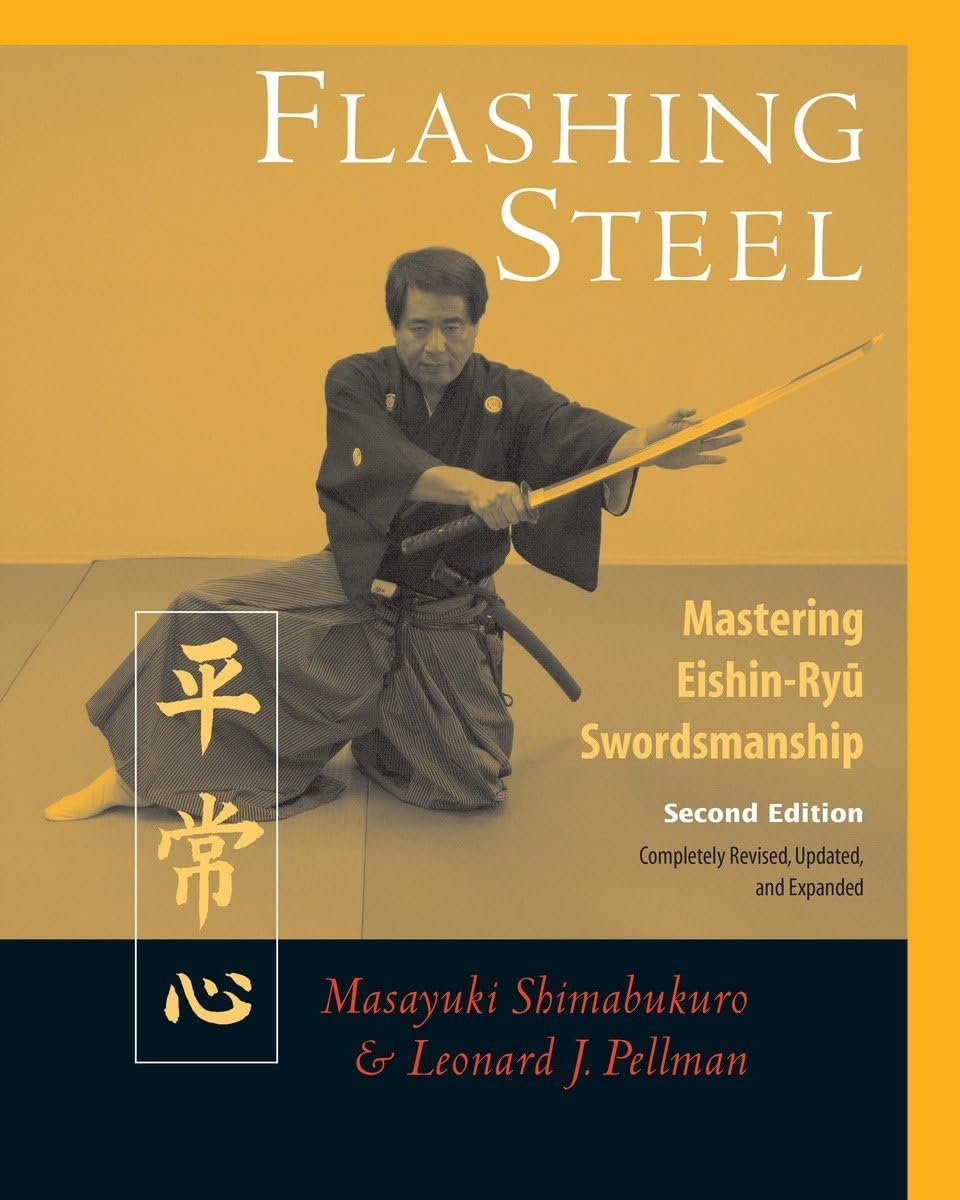

Flashing Steel, Second Edition: Mastering Eishin-Ryu Swordsmanship [Masayuki Shimabukuro, Leonard Pellman] on desertcart.com. *FREE* shipping on qualifying offers. Flashing Steel, Second Edition: Mastering Eishin-Ryu Swordsmanship Review: Excellent Beginner to Intermediate Level Iaijutsu - There is a lot of great stuff in Flashing Steel, but there are also a few things to consider before purchasing. The back cover claims, "Flashing Steel is the most comprehensive guide available in iaijutsu...." when in fact its not. It also says, "...with ten partner exercises applying iaido principles in realistic attack and defense situations." I personally wouldn't say they are realistic at all. All that aside, the book is really geared towards beginner to intermediate iaido practitioners and here it delivers. If you are unfamiliar with Muso Jikiden Eishin-ryu Iaijutsu, it is a sword art that places tremendous emphasis on attention to detail and precision for mental and spiritual discipline. In fact, this book makes a point of clearly stating the art is not geared toward combat but rather on self-cultivation. "The fact that you will probably never engage in a real sword battle may, paradoxically, be the greatest benefit of sword training! Those who train in martial arts that have obvious practical application...too often find themselves so involved in developing skill in the physical self-defense applications of their art that they overlook their mental and spiritual training." (p11) This statement is both very honest and very accurate. The book continues, "...as a martial art that is highly ritualized, moderately paced, and without obvious street-application, iaijutsu provides an ideal environment in which to refine mental and spiritual discipline." Heijoshin is difficult to translate but is roughly equivalent to a 'serene yet fully alert state of mind'. This is the goal of this art. As to the techniques and 42-katas shown, they are very basic and pretty much use the same Nukitsuke (drawing cut), Chiburi (blood removal), and the same Noto (resheathing). To be fair he briefly demonstrates the Chiburi/Noto variation preferred by Katori Shinto Ryu (and myself) but he does not use this in his kata. There is a decent but still slightly lacking description on Kokyu (breath control) and the waza (techniques) are shown from both seiza (kneeling posture) and kamae (stance). The two-man sequences take up a lot of space and the only real value to them from my perspective is to illustrate range, which could have been done with greater economy had that been the author's intention. Beginners may have some trouble following the b/w sequence images for the waza as there are brief actions missing that may not be understood, but as far as martial art books go its not too bad here. I love iaido, but in practice if you are seeking spiritual development, less than a decade of diligent Ashtanga yoga will accomplish more than a lifetime of iaido. Unfortunately the Search Inside feature is not up. The table of contents include: 1) History p1 2) Philosophy p11 3) Eyes of a Samurai p31 4) Sword Nomenclature p47 5) Progression of Training p51 6) Preparation & Etiquette p63 7) Fundamentals p85 8) Omori-ryu Seiza Waza p123 9) Chuden Tatehiza (crouching) Waza p151 10) Okuden Tatehiza Waza p175 11) Okuden Suwariwaza p209 12) Tachiuchi (standing) no Kurai p223 13) Zen Nippon Kendo Renmei Seitei Iai Kata p253 14) Tameshigiri (cutting) p223 15) Summary of Eishin-ryu p299 16) Promotion Guidelines p303 17) Tournament Participation p309 18) The Way to Victorious Life p317 App A: Samurai no Kokoro-e p333 App B: Supplemental Materials The author has the correct positive martial message, and I was continually impressed by this fact. If you are studying Eishin-ryu or plan to in the future, this is an essential guide. Review: Outstanding revision; great photos and descriptions - As a self-taught beginner, I wanted one comprehensive, truly instructive book on iaido. This volume is perfect. Unlike a lot of over-priced martial arts books, this has detailed, thorough content and clear photos, at a good price. As a Christian, I disagree with a number of the philosophical/Zen Buddhist themes presented in the book, but even these issues and "precepts" were presented in an excellent generalized format, with room for debate and "translation" into other worldviews. I enjoyed being able to read the philosophical parts of a martial arts book and get something out of it. The actual techniques and descriptions look superlative. The authors keep a good balance between the "art" and actual combat efficiency of the moves. This manual should provide many good hours of learning and practice.
| Best Sellers Rank | #1,447,127 in Books ( See Top 100 in Books ) #1,458 in Japanese History (Books) #1,727 in Sports History (Books) #2,589 in Martial Arts (Books) |
| Customer Reviews | 4.8 4.8 out of 5 stars (163) |
| Dimensions | 7.99 x 0.79 x 9.97 inches |
| Edition | Expanded,Updated |
| ISBN-10 | 1583941975 |
| ISBN-13 | 978-1583941973 |
| Item Weight | 1.85 pounds |
| Language | English |
| Print length | 352 pages |
| Publication date | January 15, 2008 |
| Publisher | Blue Snake Books |
R**N
Excellent Beginner to Intermediate Level Iaijutsu
There is a lot of great stuff in Flashing Steel, but there are also a few things to consider before purchasing. The back cover claims, "Flashing Steel is the most comprehensive guide available in iaijutsu...." when in fact its not. It also says, "...with ten partner exercises applying iaido principles in realistic attack and defense situations." I personally wouldn't say they are realistic at all. All that aside, the book is really geared towards beginner to intermediate iaido practitioners and here it delivers. If you are unfamiliar with Muso Jikiden Eishin-ryu Iaijutsu, it is a sword art that places tremendous emphasis on attention to detail and precision for mental and spiritual discipline. In fact, this book makes a point of clearly stating the art is not geared toward combat but rather on self-cultivation. "The fact that you will probably never engage in a real sword battle may, paradoxically, be the greatest benefit of sword training! Those who train in martial arts that have obvious practical application...too often find themselves so involved in developing skill in the physical self-defense applications of their art that they overlook their mental and spiritual training." (p11) This statement is both very honest and very accurate. The book continues, "...as a martial art that is highly ritualized, moderately paced, and without obvious street-application, iaijutsu provides an ideal environment in which to refine mental and spiritual discipline." Heijoshin is difficult to translate but is roughly equivalent to a 'serene yet fully alert state of mind'. This is the goal of this art. As to the techniques and 42-katas shown, they are very basic and pretty much use the same Nukitsuke (drawing cut), Chiburi (blood removal), and the same Noto (resheathing). To be fair he briefly demonstrates the Chiburi/Noto variation preferred by Katori Shinto Ryu (and myself) but he does not use this in his kata. There is a decent but still slightly lacking description on Kokyu (breath control) and the waza (techniques) are shown from both seiza (kneeling posture) and kamae (stance). The two-man sequences take up a lot of space and the only real value to them from my perspective is to illustrate range, which could have been done with greater economy had that been the author's intention. Beginners may have some trouble following the b/w sequence images for the waza as there are brief actions missing that may not be understood, but as far as martial art books go its not too bad here. I love iaido, but in practice if you are seeking spiritual development, less than a decade of diligent Ashtanga yoga will accomplish more than a lifetime of iaido. Unfortunately the Search Inside feature is not up. The table of contents include: 1) History p1 2) Philosophy p11 3) Eyes of a Samurai p31 4) Sword Nomenclature p47 5) Progression of Training p51 6) Preparation & Etiquette p63 7) Fundamentals p85 8) Omori-ryu Seiza Waza p123 9) Chuden Tatehiza (crouching) Waza p151 10) Okuden Tatehiza Waza p175 11) Okuden Suwariwaza p209 12) Tachiuchi (standing) no Kurai p223 13) Zen Nippon Kendo Renmei Seitei Iai Kata p253 14) Tameshigiri (cutting) p223 15) Summary of Eishin-ryu p299 16) Promotion Guidelines p303 17) Tournament Participation p309 18) The Way to Victorious Life p317 App A: Samurai no Kokoro-e p333 App B: Supplemental Materials The author has the correct positive martial message, and I was continually impressed by this fact. If you are studying Eishin-ryu or plan to in the future, this is an essential guide.
S**Y
Outstanding revision; great photos and descriptions
As a self-taught beginner, I wanted one comprehensive, truly instructive book on iaido. This volume is perfect. Unlike a lot of over-priced martial arts books, this has detailed, thorough content and clear photos, at a good price. As a Christian, I disagree with a number of the philosophical/Zen Buddhist themes presented in the book, but even these issues and "precepts" were presented in an excellent generalized format, with room for debate and "translation" into other worldviews. I enjoyed being able to read the philosophical parts of a martial arts book and get something out of it. The actual techniques and descriptions look superlative. The authors keep a good balance between the "art" and actual combat efficiency of the moves. This manual should provide many good hours of learning and practice.
V**R
Excellent Book
I am not a practitioner of Eishin-ryu, I really just bought to the book to get the basics of how to handle the sword for the martial art I train in. That being said, this is an excellent book. I would say that the most important chapters in the book are chapters 1-3. These chapters, while not a comprehensive review of the budo, did IMHO a really good job of getting to the core of what it means to train in the art. I would also say that the information presented these three chapters are definitely applicable to every area of a person's life. I would highly recommend the book to anyone just trying to get the basics of how to properly use the sword. I would also highly recommend reading and reading the introductory chapters to really contemplate on why you chose to follow a particular martial way. Do this before you go chasing after the techniques showcased in the book.
C**E
Great book
Very thorough, excellently written. Gets 4 stars because it needs to be understood with a good instructor.
P**N
Written with a sharp, flashing-steel pen... SEVEN STARS
I have read many martial arts books over the years and found this one of the most satisfying. It is so well-written it was actually exciting to read. My yellow highlighter streaks nearly every page. The instructions and photographs are exceptionally clear. The first third of the book (of 338 pp.) deals with fundamentals--and I'm not talking about stance and strikes. The authors offer the clearest summary of martial arts philosophy I've ever read, covering its spiritual basis, attitude and a student's appropriate progression. For example, technique should progress "big-strong-fast-light," meaning get the basic form down accurately, learn to do it well (with power), then speed and lightness will come almost effortlessly and, with repetition will increase one's power and accuracy. These contextual explanations help considerably when doing the techniques. The dual authorship by a Japanese and an American master, who have worked together for decades, greatly enhances the book's presentation. The use of annoyingly obscure (to us English-speakers)Japanese words and phrases is not overdone, as in many martial arts books and is always clearly explained. I don't actually do iajustsu or iado, but this book has helped considerably with my kenjustu practice and bokken workouts. This book is so much better than Nicklaus Suino's "The Art of Japanese Swordship" (on the same Eishin-Ryu Iado), but that's another review.
S**M
This is a lovely book! Well written and with excellent photographs breaking each technique up in to smaller stages. VERY helpful for the practice of Iai, and a lot of history too! This is my favourite buy on Amazon so far!!!!
M**N
Libro fantastico per apprendere l'arte dello ia-jutsu; non può mancare nella libreria di un praticante.
A**R
Love this book! !!
W**A
Is good
T**O
Mit eines der besten Bücher über Iaido. Zwar immer noch nicht zum Selbststudium geeignet (das bedarf dann doch eines Lehrers), aber als Referenzwerk erstklassig. Gute Hintergrundinformation, sehr viele Bilder, präzise Beschreibungen der Techniken und Erläuterung von deren Bedeutung. Mit einer DVD dieses populären Stils (gibt es genügend, auch von Meister Shimabukoro)wäre das Buch perfekt.
Trustpilot
1 month ago
2 weeks ago