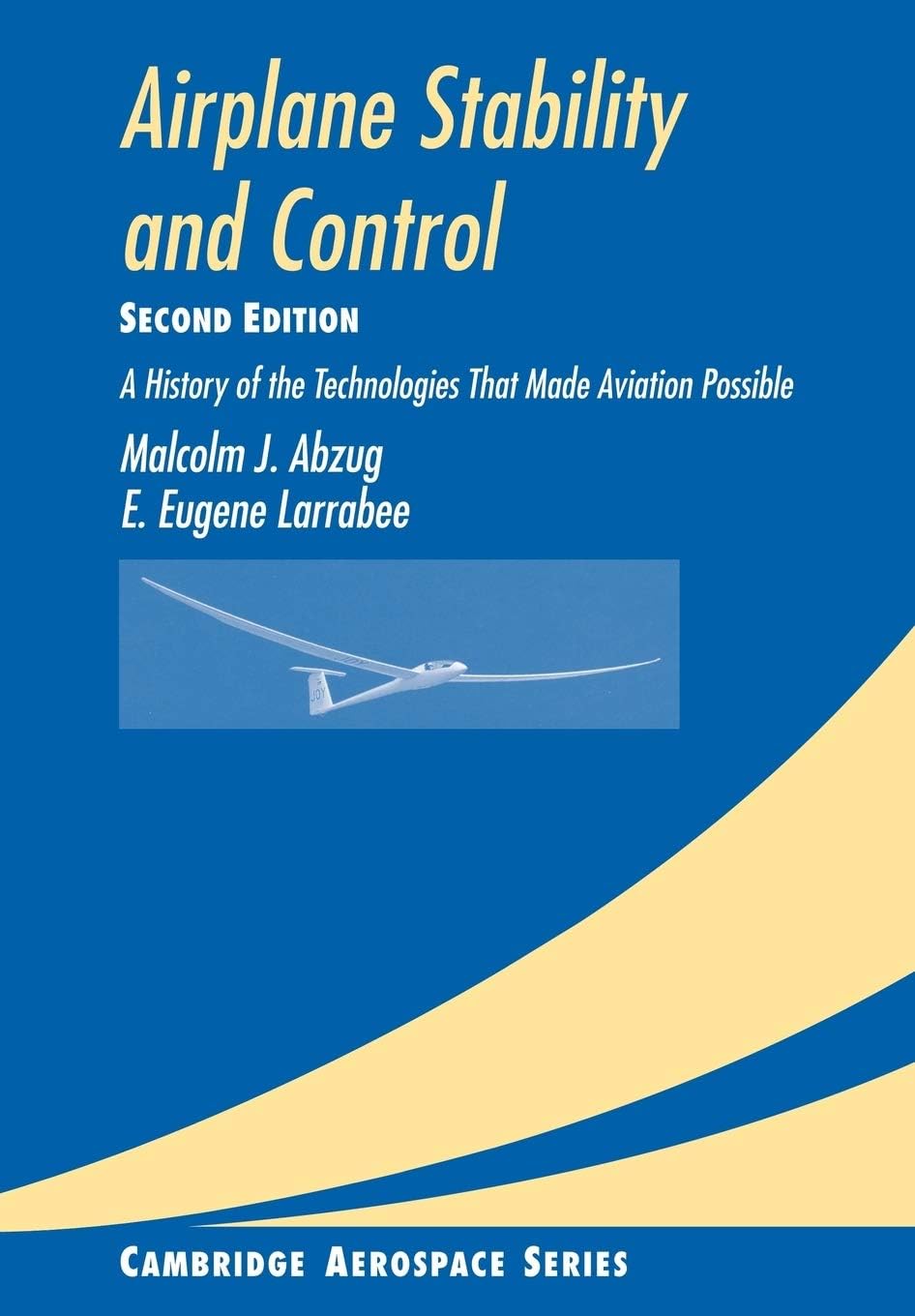


Airplane Stability and Control: A History of the Technologies that Made Aviation Possible (Cambridge Aerospace Series, Series Number 14) (Volume 0)
Desertcart purchases this item on your behalf and handles shipping, customs, and support to Hungary.
Description
The authors, widely known for their contributions to airplane design and development, have captured both the technological progress and the excitement of this important facet of aviation. This updated edition includes new developments in propulsion-controlled aircraft, fly-by-wire technology, redundancy management, applications, and safety. It is profusely illustrated with photographs and figures, and includes brief biographies of noted stability and control figures along with a core bibliography.
Specifications
| Dimensions | 6.69 x 0.94 x 9.61 inches |
| Edition | 2nd |
| Isbn 10 | 0521021286 |
| Isbn 13 | 978-0521021289 |
| Item Weight | 1.46 pounds |
| Language | English |
| Part Of Series | Cambridge Aerospace |
| Print Length | 416 pages |
| Publication Date | October 13, 2005 |
| Publisher | Cambridge University Press |
Reviews
User
Excellent book
This is a book I have waited some time to purchase, how glad I am to have eventually obtained it. The knowledge inside is worth more than the purchase price. Thank you for the excellent service you provided in obtaining my new found knowledge.
User
Covering the waterfront
The first question to ask about this work is ...for whom is it written? The authors seem to aim to practitioners in the field who may lack historical perspectives on the issues they confront. As such, working familiarity with the advanced mathematics of control systems is assumed. On the other hand, any technical professional not frightened by words like eigenvalues and linearization and so on can certainly find a lot of interesting material to think about. To such an audience, this becomes a history of the largely successful effort to understand the full complexities of maneuvering an aircraft controllably in three dimensions. It certainly makes clear that this is not a trivial matter and much that we take for granted in modern aviation was the result of a lot of hard and not very visible or spectacular work.The book is copiously illustrated both with prints of mathematical equations, charts, graphs and the like but also with contemporaneous engineering and technical pictures and schematics of actual hardware. There is a chapter-by-chapter bibliography, mostly of original papers and a useful index.The organization of the book is noteworthy in that it is broken into 24 separate topics (chapters), each with their own history, though the authors do explicitly state where cross references may be found. Many of the topics are of interest in isolation such as the deep stall phenomenon, early jet control systems, spin recovery, the specific needs of naval aviation, the effect of aeroelasticity on control, and so on.So, if not a practitioner, then a technically literate layperson with a deep interest in aviation would find much to enjoy in this work.
User
Five Stars
Great book that traces science of S&C and it's historical development.
User
Excellent reference
Excellent collection of lessons learned. Definitely a worthwhile reference to have on the shelf. Each chapter can stand alone, so read it cover to cover or just the chapters or sections that are meaningful to you.It is a little lacking in the quantitative data.
User
A "must have" book
This is simply a "must have" book for anyone interested in the dynamics of aircraft, flight control, and evolution of the modern aircraft. Airplane Stability and Control can be read as an aviation history book, as a compendium of the technical problems that arose in the development of airplanes, and as a manual for solving these problems. The book is a beacon that guides the design of new aircraft; it is technical, complex, and deep, yet it rarely refers to equations. It adds a much-needed dimension to the study of aeronautical engineering, which is increasingly focused on mathematics and numerical methods.
User
airplane stability and control
Very good undergraduate text on aircraft stability, control, and dynamic modeling. Linear algebra tools needed are developed. Easily understandable. I would recommend it.
User
Aviation history and technology
written in an interestingform in spite of the nature of the subject.The authors know what they are talking about
User
Five Stars
Good qualité. Fast delivery.
User
Tolle Übersicht
Das Buch sammelt Entwicklungen, die Hindernisse bei der Verbesserung von Flugzeugen beseitigten. Aufgelistet werden auch die Personen, die zündende Ideen hatten, nicht nur im US-amerikanischen Raum. Das Sach- und Namensregister ist hilfreich. Lebendig geschrieben mit gut sortierten Quellenangaben.
Common Questions
Trustpilot