đ¶ Unlock studio-quality sound on the goâbecause your ears deserve the best.
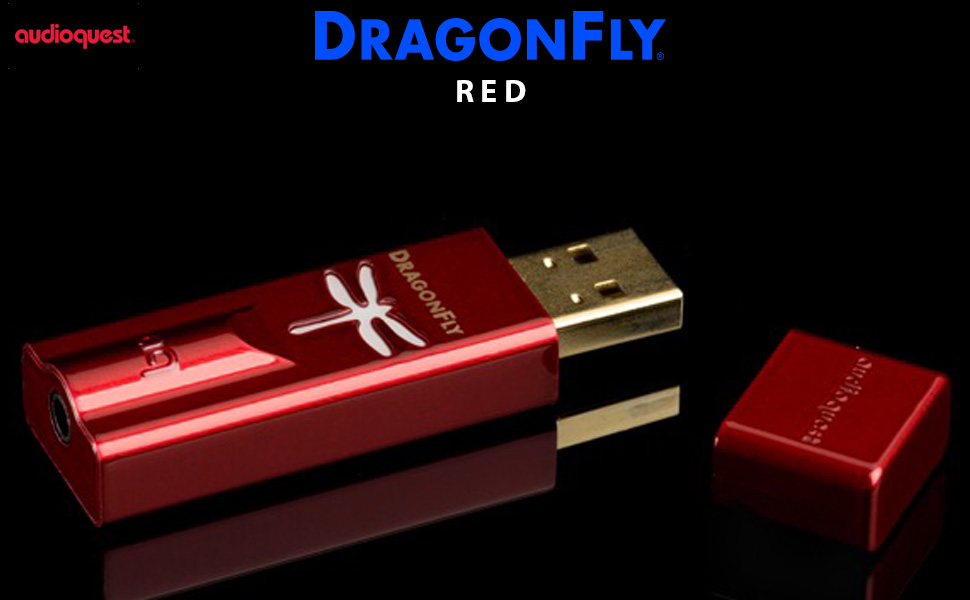
The Dragonfly Red USB Digital-to-Analog Converter is a compact, high-performance DAC featuring a 32-bit SABRE DAC2.1v chip. It enhances audio detail, transparency, and tone, driving nearly any headphones with rich, high-resolution sound. Compatible with Apple and Android devices via a simple adapter, it supports playback from MP3s up to 24-bit/96kHz files through a convenient USB Type A connection.


H**C
Whatâs Old is New Again.
Whatâs Old is New Again.All the reviews out there in the blogosphere/vlogosphere that tout the Dragonfly Cobalt and its ability to enhance your listening experience are overwhelmingly positive, so you can certainly look up any of those reviews from an expertâs point-of-view. But from an Average Guyâs view (like me), I can definitely hear the difference when using this device.I tend to listen to music in my car more so than any other place. And, for that, I usually stream music via my phone (Amazon Music HD) through the carâs AUX port. I have been doing this by simply taking a high quality 3.5mm audio stereo cable with two male heads and plugging one head into the AUX port and the other into the phoneâs headphone jack. I own an LG G8 Thinq (the last flagship phone LG made in 2019 prior to exiting the smartphone segment; and this phone features that rare headphone 3.5mm headphone jack). Back then (and even today in late 2021), that in-phone DAC was generally regarded as the best by quite a margin (the phoneâs max sample rate output is 24-bit / 48 KHz).Meanwhile, I own a 2014 BMW 3 Series and I have done lots to improve its musical components. Iâve upgraded my amplifier (Up7BMW) and all speakers/A-Pillar tweeters (FOCAL brand). And, I purchased an Equalizer app on the Google Play Store. Still, wanting higher fidelity, I then purchased the Dragonfly Cobalt DAC.Immediately, even with all of the upgrades that Iâve invested into my carâs sound system, I could hear a musical boost. And when I play my favorite songs, old and new, the enhanced fidelity peels back all of these musical elements that I had never really noticed before (a more pronounced drum beat; the sliding of the fingers along the neck of a guitar; the raw emotion of a singerâs voice; better defined strumming from a generally-hard-to-notice acoustical guitar, etc⊠- what audiophiles would describe as neutrality). Iâve read various articles stating that listening to your radio does sound muddy, which it does. You can (and I can) hear a difference when playing a CD. But, adding a good DAC takes it up one notch further, and you feel like youâre right there in the front row of a concert or at the recording studio itself.Now, your listening experience may differ because not everyone âhearsâ the same or perhaps as well. So, if seeing a number helps you to visualize improvement (although âseeing-is-believingâ is different than âhearing-is-believingâ in this case), hereâs what Iâm seeing with my LG G8 ThinQ. Without the Cobalt, the phoneâs DAC can stream music at up to a sample rate of 24-bit / 48 khz, which is pretty good. I know this because with Amazon Music HD, you can press the music quality âbadgeâ to bring up this kind of info. Now, with the Cobalt plugged in, the output increases to 24-bit / 96 khz. Iâve read that the max output, though, would be 24-bit / 192 khz, so letâs quickly talk about that pinnacle of sound quality for a second. The only way of possibly getting there from my readings (and Iâm sure there are other ways that I havenât discovered yet) is by subscribing to Tidalâs HiFi Plus Tier (which is their top tier) AND also downloading onto your phone an app called USB Audio Player Pro (also known as UAPP). Somehow â and I profess my ignorance on this as Iâm not a sound engineer â this app plus the Dragonfly Cobalt plus its ability to play well with Tidal (the technical term sound engineers use is âunfoldingâ) allows access to that 24-bit / 192 khz musical experienceAnyway, as youâll already know, the Dragonfly has this helpful light that defines the quality of the music youâre hearing. Unfortunately though, unless youâre paying $240 a year for Tidalâs top hi-res tier, that light then also gives you a sense of FOMO. I pay $80 a year for Amazon Music HD (as I am already an Amazon Prime member). Now, for just $80 a year and despite not being able to reach that 24-bit / 192 Khz threshold, I can still attain musical nirvana. So, Amazon Music HD is totally worth it. And the Dragonfly Cobalt, IMHO, is totally worth it too.But, as with all things subjective (like hearing), your mileage may vary. Will this be worth it to you? In this case, there are four things that youâll want to considerA) Can you hear the difference? Again, some of us have better hearing than others. If you canât hear much the difference between music over the radio and music on a CD, then you probably wonât hear much of a sonic upgrade here.B) How many hours a day will you use this? That is, why purchase a pricey doodad if youâre only going to use it now and then? Itâs kind of the same in-your-head argument when you think about joining a gym or subscribing to Disney+.C) Think about your music source. The idea of a DAC is to allow it to further âunwrapâ the audio file to allow for that richer listening music (again, using that term âneutralityâ). But, if youâre listening and happy with Spotify Free or any other lossy music tier (usually the free ones with possible ads), those files wonât have much to reveal anyway. The entry point at which to consider whether to invest in a DAC or not is when you are subscribing to a hi-res music service (i.e.: Quboz; Amazon Prime HD; Tidal Hi-Fi; etcâŠ).D) Finally, think about the equipment that will be outputting your sound (e.g. earphones, earbuds, speaker systems). If they are of low quality, then a DAC probably wonât do much. And keep in mind that this DAC would also probably cost MORE than most run-of-the-mill earphones, earbuds, speakers).Oh, I do want to bring up one thing if you subscribe to Amazon Music HD. I saw on their FAQ page that Amazon Music HD is not always reliable in giving max audio quality if it doesn't sense a super-fast internet connection (or maybe if a lot of subscribers are trying to stream hi-res music at the same time â letâs call it âcongestionâ), so Iâve seen the light turn both powder blue (denoting a bitstream of 96 KHz) as well as cobalt blue (denoting a bitstream 48 KHz for the same song during different times of the day, but never below that number if youâve set songs to play at HD or better quality). In fact, on its FAQ page, it does say, âFor streaming, the current source file quality may change due to varying network conditions.â So, if youâre subscribing to Amazon Music HD and see this happening, itâs not the Cobalt malfunctioning.Finally ⊠hereâs a question youâll want to ask yourself and a suggestion. Have you looked at the THX Onyx? It is also a very well-regarded DAC and probably a 2nd place runner-up if you read the various reviews out there about DACs (with the Cobalt being the consensus winner when talking about power/portability). However, at the time of this writing, the Onyx is currently on sale for $150 (down from about $200, and can be found here on Amazon or on Razer.com). Hmmm⊠$150 for the Onyx vs $330 for the Cobalt? That does make the Cobalt a tougher sell, actually.Again, the only real downer here is the price. $330 seems pricey, even though itâs a svelte yet powerful top-of-the-line product.If you are willing to consider really good dongle DACs with perhaps less of a svelte/compact form factor that cost just half as much, you may also want to check out these very worthy alternatives, also found here on Amazon.- THX Onyx, $150- Helm Bolt DAC, $150- Astell & Kern USB-C Dual DAC Cable, $100In the end, the Dragonfly Cobalt is a 5-star product (although Iâm not convinced that itâs $150 better than the THX). Iâm very happy with this product. If you tend to listen to music quite a bit to complement your day, then investing in a really good DAC like the Dragonfly Cobalt makes for a solid purchase decision.Good luck on finding what suits you best.
M**T
Phenomenal value, makes huge difference, not super durable
I have 4 of these. One developed a problem where one of thetwo stereo channels goes iut depending on how pressure is put onto the unit -- should be fixable with some solder. Another lost a piece of the blue plastic on the microphone jack end that keeps the plastic housing on. Sound quality is great and much improved over not using a stand-alone DAC. You need good source material and decent speakers to get the most out of it. I use Tidal for source material. For speakers I use Sennheiser 650HD headphones, my car's custom sound system, or a regular old receiver and speakers. All soiund great. Note that Android phones don't work well with this product -- you can use USB Audio Pro but can't take advantage of the downloaded material for offline storage you get with the Tidal app. The best cheap solution for mobility is an older iPhone so you can get full support of this product with the Tidal app and take advantage of maximum quality downloaded files so it doesn't matter if you lose internet connection. I use an iPhone 6s dedicated to this purpose that is velcroed to a wireless charger for my car.
C**L
DragonFly, if you travel by ...
DragonFly, if you travel by ... JImi would have loved this one. Want to get EVERYTHING out of your gorgeous Beoplay H6s? (1st gen, bien sur). Just link em up to the DragonFly Red and it will take less than half a day to tell the difference. Subtle, but real. You have to be in genuine listening mode. Like, I mean listening, not thinking about the world or running to catch your plane. Such palpable, audible beauty requires YOU! If you can sustain that mind, even for a while, it will make you smile. Great way to play FLAC tracks off of Tidal onto a Tab S2, via USB Audio Player Pro into H6s or HD 598s. Portable, meaning you can take it to Ecuador, or India, and enjoy it in the evenings ... not like at the gym or in the subway. You'll want a DragonTail for your Android devices. It's an OTG cable that will enable sound to flow out of the USB port, bypassing the internal DAC and Android sound circuitry. Sweet refinement for those who can Be Here Now. - CalUPDATEHave connected the DragonFly Red to my Android phone. Fantastic results with low power consumption running at 10% of total, compared to 11% for Wifi and 38% for the phone's display screen. Tremendous SQ via the Beoplay H6 1st generation, with crisp, clean details, separation of instruments, rich, full tone, and balanced bass. This rig may be a bit more portable than I thought. Not a pocket, but a very small crossbody, sling, or chest bag should do the trick. Besides, you'll want the same to stash the cans when the world demands all your sense modalities. FLAC tracks consume more storage space, but once you delete your old Mp3s, the gigs will resurface. And the DIFFERENCE will make you SMILE. The Dragonfly Red is a tremendous innovation in "portable" audiophile gear that breathes new life into your smartphone. Buy this one. - CalFINAL UPDATEPurchased both a Northern Outback Crossbody Backpack and a Small Canvas Backpack One Strap Sling Cross Body Bag for Men for traveling with my H6 and the DragonFly Red. OK, so it is indeed portable, and you can travel with this quite easily. The crossbody has a pocket big enough to hold a phone with the DragonTail OTC cable and the DragonFly Red attached. There is a port opening for the cable to your headphones. You can walk through the airport (after security <g>) and onto the plane, all hands free. The One Strap Sling allows the same configuration but with a small tablet, like a Tab S2. As the Tab S2 with an SD card can handle 150 GB of FLAC tracks, international flights are filled with very high quality sound now :-) - Fly the Dragon.
Trustpilot
2 days ago
2 weeks ago