🖤 Print with precision, power, and polish — don’t get left behind!
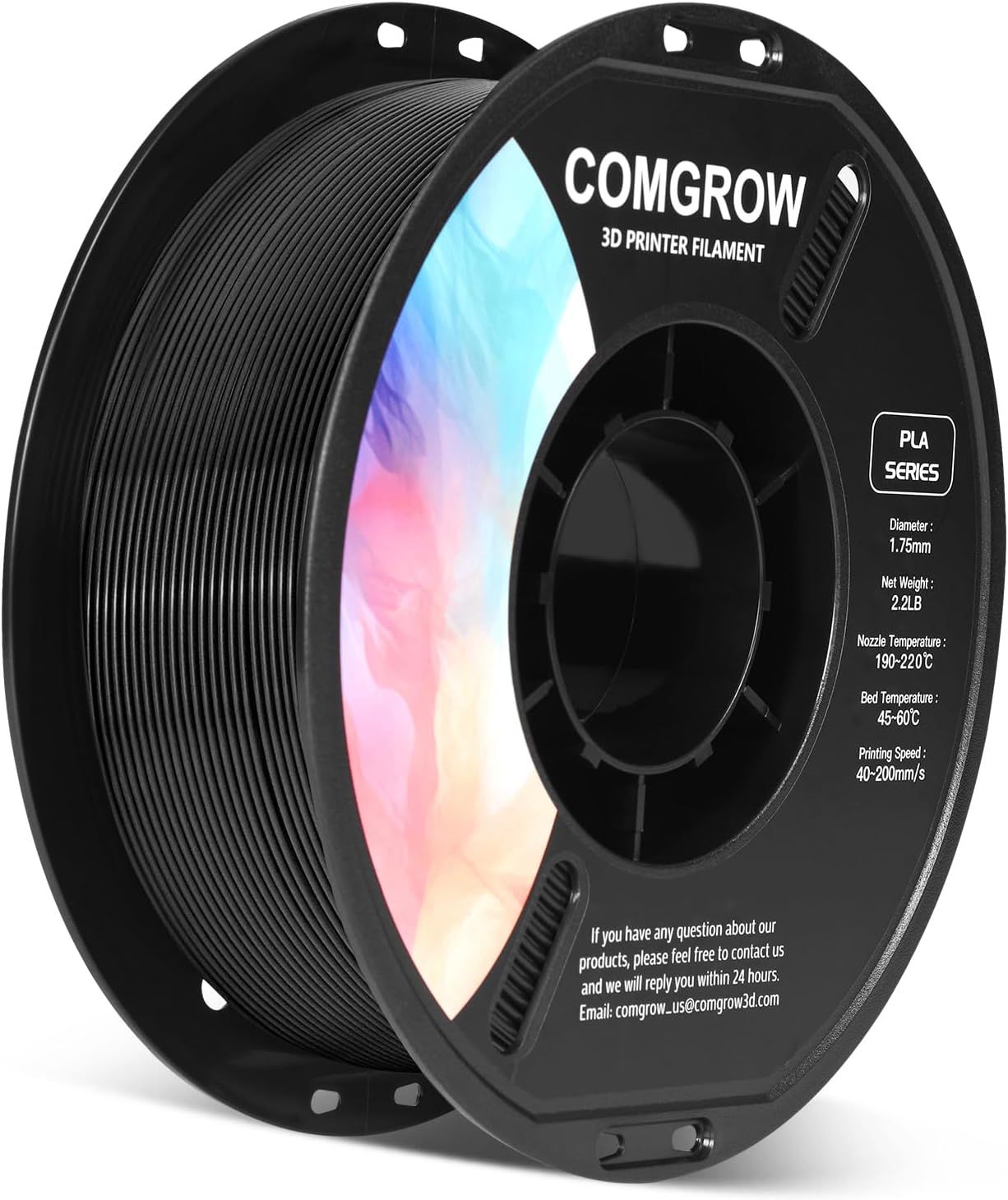
Comgrow PLA 3D Printer Filament delivers industrial-grade quality with ±0.02mm dimensional accuracy, vacuum-sealed moisture protection, and a tangle-free 1KG spool. Designed for seamless compatibility with all 1.75mm FDM printers, it ensures strong, low-shrinkage prints at an optimal 210-220°C extrusion temperature, making it the smart choice for professionals demanding reliability and flawless results.


| ASIN | B085NVCSWW |
| Additional Features | Self-adaptive control system for dimensional accuracy, Vacuum sealed with desiccant for moisture protection |
| Best Sellers Rank | #1,579 in Industrial & Scientific ( See Top 100 in Industrial & Scientific ) #18 in 3D Printer Accessories #110 in 3D Printing Filament |
| Brand | Comgrow |
| Brand Name | Comgrow |
| Color | Black |
| Customer Reviews | 4.4 out of 5 stars 4,500 Reviews |
| Item Diameter | 1.75 Millimeters |
| Item Weight | 1 Kilograms |
| Manufacturer | Creality 3D |
| Manufacturer Part Number | 3DF |
| Material | Polylactic Acid |
| Material Type | Polylactic Acid |
| Model Number | CA1F-AQ-PLA-BK 1KG |
| Number of Items | 1 |
| Special Feature | Self-adaptive control system for dimensional accuracy, Vacuum sealed with desiccant for moisture protection Special Feature Self-adaptive control system for dimensional accuracy, Vacuum sealed with desiccant for moisture protection See more |
| Unit Count | 35.274 Ounce |
M**.
Good filament dryer that can handle a pair of 1kg rolls at a time.
We print a lot on our Bambulabs a1 mini, but live in tropical Hawaii, where humidity can be an issue. This filament dryer is a major help. I use it regularly for PLA or PETG filament before printing to avoid ending up with spaghetti. It is also good for resetting desiccant bags. It only has 2 buttons, so it takes some experimentation to figure out how to get the dryer cooking and set the correct timer, but once you figure it out, it works well. You can tell it is working as condensation collects inside the lid during cook time, even with the tiny plugs open. I just open it up, swab out the condensation, and let it get back to cooking a few times when I see a very fogger up lid.
K**G
Does the job great price
Works good, especially for price vs name brands. Wish it would go over 6 hours and over 50° but other than that it does a great job. I will buy another one soon so I don’t have to switch around filaments as much.
R**Z
the perfect print
The Comgrow PLA 3D Printer Filament is a reliable and affordable option for hobbyists, makers, and professionals who need high-quality prints with consistent performance. With a 1.75mm diameter and a dimensional accuracy of +/- 0.02mm, this filament ensures smooth extrusion and precise layer adhesion, minimizing common printing issues like clogging and stringing. The 1KG spool provides ample material for various projects, from detailed prototypes to functional parts and artistic models. One of the standout features of this filament is its strong layer bonding and minimal warping, making it ideal for both beginners and experienced users. PLA (Polylactic Acid) is known for being environmentally friendly, easy to print with, and suitable for a wide range of applications, including home décor, educational models, cosplay props, and engineering prototypes. The Comgrow PLA Black filament offers a deep, rich black color with a smooth finish, making prints look professional without requiring excessive post-processing. It works well with most FDM 3D printers, and its low printing temperature (190-220°C) makes it compatible with standard heated beds at around 50-60°C. Overall, the Comgrow PLA filament provides great value for money, delivering consistent quality, good adhesion, and reliable extrusion. It’s perfect for those looking to produce high-resolution prints with minimal hassle. Whether you're a beginner exploring 3D printing or an experienced maker working on intricate designs, this filament is a solid choice for your printing needs.
J**E
It works
It works good, just gets very hot after a long period of usage. The rubber piece that closes the hole comes off easily, I lost 2 already. Contacted customer service, still waiting to hear back. The filament quality is great with this on it also enhances print speed and color which helps when I'm printing large pieces. I just wish it didn't get so hot.
J**.
Great product lives up to its worth
It looks great next to my printer it saved me from warping because I use nylon cf so it’s hard for me to print without drying this saves me a bunch of time and money
D**L
Difficult to set up, amazing once it's printing. Not for beginners.
So first off, I'm new to 3D Printing but not to technology and understanding how to fine tune things to get them to work. I am basing my review of this filament as compared to the small filament sample that is included with the Ender 3 V2 on purchase. I bought this filament, alongside the Ender 3 V2 and the CR Touch from Comgrow as part of a sale/discount. I knew I was going to need more filament than what the printer comes with, so figured I'd give Comgrow's filament a shot since I already had the order for everything else ready to go. This filament is very picky about bed adhesion. Even with a bed leveled to ~0.18 variance and the Z-Axis offset appropriately set, it can be very difficult to get this filament to stick to the bed. Once the first layer is down though, the quality of prints have been amazing. For my Ender 3 V2, I found the following settings and experiences to work the best. There's still a lot of baby sitting in the initial layer, so be aware. 210C nozzle, 65C bed. For first layer: 50% Print Speed (or lower if lots of curves), 0% fan speed. After first layer: 100% Print Speed, 100% fan speed. Always print with a brim. 5mm minimum. While the printer is printing the brim, monitor it for adhesion. It'll also give your actual print better adhesion since the initial layer will be bonding to both the bed, and the brim. On any nozzle temps over 195C, I find that this filament likes to extrude during the initial print setup, and will commonly curl back onto the nozzle and gunk it up. Anything less than 200C, and it won't adhere to the bed on the first layer. Due to this, pay attention during the first couple of line prints to make sure the nozzle doesn't have excess filament wrapped around it and that it has shed it correctly. You may need to use the needle like tool to "guide" the filament off of the nozzle before your main print starts. The filament sticks to itself amazingly, so once the initial layer is done you can ramp everything back up to 100%. I've included four photos, one of the initial layer brim of a current print going down problematically (had to lower my z-offset on the fly by 0.1 to resolve), and three photos of a print I finished yesterday. As a beginner, I like the way this stuff prints/looks after the fact but I really dislike how much babysitting I have to do with the initial layer. The filament that came with the printer was not so picky, and I'm looking forward to finding similar filaments as that. The reduced print speed in the initial layer paired with the babysitting increases the amount of time I have to actively spend to ensure that the print is going to succeed. I wouldn't buy this filament again unless I was being very picky about the aesthetics of my print, because this stuff does look great. I would not recommend it to a beginner.
D**A
Quiet
So far this has worked great for drying my filament. It is easy to work and is very quiet. This is a great deal for the price if you are just starting or printing as a hobby.
T**L
Works - but you need to know HOW it works.
Overall I am pleased, but I want to share how this performs. First off, the design changed a little from the pictures, it now has four holes for filament to feed through. Two on the top , as shown, and now two more on the front. All of the holes have silicone seals to close them off, so this is an improvement. Now for the results of my testing. I put a hygrometer inside the case and graphed the results. The unit dries the filament very slowly, so if you have filament that is very moist, you’ll likely need to run this for days to dry it. I averaged around 0.6 to 0.7% per hour (takes about 4 hours before it starts dropping). So it’s slow and steady, which is not a bad thing. Once you have it fairly dry, it will start absorbing moisture again (even if you don’t open the case). In my tests, once the drying cycle completes, the humidity inside the enclosure will start to gradually increase again. Slower than the drying cycle, but steadily increasing. The case has no openings except for filament holes (plugged for testing) and the joint between the base and lid. The drying is accomplished by heating and a small fan that just circulates the air inside the case (it is not vented to the room). So for the humidity to drop the moisture has to be seeping through the joint between the base and the lid. So when the cycle stops, the reverse starts to occur. Final thoughts: I am not pointing this out as a flaw (I still gave it 5 stars), but rather to help others to understand how the device works/behaves. So now I know that the device will need to be run periodically to maintain the target moisture level in the filament AND that the dryer itself is not a good long term storage box. Once filament is dry and won’t be used for a while, it should be stored in something that is air tight to maintain the proper moisture levels.
Trustpilot
3 weeks ago
5 days ago