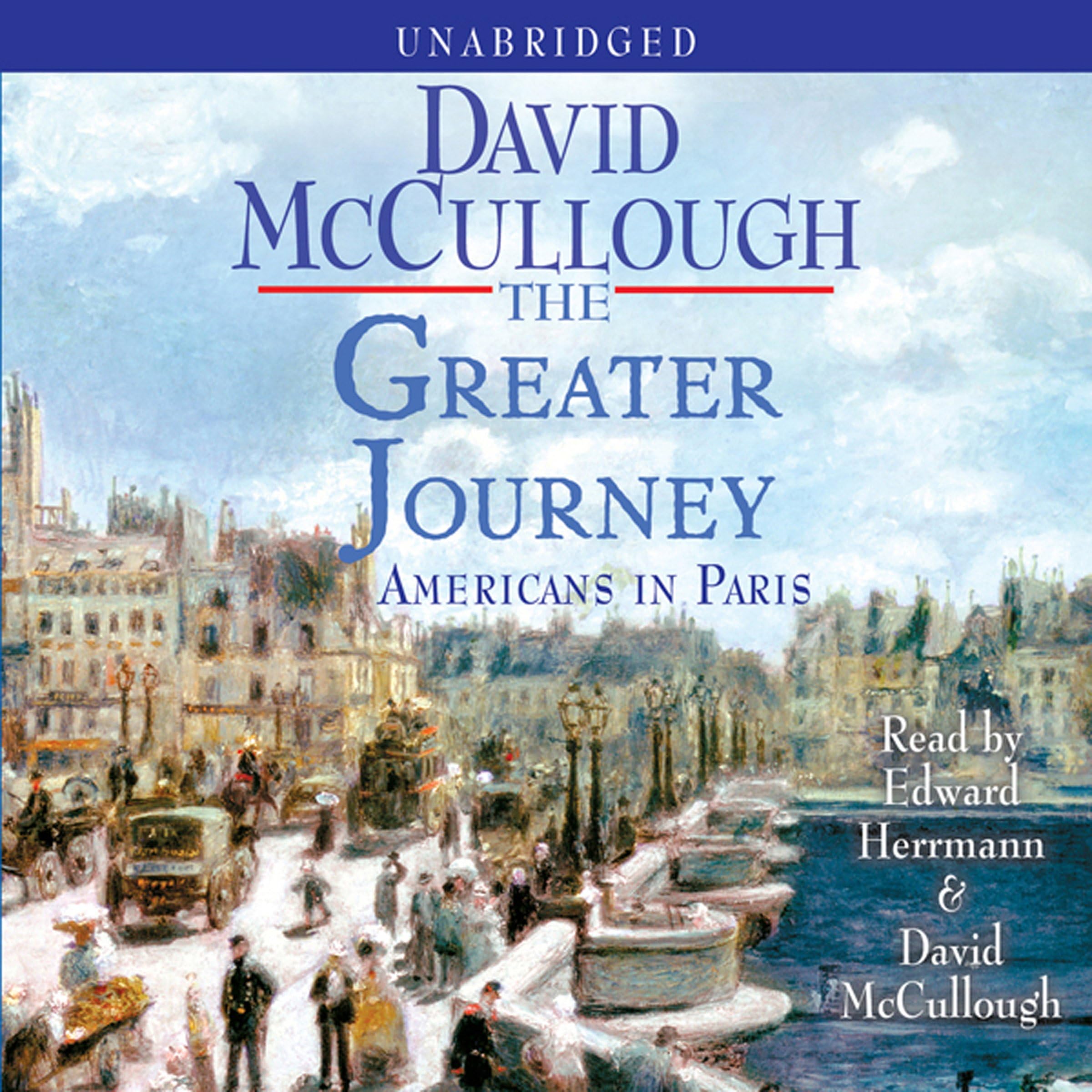

The #1 bestseller that tells the remarkable story of the generations of American artists, writers, and doctors who traveled to Paris, fell in love with the city and its people, and changed America through what they learned, told by America’s master historian, David McCullough. Not all pioneers went west. In The Greater Journey , David McCullough tells the enthralling, inspiring—and until now, untold—story of the adventurous American artists, writers, doctors, politicians, and others who set off for Paris in the years between 1830 and 1900, hungry to learn and to excel in their work. What they achieved would profoundly alter American history. Elizabeth Blackwell, the first female doctor in America, was one of this intrepid band. Another was Charles Sumner, whose encounters with black students at the Sorbonne inspired him to become the most powerful voice for abolition in the US Senate. Friends James Fenimore Cooper and Samuel F. B. Morse worked unrelentingly every day in Paris, Morse not only painting what would be his masterpiece, but also bringing home his momentous idea for the telegraph. Harriet Beecher Stowe traveled to Paris to escape the controversy generated by her book, Uncle Tom’s Cabin . Three of the greatest American artists ever—sculptor Augustus Saint-Gaudens, painters Mary Cassatt and John Singer Sargent—flourished in Paris, inspired by French masters. Almost forgotten today, the heroic American ambassador Elihu Washburne bravely remained at his post through the Franco-Prussian War, the long Siege of Paris, and the nightmare of the Commune. His vivid diary account of the starvation and suffering endured by the people of Paris is published here for the first time. Telling their stories with power and intimacy, McCullough brings us into the lives of remarkable men and women who, in Saint-Gaudens’ phrase, longed “to soar into the blue.” Review: Masterful Writer McCullough Makes 19th Century Paris Come ALIVE - FIVE STARS !!!!! - Every time David McCullough puts his fingers to the typewriter that he uses to write with, he seems to transform our understanding of the topic he is studying. Whether it was President Harry Truman or for me Mornings on Horseback, I have walked away from his books with an enlightened feel for the topic that I have only been able to achieve with very few authors. James Michener is one who comes to mind immediately. With this book, The Greater Journey, the author has now thoroughly engaged the reader with a topic seldom written about but very deserving of study. It is only natural that we as Americans feel we live in a self centered world; after all we have 2 vast oceans that have protected our shores from invasion for several centuries, and probably will for several more. It simply does not occur to us that since our beginnings, many Americans have chosen to spend considerable time abroad, and in some cases decades of their lives. During the 1800's and specifically from 1830 until 1900, there was a wave of intellectual migration that headed not west to America, but east to Paris, France from America. Keep in mind that we now sit in a country that is preeminent in the world, financially, intellectually, and probably culturally as well. Back then, we were just forming as a nation. The Indian wars were still in process, and the Civil War would also take place, which became the second re-creation of the United States. McCullough is totally aware of this comparison and makes wise use of it throughout this 456 page book composed of 14 distinct chapters separated into 3 parts, followed by a wonderful epilogue, and a very useful bibliography. The author understands history, and is always mindful of the relative positions of different nations. During this period we were not yet the top dog that we were to become after World War I. Europe still controlled the world's greatest universities and they were already centuries old. If you are going to read this book in a physical format as opposed to the Kindle digital version, you are in for a treat because the paper chosen is exquisite, and the font selection is superb. If you are an older reader as I am, you will appreciate the time that was taken to design the book appropriately for readers that still relish a physically well made book, and that's what we have here. This is the story of a 70 year period in the history of Paris, and the scores of Americans who occupied it, lived there, and helped participate in the transformation of what is called the city of light. It is also the story of scores of for want of a better word can be called expatriate Americans, although many of them did return to their native United States at different times. McCullough is one of the few authors who truly captures the essence of an environment and then proceeds to envelop it with a reality that absorbs and perhaps even demands our attention as readers. His description of the relationship between James Fennimore Cooper and Samuel F.B. Morse and their joy in living in this magnificent city and the effects it had on their work will remain in the reader's soul for many years after the book is put back on the shelf. When Morse painted his masterpiece, it was done in Paris, and perhaps after reading this book, one realizes it could only have been done in Paris. The city of lights already had vast boulevards, and extraordinary parks decades before the United States designed them. Indeed, New York City's Central Park which would be created later in the century would take much from Paris, and other European cities. The Americans who would go to Paris and spend years there would recall later after returning to the United States the joy of the parks, the energy of the city itself and the sheer unequalled cultural delights that embodied Paris. Visually we can still see much of this in the work of the Impressionist School of painting. I found the author's handling of Mary Cassatt, who was a Philadelphia born daughter of American socialites who went on to be an illustrious painter as a principal part of the Impressionist school, to be particularly well done. Her relationship to Edgar Degas the renowned painter of the ballet and horses, as well as landscaping is thoroughly chronicled in the book. McCullough's ability to weave life into life, with Paris as the focal point constantly holding the book together in such a way that the reader feels compelled to continue to read, not pausing to eat is what in the end keeps the author at the pinnacle of his profession today. It is obvious that this book was a labor of love for the author. It comes shining through with the admiration that McCullough holds for both Oliver Wendell Homes the American medical student in Paris, and Ralph Waldo Emerson, a name we all recognize. He even takes the time to take us through the time that Mark Twain spent in this wonderful city. Not only was Paris transformed by the Americans that occupied it during this century, but Paris itself went through extraordinary changes and development. Kings re-invented the city several times during this century. Vast numbers of poor were displaced and sent to the country. It was invaded during this period as well. Later vast tree lined streets and boulevards would be created that became the envy of Europe. The Louvre would be increased in size enormously in an attempt to make it the most important museum on the entire continent, and France would succeed in this effort. McCullough intertwines the story of Paris, its growth, its impact on the Americans and what the Americans brought back to America as a result, into a book in such an imaginative way that the reader will find himself revisiting this book from time to time. In the end the book is riveting, and this is a phrase I find myself continuing to use every time I pick up a book written by this author. Many lives are captured in this masterpiece. They include George Healy the portrait painter, Nathaniel Hawthorne whose writings still continue to occupy many a college freshman's late nights, and future American Senator Charles Sumner who would have his views on slavery refined while living in Paris. Indeed he became an abolitionist as a result of his Parisian experience. CONCLUSION: Prior to reading The Greater Journey, I believed I had a good understanding of 19th century Paris. Having studied the art of that period, going to the Louvre, and sitting in on lectures dealing with Paris in the 1800's, I looked forward to seeing what this author could add to the story. I did not expect what I got, which was to have him blow away my understanding and replace it with something that came alive and stood on many different legs of understanding, but isn't that what great writing can do. It can simply make things come alive again. You feel as though you are there, and McCullough puts us right there in the thick of the action. Although it is not the whole story, if you have any interest at all in understanding the transformative art period that was the Impressionist movement it is vividly captured here in the lives of Augustus Saint-Gaudens with John Singer Sargent, and Mary Cassatt. David McCullough is already an acclaimed author with two Pulitzers and two national Book Awards, and it looks like with this book, he's got another Pulitzer coming down the pike. Thank you for reading this review. Richard C. Stoyeck Review: Americans in the thrall of Paris - As someone who has spent considerable time there and loves the city, I enjoyed much of "The Greater Journey:Americans in Paris". Had it been about a place that I wasn't so taken with, I would have to say that McCullough's book is a bit erratic in its focus, kind of flat in the presentation of its characters and dull in explication of the historical context. In any event, I learned a lot about how and why many important 19th Century Americans were drawn to Paris for education, culture or simple hedonistic reasons. McCullough's focus on the 19th Century only fills in some gaps in this specific historic relationship whereas as the 20th Century has long been the greater period of interest and writing and the ex-pat Americans of that period far better known to 21st Century readers. As several reviewers have pointed out, "The Greater..." offers some good, if brief, commentary on the history of the city itself, particularly on the Franco-Prussian War and the Communard uprising that followed. The period of the 1889 Paris Exposition is also well-detailed and interesting. On the other hand, while a lot is reported about meetings of Americans with King Louis-Philllipe in the early part of the century, there isn't much background offered on how the man got to the throne. Louis-Phillipe's own connection with the U.S. is mentioned briefly, but only enough to whet the appetite for more.. Overall, I have to agree with both the reviewers who waxed enthusiastic about the book and those who were disappointed. It's an entertaining story, with a lot of insight into a particular history of an endlessly fascinating city. It is very well (if unevenly) documented, drawing on first-person sources. At the same time, it does lack some of the snap and sparkle of a book where the author has pulled together more three-dimensional characters from the body of resources at hand. But maybe McCullough would argue that that isn't the proper role for a historian?
R**T
Masterful Writer McCullough Makes 19th Century Paris Come ALIVE - FIVE STARS !!!!!
Every time David McCullough puts his fingers to the typewriter that he uses to write with, he seems to transform our understanding of the topic he is studying. Whether it was President Harry Truman or for me Mornings on Horseback, I have walked away from his books with an enlightened feel for the topic that I have only been able to achieve with very few authors. James Michener is one who comes to mind immediately. With this book, The Greater Journey, the author has now thoroughly engaged the reader with a topic seldom written about but very deserving of study. It is only natural that we as Americans feel we live in a self centered world; after all we have 2 vast oceans that have protected our shores from invasion for several centuries, and probably will for several more. It simply does not occur to us that since our beginnings, many Americans have chosen to spend considerable time abroad, and in some cases decades of their lives. During the 1800's and specifically from 1830 until 1900, there was a wave of intellectual migration that headed not west to America, but east to Paris, France from America. Keep in mind that we now sit in a country that is preeminent in the world, financially, intellectually, and probably culturally as well. Back then, we were just forming as a nation. The Indian wars were still in process, and the Civil War would also take place, which became the second re-creation of the United States. McCullough is totally aware of this comparison and makes wise use of it throughout this 456 page book composed of 14 distinct chapters separated into 3 parts, followed by a wonderful epilogue, and a very useful bibliography. The author understands history, and is always mindful of the relative positions of different nations. During this period we were not yet the top dog that we were to become after World War I. Europe still controlled the world's greatest universities and they were already centuries old. If you are going to read this book in a physical format as opposed to the Kindle digital version, you are in for a treat because the paper chosen is exquisite, and the font selection is superb. If you are an older reader as I am, you will appreciate the time that was taken to design the book appropriately for readers that still relish a physically well made book, and that's what we have here. This is the story of a 70 year period in the history of Paris, and the scores of Americans who occupied it, lived there, and helped participate in the transformation of what is called the city of light. It is also the story of scores of for want of a better word can be called expatriate Americans, although many of them did return to their native United States at different times. McCullough is one of the few authors who truly captures the essence of an environment and then proceeds to envelop it with a reality that absorbs and perhaps even demands our attention as readers. His description of the relationship between James Fennimore Cooper and Samuel F.B. Morse and their joy in living in this magnificent city and the effects it had on their work will remain in the reader's soul for many years after the book is put back on the shelf. When Morse painted his masterpiece, it was done in Paris, and perhaps after reading this book, one realizes it could only have been done in Paris. The city of lights already had vast boulevards, and extraordinary parks decades before the United States designed them. Indeed, New York City's Central Park which would be created later in the century would take much from Paris, and other European cities. The Americans who would go to Paris and spend years there would recall later after returning to the United States the joy of the parks, the energy of the city itself and the sheer unequalled cultural delights that embodied Paris. Visually we can still see much of this in the work of the Impressionist School of painting. I found the author's handling of Mary Cassatt, who was a Philadelphia born daughter of American socialites who went on to be an illustrious painter as a principal part of the Impressionist school, to be particularly well done. Her relationship to Edgar Degas the renowned painter of the ballet and horses, as well as landscaping is thoroughly chronicled in the book. McCullough's ability to weave life into life, with Paris as the focal point constantly holding the book together in such a way that the reader feels compelled to continue to read, not pausing to eat is what in the end keeps the author at the pinnacle of his profession today. It is obvious that this book was a labor of love for the author. It comes shining through with the admiration that McCullough holds for both Oliver Wendell Homes the American medical student in Paris, and Ralph Waldo Emerson, a name we all recognize. He even takes the time to take us through the time that Mark Twain spent in this wonderful city. Not only was Paris transformed by the Americans that occupied it during this century, but Paris itself went through extraordinary changes and development. Kings re-invented the city several times during this century. Vast numbers of poor were displaced and sent to the country. It was invaded during this period as well. Later vast tree lined streets and boulevards would be created that became the envy of Europe. The Louvre would be increased in size enormously in an attempt to make it the most important museum on the entire continent, and France would succeed in this effort. McCullough intertwines the story of Paris, its growth, its impact on the Americans and what the Americans brought back to America as a result, into a book in such an imaginative way that the reader will find himself revisiting this book from time to time. In the end the book is riveting, and this is a phrase I find myself continuing to use every time I pick up a book written by this author. Many lives are captured in this masterpiece. They include George Healy the portrait painter, Nathaniel Hawthorne whose writings still continue to occupy many a college freshman's late nights, and future American Senator Charles Sumner who would have his views on slavery refined while living in Paris. Indeed he became an abolitionist as a result of his Parisian experience. CONCLUSION: Prior to reading The Greater Journey, I believed I had a good understanding of 19th century Paris. Having studied the art of that period, going to the Louvre, and sitting in on lectures dealing with Paris in the 1800's, I looked forward to seeing what this author could add to the story. I did not expect what I got, which was to have him blow away my understanding and replace it with something that came alive and stood on many different legs of understanding, but isn't that what great writing can do. It can simply make things come alive again. You feel as though you are there, and McCullough puts us right there in the thick of the action. Although it is not the whole story, if you have any interest at all in understanding the transformative art period that was the Impressionist movement it is vividly captured here in the lives of Augustus Saint-Gaudens with John Singer Sargent, and Mary Cassatt. David McCullough is already an acclaimed author with two Pulitzers and two national Book Awards, and it looks like with this book, he's got another Pulitzer coming down the pike. Thank you for reading this review. Richard C. Stoyeck
B**)
Americans in the thrall of Paris
As someone who has spent considerable time there and loves the city, I enjoyed much of "The Greater Journey:Americans in Paris". Had it been about a place that I wasn't so taken with, I would have to say that McCullough's book is a bit erratic in its focus, kind of flat in the presentation of its characters and dull in explication of the historical context. In any event, I learned a lot about how and why many important 19th Century Americans were drawn to Paris for education, culture or simple hedonistic reasons. McCullough's focus on the 19th Century only fills in some gaps in this specific historic relationship whereas as the 20th Century has long been the greater period of interest and writing and the ex-pat Americans of that period far better known to 21st Century readers. As several reviewers have pointed out, "The Greater..." offers some good, if brief, commentary on the history of the city itself, particularly on the Franco-Prussian War and the Communard uprising that followed. The period of the 1889 Paris Exposition is also well-detailed and interesting. On the other hand, while a lot is reported about meetings of Americans with King Louis-Philllipe in the early part of the century, there isn't much background offered on how the man got to the throne. Louis-Phillipe's own connection with the U.S. is mentioned briefly, but only enough to whet the appetite for more.. Overall, I have to agree with both the reviewers who waxed enthusiastic about the book and those who were disappointed. It's an entertaining story, with a lot of insight into a particular history of an endlessly fascinating city. It is very well (if unevenly) documented, drawing on first-person sources. At the same time, it does lack some of the snap and sparkle of a book where the author has pulled together more three-dimensional characters from the body of resources at hand. But maybe McCullough would argue that that isn't the proper role for a historian?
J**K
Delightful Stories, Beautifully Told
I have a colleague who likes to say of her favorite authors that, if they wrote a book about paint drying, she'd be delighted to read it. Though perhaps exaggerated, I feel that just this sentiment applies here. I am, by training, a theologian and a biblical scholar. By avocation, I am a reader of history but usually of the mid-20th century (World Wars, Civil Rights, etc). Thus, a book on Americans in 19th-century Paris is anything but my area of expertise or interest. Reading about 19th-century Europe is about as close as I come to reading works of the "paint-drying" variety. Yet, David McCullough has once again managed to captivate me with these interwoven stories of inventors, doctors, and artists and the deep entwinement that marks American and French history. The book is interesting, first of all, because the book centers on a place rather than a person (McCullough is perhaps first thought of by most as a biographer), so I was curious to see if and how he could "bring to life" a 19th-century city. Of course, this is the David McCullough of "John Adams" fame, so there was never much in the way of doubt as to what he could actually accomplish. There is an unbelievable ease to his writing. Though his scholarship is immense (especially when you consider all the excerpts from personal letters and diaries), it never weighs the story down nor does it give the book the "clunky" feel so common to most academic works. Perhaps that is due to McCullough's virtually-inerrant sense for the "telling" anecdote that encapsulates the point or captures the spirit of what he is trying to convey. Here are stories of the formative years of many of America's "leading lights" of the 19th century: Samuel F.B. Morse, George Catlin, Mary Cassatt, Oliver Wendell Holmes, and John Singer Sargent, among others…all told with ease and grace and fine sense of the entanglement that makes human life and society so rich and exciting. If the book does anything, I believe it shows, first of all, the deep kinship that bonds the United States of America to the country of France. It also reminds me that, though world history is vast and complicated, for all intents and purposes, the modern world revolved around Paris for much of the 19th century…artistically, technologically, medically, politically. Perhaps our postmodern ethos has made us so intent on telling the "forgotten" stories of history (a moral duty, no doubt) that we've almost lost the ability to discern the "pivotal" stories that have shaped not just the contemporary moment but the trajectories of decades and even centuries to come. There are "centers" to world events (assuredly not all Western European or North American), and McCullough's thoughtful portrayal has me considering where such influence might be found today. That is the ultimate power of good history: to recall the past in such a way as to reshape our comprehension of the present. And that is precisely what David McCullough's work unfailingly does.
J**N
History at its best.
From the year 1830 to about the 1900's many Americans crossed the Atlantic in search of an education in France. Their objective was to improve themselves and bring back to the US the knowledge they could only then acquire in the French capital, Paris. Politicians, doctors, writers and artists endured the trip driven by a desire to learn and expand their horizons. In most cases, they arrived in Paris with no money, no knowledge of the language and very little idea of what they should expect. Due to the difficulty of the trip, they stayed years in Paris, worked very hard and absorbed every idea they were exposed to. Their stories are amazing and very illuminating. The result of their journey was an elite group that really launched the US on its way to occupy its place at the forefront of civilized nations. Many books have been written about the original Franco-American relations after the Revolutionary war (Jefferson, B. Franklin, etc...) . Also, most people are familiar with the 20th century iconic Americans that paid a visit to the City of Lights (Heminway, Gertrude Stein or Scott Fitzgerald.). But the period covered in McCullough's book is a little more obscure even though it is by no means less important. It's the time of the American Civil War and the Third Republic in France, the time of Abolitionism and the Commune. These were tumultuous times by any standard and it is simply amazing to read about the talented people that risked everything not only for personal glory but to bring back to America culture and new ideas. For some reason the first three chapters of this book are a bit hard to get through however. These chapters deal will writers like Fenimore Cooper and doctors like Wendell Holmes. But by chapter five I wasn't able to put it down. First, the book has a nice way of weaving the stories of all the characters involved and follow them across time and historical events. Secondly, the biographies of these Americans were indeed interesting, even exceptional. Who knew Morse was a very talented painter before going on to invent the telegraph for example? That the first american female doctor graduated in Paris. Painters like George Healy, O. Tanner, Beckwith, Singer Sargent and Mary Cassatt. Sculptors like Saint-Gaudens. Politicians like Sumner and Wishburne. The American colony in Paris grew and was tested at times by the various upheavals that shook France and the US, the Franco-Prussia war and La Commune being probably the most dramatic and violent fro the french residents but also, of course, the American Civil War. McCullough is a good writer in that he is able to convey not only the facts but also delves into the difficulties, heroism, and even moods of the people he writes about by researching their correspondence and documents. I recently read a book that would be the perfect companion to McCullough's but from the perspective of french painters: "The Judgement of Paris" . As a painter myself, I found interesting to know that both Manet and Wishburne were both inside Paris during Bismarck's siege, that Singer Sargent and many other American painters were competing with the likes of Meissionier and the group that would eventually become the "Impressionists" for medals in the Salon. But also the conditions in which artists worked and studied in France would interest any art student today and put things in perspective as to what being an artist meant and means today. The statue of Liberty, the Tower Eiffel, the Smithsonian Institute , many monuments and museums that adorn American Cities, ideas about science and politics, art collections and emblematic artworks... they all make an appearance, step down from their pedestal and become alive , controversial and relevant once more.
S**.
Inspiring - like the city itself
In his latest book, David McCullough switches gears and writes about 19th-century Paris and the irresistible pull that the City of Light had on American artists from 1830 to 1900. I thoroughly enjoyed this book and learned a great deal about American artists of this period. In the first section of this three-part book, each of which covers a period of 20 or so years, McCullough explains that Paris was not only the center of the arts' world but the leading hub for medical research. He shows us Paris from the point of view of artists and medical students who made the month-long journey by sea (at the time that the book begins, sailing ships were the means of transportation, soon to be replaced by steam-powered ships), describing their first impressions of a city that was much larger than any U.S. city of the time. Letters sent to loved ones back home provide some vivid snapshots, like this one from artist Augustus Saint-Gaudens: "... I stood bewildered with the lights of that square and the avenues des Champs-Elysees bursting upon me. Between the glory of it all and the terrible weight of the bag... I made my way up the interminable avenue des Champs-Elysees to the Arc de Triomphe." Paris gave these aspiring artists access to museums where they could view great works of art and to the "ateliers" where they received training. Some artists, like John Singer Sargent, turn out to be far more talented than their teachers. The environment of the city provided crucial inspiration, and many would travel to the city several times throughout their lives. When an ill and depressed Saint-Gaudens travels back to Paris, the city literally saves him, preventing him from committing suicide. "... it was Paris - the morning light of Paris, the sparkle of the Seine from the Pont des Arts, the architecture of Paris - that had saved him." "The Greater Journey" works both as a history of Paris during this time period and as a series of mini-biographies. In part two, which delves into the siege of Paris during the Franco-Prussian War and the persecution that took place during the Paris Commune, the book at times becomes more of a general history of Paris. This section is worthwhile, but I was glad when part three resumed its focus on the lives of the artists. McCullough's appreciation of Paris and of the artists' works shines throughout, and he provides insight into the artistic process. For instance, he explains that the artist Saint-Gaudens often created as many as 17 models, each one slightly larger, before creating his full-scale sculptures. And here's a great description of the artist John Singer Sargent as he paints a portrait of the famous writer Robert Louis Stevenson: "Palette in hand, brush in the other, Sargent would look at his subject then advance on the canvas, as if in a duel, make a few swift strokes, back off, look again, then advance again and again, and all the while talking." All-in-all, this is a must-read for anyone who's interested in Paris and its influence on important American artists of the 19th century.
D**Y
History through one man's eyes
I bought this book because David McCullough's books are always a fascinating way to learn history. I have traveled to Paris a few times myself, so I looked forward to it. Unlike his other books, though, instead of telling a single story, this is a collection of anecdotes, describing the many different reactions Americans had to Paris. It is interesting, for example, to see the difference between the kinds of people who traveled there at the beginning of the century-young (usually broke) adventurers-and those who traveled later-the wealthier ones. Mr. McCullough tells the stories well, and it was interesting to imagine these people leaving North America for the first time, only to discover that people out there don't think like we do. Instead of the rough frontier, Paris was a fascinating collection of urban architecture and people. After all, none of them had the benefit of brochures or other guides to give them an idea of what to expect. The travelers by and large showed themselves well, however, and America was well represented. The thing that was remarkable to me about the book was how much it drove home the fact that my American education had left me quite ignorant of the history of 19th Century France. The successions of revolutions, the Prussian siege of Paris, the Paris Commune--These were all new to me. I have recently learned, however, that my lack of historical education left me vulnerable to Mr. McCullough's biases. I mentioned to my European wife that I was learning about the Paris Commune as a source of great brutality, and when it was clear that that was all I had learned about it, she was shocked. Not that the brutality wasn't there, but the Paris Commune had an impact on world history that went far beyond the two months of difficulties described by Mr. McCullough. My wife required me to do some homework. I started with the Encyclopedia Britannica. There was no mention of it. Hmm. Telling. So, I went to Wikipedia. There is a most interesting and comprehensive article there. It turns out that what happened was important. Yes, it was brutal. This, however, was the first time the working classes had taken power during the industrial revolution. The aristocracy was being overturned by thousands of workers. This was an inspiration for Karl Marx. In the course of its short tenure, a few decrees were implemented: - separation of church and state - abolition of night work I ht hundreds of Paris bakeries. - the granting of pensions to the unmarried companions and children of National Guards killed on active service, - the right of employees to take over and run an enterprise if it were deserted by its owner. - plus several others in the same category. Women organized the first feminist movement in Europe. Yes, the aristocracy took it back after two months. But this was the first rumbling of a real recognition that the industrial revolution, with its benefits to the capitalist owners and its hardships for the workers was not an entirely happy affair. Of course, the wealthy Americans who could afford to travel to Paris were not conscious of this, and since Mr. McCullough's book is focusing on their personal experiences, he may be forgiven for not having put the Paris Commune in this perspective. But, as I said, this is one of the few opportunities for me to learn something of the history of Paris, and I feel short-changed for not having seen at least an acknowledgement of the significance of this admittedly terrible experience. One other complaint: In the first part of the book, he takes great pains to describe the experiences of the medical students, including Oliver Wendell Homes. Having the opportunity to study at the world's most famous hospitals was a true privilege. At one point he does mention that, in spite of all the work done to expand the body of knowledge of medicine, most people who came into the hospital died. But it is only a passing mention. Ok, this isn't the book in which to describe lonely campaign of the Hungarian Doctor Ignac Semmelweis in his attempt to have doctors in Vienna wash their hands after handling corpses and before touching patients. He did extensive study and effectively proved that disease could be passed from doctors and nurses to patients. But the medical establishment would have none of it. What Mr. McCullough could have pointed out, however, was that it was the American, Oliver Wendell Holmes, based on his experience in Paris, who took up the campaign when he returned to the US. As with the European medical community, it was a hard sell in the United States as well, but Oliver Wendell Holmes was the champion that eventually got it recognized. As always, Mr. McCullough's book is interesting and entertaining to read, but his carelessness with history costs him two stars.
F**N
Not All Pioneers Went West
"Not all pioneers went west," ends the first chapter in David McCullough's newest book, "The Greater Journey". Paris has long captivated the hearts and minds of late 20th and 21st century Americans. The Paris that first pops into mind for most, though, is that of Hemingway's "Moveable Feast". The Jazz Age. The Paris of F. Scott and Zelda Fitzgerald. Of late night cocktails in sleepy cafe corners. Of writers and painters with oversized egos, and a Falstaffian disposition towards work, a self-assured gluttony. This much-adored Paris is the underground dream-world of Owen Wilson's character in Woody Allen's newest film, "A Midnight in Paris". McCullough, however, in "The Greater Journey", chooses to tell the story of an earlier generation of American immigrants. Those of a time when ambitious Americans, growing up in the infant stages of their native country, had to look east to the City of Lights for continuing education and career advancement opportunities. The period from 1830-1900 was a time before the United States had established itself as the center of higher learning, and the place that immigrants from all over the world travelled to in search of knowledge. For Oliver Wendell Holmes, Samuel Morse, James Fenimore Cooper, John Singer Sargent, and all the characters in "The Greater Journey", Paris was that city. McCullough's characters, because of the earnestness of their endeavors, are far more the heroic protagonists then those that epitomized later generations. They were not the savant flaneur that Hemingway was. They were not like Charlie, the autobiographical protagonist in Fitzgerald's 1931 short story "Babylon Revisited", who spent his immigrant days in Paris before the 1929 stock market crash making "nothing out of something" by "catering to vice and waste on an utterly childish scale." "The Greater Journey's" oldest heroes, for one, were men that knew and admired the Marquis de Lafayette, friend to Washington and Jefferson, who embodied much of the principles that the Founding Fathers had used to sustain them in their fight for freedom. The common thread of every one of the east-going pioneers in "The Greater Journey" are that they were all tireless workers. They were men and women that worked to make a difference. They worked to live the life they had envisioned for themselves. Work, they knew, not chance, not anything else, was their only passport to their personal hopes, duties, and aspirations. Wendell Holmes, one of "the Medicals" who had come to Paris in search of the most advanced medical training available in the world at the time, wrote to his father of the experience, "I have never been so busy in my life...The lessons are ringing aloud through all the great hospitals. The students from all lands are gathered..." James Jackson Jr., a peer of Holmes', is characterized by his father as a man who "rejoiced openly when he made an acquisition in knowledge." One can imagine a young man or woman from Beirut or Bucharest in 2011, walking down the halls of Harvard, its ceilings stretching skyward, the whole place and time overwhelming them with the very feeling that Holmes and Jackson Jr. trumpeted in their letters centuries ago: that they are part of something, at a center of learning, a place where knowledge, the opportunity to learn, to work, to discover something entirely new is readily available for those willing and able to put forth the effort. McCullough, through his love of history and his belief in the transformative power of books and knowledge, has done in "The Greater Journey" what he has done so many times before: made history come alive. McCullough, through this book, has hopefully spurred the American psyche, and awoken it to a time in its own history that had temporarily lost the allure it deserves, obscured as it was underneath the white, glitzy ballroom lights of Hemingway and Fitzgerald's Roaring 20's. McCullough's world is no Babylon. It has more staying power. McCullough in this book proves that the American immigrants of the 19th century simply needed an author- dedicated to the same principles as they- to renew modern-day reader's focus on their forbearers grand accomplishments. In this book, McCullough has done as right by these American pioneers of the 19th century, as they by him.
J**E
This is such an interesting reas
Perfect condition. A wonderfull book to escape from the heat.
S**B
Four Stars
Good insight on those times
B**A
Endeavour
This is a beautifully written and interesting narrative, concerning those Americans who sailed or came by steamer ships from New York and other eastern seaboard ports and as far south as Louisiana to France. Some arrived at Le Havre, others at Calais and Boulogne, after which they faced an onward 24 hour journey to Paris by a diligence. It certainly raises the question - what drove these Americans to undertake such a potentially dangerous crossing of the Atlantic, not necessarily speaking any French and having, in most cases, limited financial resources? David McCullough's book spans the period 1830 to 1900, a period known as the Belle Époque, meaning the Beautiful Epoch. Throughout this period, Paris was the acknowledged hub from the standpoint of technical and artistic knowledge and accomplishment and it was this that drew Americans from the New back to the Old World. Whilst Paris was an exciting, perhaps romantic city, until 1853 it was nonetheless a Medieval cesspit. The narrative follows the fortunes of a number of talented American (and French) individuals, some of whom will be well known, others not but there are plenty of surprises as their respective life-stories unfold. Many of the people David McCullough introduces would experience the July Revolution, culminating in the overthrow of King Charles X, equally, some remained in Paris during the Franco-Prussian War and the Siege of Paris. Not that it was in question but this is a further example of David McCullough's skill at historical narrative. It is an enjoyable, informative book. A highly recommended read.
I**S
One Hundred Years of History in Paris
Initially, I became familiar with McCullough’s work through the HBO series “John Adams”. I was amazed at his thorough style and attention to every detail in respect to a lesser known founding father. With “The Greater Journey” David McCullough has brought us another great century of American history. This time he follows the journey of ex-pats living in Paris, the center of civilization. They were there on a mission to learn and better themselves in order to help their new nation advance. There are so many stories and characters that when I picked up the book it was a bit intimidating. However, this book turned out to be a page turner, as the author masterfully intertwines all these stories into a beautiful work of art and history. And David McCullough knows about art. The book has a quite a few pictures of art works produced in this era by masters such as Morse, Healy, St. Gaudens, Sargant, and Cassat. The descriptions of these works and the creative process they went through is simply excellent. The bibliography alone is over one hundred pages. Furthermore, this book beyond the individual stories of its characters also brings to light the history of Paris in the 19th century. From revolutions, and violence, and war, to an age of enlightenment, and prosperity, finishing with the Belle Époque. I would highly recommend this book as good reading to be savored and cherished. The sacrifices that these generations of Americans went through in pursuit of knowledge and artistic growth are truly inspirational.
I**H
Well worth the read
This is a fascinating book. Well-written (a very experienced author; winner of two previous Pulitzer Prizes I gather) and as much a biography of Paris in the Nineteenth Century as it is of the Americans of all sorts who lived in the city. Some famous names but many I'd not heard of before. The author uses their own letters to give an insider's feel to the book. The sections in the middle of it on the Second Empire, the Siege of Paris and the Commune are simply riveting.
P**S
Libro muy recomendable sobre la historia de americanos en Paris
Un libro espectacular, escrito por un gran historiador. Se lo di de regalo a mi madre y le encanto!
Trustpilot
4 days ago
1 month ago