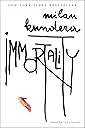
Immortality: A Novel (Perennial Classics)
Product ID: 12111576
Desertcart purchases this item on your behalf and handles shipping, customs, and support to Hungary.
New York Times Bestseller "Inspired. . . . Kundera's most brilliantly imagined novel. . . . A book that entrances, beguiles and charms us from first page to last." — Cleveland Plain Dealer Milan Kundera's sixth novel springs from a casual gesture of a woman to her swimming instructor, a gesture that creates a character in the mind of a writer named Kundera. Like Flaubert's Emma or Tolstoy's Anna, Kundera's Agnès becomes an object of fascination, of indefinable longing. From that character springs a novel, a gesture of the imagination that both embodies and articulates Milan Kundera's supreme mastery of the novel and its purpose: to explore thoroughly the great themes of existence. Review: Awesome and witty -- wonderfully entertaining and insightful - Milan Kundera is the best novelist I have ever read. His power lies in his great intellect, keen and unerring observations of human behaviors, and his immaculate control of language to yield the exact effect he desires. Even though I cannot read his works in the original Czech or French, the English translations are as, if not more, satisfying than the greatest of original English works. "Immortality" proves to be even better than the already awe-inspiring "The Book of Laughter and Forgetting." The point really is not the plot, but how it's plotted. It's the originality of working his voice into the surface of the text without subverting the comfortable author-reader decorum. It's the exploration of the nature (or un-nature?) of relationships, the impossibity of understanding between "different" kinds of people, and the longing for those with whom such understanding is possible. Agnes for her father. Her father for a woman that he might have met too late in life. Milan Kundera for an ideal reader. The other part of the plot is centered on the anecdotal relation between Goethe and Bettina. It's a long discussion of how the title of the book, immortality, figures in in a relationship such as that between Goethe and Bettina. The story itself is fascinating enough that I never raised a question as to why the two plots are set side by side. I might come upon some insight later on, but one thing is pretty clear, Bettina is what Agnes is not. Even though the book seems to caste Agnes' sister Laura as Agnes' opposite, Bettina is the real counterpart to Agnes. One yearns for immortality in the public memory, the other for a quiet, private understanding. And from the sympathy he bestows upon Agnes, it is quite obvious that Kundera is partial to Agnes' kind yearning. But he also understands Bettina perfectly well. After all, he shares the same yearning for immortality. Review: Great book - In great condition & delivered on time.


| Best Sellers Rank | #105,086 in Books ( See Top 100 in Books ) #2,273 in Classic Literature & Fiction #5,021 in Literary Fiction (Books) #36,778 in Genre Literature & Fiction |
| Customer Reviews | 4.4 out of 5 stars 446 Reviews |
S**E
Awesome and witty -- wonderfully entertaining and insightful
Milan Kundera is the best novelist I have ever read. His power lies in his great intellect, keen and unerring observations of human behaviors, and his immaculate control of language to yield the exact effect he desires. Even though I cannot read his works in the original Czech or French, the English translations are as, if not more, satisfying than the greatest of original English works. "Immortality" proves to be even better than the already awe-inspiring "The Book of Laughter and Forgetting." The point really is not the plot, but how it's plotted. It's the originality of working his voice into the surface of the text without subverting the comfortable author-reader decorum. It's the exploration of the nature (or un-nature?) of relationships, the impossibity of understanding between "different" kinds of people, and the longing for those with whom such understanding is possible. Agnes for her father. Her father for a woman that he might have met too late in life. Milan Kundera for an ideal reader. The other part of the plot is centered on the anecdotal relation between Goethe and Bettina. It's a long discussion of how the title of the book, immortality, figures in in a relationship such as that between Goethe and Bettina. The story itself is fascinating enough that I never raised a question as to why the two plots are set side by side. I might come upon some insight later on, but one thing is pretty clear, Bettina is what Agnes is not. Even though the book seems to caste Agnes' sister Laura as Agnes' opposite, Bettina is the real counterpart to Agnes. One yearns for immortality in the public memory, the other for a quiet, private understanding. And from the sympathy he bestows upon Agnes, it is quite obvious that Kundera is partial to Agnes' kind yearning. But he also understands Bettina perfectly well. After all, he shares the same yearning for immortality.
J**R
Great book
In great condition & delivered on time.
M**O
Pleasant read with many interruptions in the main story.
No argument about the material and the major point of the story, It is a pleasant read. I felt that Milan Kundera's viewpoint on immortality is more geared towards the artists' community. There are definitely very many points that I started feeling it is now becoming more general, but a lot of interruptions in the story made it sometimes hard to follow the main point. I personally enjoyed his other work better, i.e. The unbearable lightness of being, primarily due to less interruptions in the main story.
W**2
For ME, Kundera takes two or three readings to appreciate
A late-comer to Kundera, my little grey cells must work overtime for it all to sink in--but it is worth it. I finish each book then begin again to pull all the pieces together. At my 3rd reading I begin to underline passages. Unlike any author I've read, I find myself putting down his books after each chapter to cogitate.
C**M
A brilliant work but not highly recommended
I will open my review with a quote from Kundera (supposedly) himself: "...I was becoming sadder and sadder: if a reader skips a single sentence of my novel he won't be able to understand it, and yet where in the world will you find a reader who never skips a line? Am I not myself the greatest skipper of lines and pages?" If you are considering this book because you had just finished "The unbearable lightness of being" then I would advise you to reconsider. If you are a die-hard fan of Kundera then this is the book for you. I personally lost interest in following the story lines about 1/3 into the novel. And thus I find myself fast-pacing and skipping lines to the end. This is a brilliant work for an author to create but quite a laborious read (if not boring at time) for a reader. The story line(s) is (are) faintly recognizable and difficult to follow until the end. There are just too much details in between (and vulgarities as well as obscenities) that I personally think ended up inundating the readers. This could have been written better personally if Kundera had intended for his readers to enjoy (and not to skip lines). Instead, I believe he was just satisfying his creativity. Is that good or bad? It depends. I'm not a critic so it somewhat annoys me when I anticipate an enjoyable read. If I am to write a formal review then it could be quite interesting.
M**C
It's Kundera as usual
I love Kundera and this was a typical novel of his. Light and deep, funny and compelling, wistful and philosophically stimulating
A**Z
Immortality like the desperate attempt to overcome that hideous fear of ...
By alternating narratives M.Kundera introduces the story of the main character and some insights that he has about the life of Goethe. The reflection revolves around a topic that torments man: death. Immortality like the desperate attempt to overcome that hideous fear of dissapearing...
L**O
good book but received different cover
i was sent a book with a completely different cover which i was not happy about since i was really excited to receive the cover specifically that was pictured
S**T
Perhaps Kundera's best work
Great novel. I think this is Kundera's best work so far. It's a mystery why he's still not got Nobel Prize.
K**M
Five Stars
I am happy with this book.
H**I
Obra y autor excelentes
Otro libro excelente de Milan Kundera
S**Y
Good
Good
D**T
Great!
Read it! It is amazing!
Trustpilot
2 weeks ago
2 weeks ago