Buy anything from 5,000+ international stores. One checkout price. No surprise fees. Join 2M+ shoppers on Desertcart.
Desertcart purchases this item on your behalf and handles shipping, customs, and support to Hungary.
🍝 Elevate your pasta game—fresh, fast, and fabulously homemade!
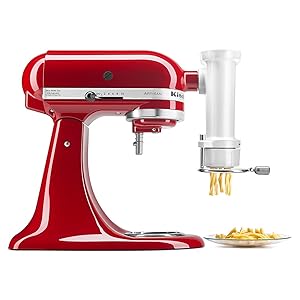
The KitchenAid KPEXTA Pasta-Extruder Attachment converts your stand mixer into a versatile pasta maker with 6 interchangeable plates for classic shapes like rigatoni and spaghetti. Designed for easy mounting and compact storage, it features a built-in cutter for customizable noodle lengths and comes with cleaning tools and recipe inspiration. Durable and user-friendly, it streamlines fresh pasta making from dough to dinner in under 30 minutes.


| ASIN | B003GWZ9ZK |
| Best Sellers Rank | #508,887 in Kitchen & Dining ( See Top 100 in Kitchen & Dining ) #229 in Pasta Molds & Stamps #28,674 in Small Appliance Parts & Accessories |
| Brand | KitchenAid |
| Brand Name | KitchenAid |
| Color | Pasta Extruder |
| Customer Reviews | 4.6 out of 5 stars 961 Reviews |
| Global Trade Identification Number | 00883049140162, 05413184400033, 05413184410902 |
| Included Components | Stand Mixer |
| Is Electric | No |
| Is the item dishwasher safe? | No |
| Item Part Number | 5KPEXTA |
| Item Weight | 1700 Grams |
| Manufacturer | KitchenAid |
| Manufacturer Part Number | FC372 |
| Manufacturer Warranty Description | Hassle Free 1 Year Warranty Policy |
| Material | Stainless Steel |
| Material Type | Stainless Steel |
| Model Number | KPEXTA |
| Number of settings | 6 |
| Operation Mode | Manual |
| UPC | 737989656057 883049140162 761675416953 761675416830 798527618975 726670962300 759284529591 891109650575 728295183740 781147870014 791769510458 787162345278 791769514128 |
L**R
Well made unit, great pasta!
I purchased this unit through the warehouse deals. I will start off by saying I will never make the spaghetti in this extruder...the difference in the texture between traditional rolled pasta is just overwhelming. I was taught how to make pasta by Marcella Hazan (The Classic Italian Cookbook), she had a very funny way of comparing the two styles and I tell this story often. A student in the class asked the difference between extruded pasta and rolled pasta and she replied: "You live on the third floor of an apartment building, you want to get down to the street...you have two choices, take the stairs or jump out the window. They both get you to the street but in very different states, the extruder is jumping out the window". That being said ya just can't make hollow pasta without an extruder... I will agree that weighing the flour and measuring the eggs is a sure-fire way to get consistent results and I find my kitchen scale a crucial piece of equipment. I have watched every Youtube video on this extruder and with one exception of the one made by kitchenaid, the were ALL using a dough that was way too moist. Yes, it extrudes easier but you will notice that all of the hollow pastas they make collapse and don't hold the hollow round shape once extruded. If I think that the pasta is too dry, it's usually perfect. Moist enough just to hold together if I grab a fistful. Adding the pasta dough in small amounts and ensuring it goes through the auger before adding more avoids delays and backups. As far as flour, I use the King Arthur brand pasta blend or blend durum with all purpose flour and find that makes a huge difference in texture. I made the rigatoni for my first attempt. I used the basic recipe provided by the KA instruction book and added 2 ounces of finely chopped basil. I did not adjust the water in the recipe. It came out perfect and held it's shape nicely. I had to stop myself from pushing and then pulling the cutter through each pass...you pull it toward you for one cut, then wait for the pasta to extrude again and push it for the next cut. The unit was very easy to put together and i felt it was very easy to clean. I love the way the disc holder stores within the unit and unlike others I feel this unit is very well made. The booklet talks about resting the machine between batches...well I have the 1.3HP motor so no need for that here...one of the reasons I upgraded to the 6000 was because my Epicurean could not handle pasta dough or rye bread dough and this 6000 is a beast! I was grateful that each disc had the name of the pasta that it made on it as I wasn't sure which disc was for which pasta. I'm very pleased with the performance of this unit and the quality and would recommend it.
R**R
My new favorite toy! Love it!!
I've been making homemade pasta for many years, so I finally broke down and bought this extruder. I love it! It is incredibly easy to use, and best of all, it takes a fraction of the time to make a batch of pasta, versus the process (rolling sheets and THEN cutting) I go through to make fettuccine and spaghetti with my other pasta maker attachments. I hesitated to buy this after reading all the reviews about the broken rings, and I have two thoughts about that: 1) many reviews refer to the ring as a "cheap piece of plastic" - in fact, I think the unit is well made and very sturdy, 2) it is no surprise to me that you end up with a broken ring if you follow the dough recipe in the book that comes with this attachment. The recipe ends up with dough that is WAY too stiff and I'm sure that is what put the strain on the machine for all the people who experienced a broken ring. On top of that, I don't even like the pasta as made with that dough - I tried it the first time I used the machine (although I had to add some water to make the dough even remotely pliable) and I thought my rigatoni ended up tasting like a rock - way too much egg and no water...terrible). Although many have said that the dough needs to be very stiff to use this attachment, I have found that is simply not true. Starting with the second time I used the machine, I used my regular dough recipe (below) which yields a much softer dough, and it did not clog or slow up the machine at all. However, it is definitely very important to feed only a small amount of dough into the machine at a time. If you do that, the machine will not clog, and I have no evidence that there was ever even a strain on ny unit, much less breakage of the ring. All of the plates work great - be warned that the rigatoni does come out thicker than you would expect versus store-bought pasta, but it is still delicious - just try it with a heavier sauce (such as you might use on gnocci or cavatelli). I love making spaghetti with this extruder rather than my regular pasta maker, as it allows you to skip the entire step of rolling the dough into sheets before cutting. I can literally make a batch of fresh pasta from start to finish in less than 1/2 hour now. Its fantastic! Dough recipe: 2 1/2 C all-purpose flour 1 egg 1 T olive oil 1 t salt 1/2 - 3/4 cup warm water, added slowly Note that the right amount of water depends on many factors including the humidity present. I find it is somewhat different every time, so I go by the feel of the dough - it cannot be sticky, but it should be soft. If you have to struggle to knead it by hand, you need more water. I mix the dough by hand into a soft ball and once it feels like the right consistency, I knead it with the dough hook in my Kitchen Aid mixer for 8 minutes (speed 2). After it is kneaded, you can wrap the dough ball in plastic and let it rise for an hour or so, but honestly, I've not found much difference if I'm in a rush and use it right away. Overall, I would highly recommend this attachment - it is simple to use, and makes fresh pasta making QUICK!
P**N
A fantastic device for pressed pasta.
After reading all the reviews at least twice, we bought the KPEXTA. First, we have been making pasta at home since Pierce bought me a KitchenAid with every available attachment as a present in 1981. (Hint -- cook more from scratch??) Anyway, our first attempt at home made pasta using the grinder with pasta attachment was an unmitigated disaster -- and I did it in front of company! Slowly, we learned to use pasta flour, then straight semolina. We now use Spicy World Semolina, 2-Pound Bags (Pack of 6) . Never happy with the pasta made with our meat grinder, we bought an Marcato Atlas Wellness 150 Pasta Maker, Stainless Steel and purchased dried extruded pasta in the supermarket. I hate to buy anything I can make at home, and I never seem to have macaroni on hand when we crave comfort food. So we bought the KPEXTA. So to the issues: 18 reviewers of a total of 109 stated that the retaining ring broke on first use. Inadvertently, we may have solved this problem. When "fiddling" with the KPEXTA after opening the box, I noted that unless you follow the instructions on page 3 you are going to have a problem -- "place the press upside down on a counter or table ... aligning the cross shaped peg with the matching indentation inside. When correctly positioned the top of the auger will be flush with the opening." It was very easy to mis-align the auger, while still being able to add the plate, then tighten the ring. Having suffered the problems of alignment in most of my KitchenAid attachments, and as a consequence had to buy replacements, this may be a solution to the "breaking ring" problem. Don't know for sure, but ALIGN CAREFULLY! Then, to the problem of texture and taste. We use 1 pound of semolina, 2 egg yolks and four whole eggs plus I tbs olive oil to make pasta. AND SOME TRICKS! First, weigh all your ingredients! We love the Taylor Biggest Loser 6.6 Pounds Kitchen Scale with Glass Platform because I can put the KitchenAid bowl on the scale, hit tare in either grams or ounces and pour ingredients in -- and it's inexpensive and easier on batteries than any we have owned! Two: Autolyse! Mix the semolina eggs and oil with the paddle until you have a sticky mess. Leave it sit for 20 minutes, covered, to allow the flour to absorb liquid. Then knead with the dough hook for 5 minutes. Add 1 tsp salt (to help develop gluten) and kneed for another 5 minutes. Trick 3; (from Ideas in Food -- Ideas in Food: Great Recipes and Why They Work Vacuum seal the dough and let it rest for 10 minutes. (Or, let rest an hour in a Zip-Lock bag.) You will note that a very hard, not very pliable dough as turned silky and malleable! Just right for the KPEXTA. Trick 4: Form lots of little balls, and drop one into the extruder at a time. If you must push the dough to the auger you are going too fast (or the balls are too big!) Read the instruction book and match your speed to the plate! Try Potato Chip pasta from "Ideas in Food". It works well too. I also recommend the pasta flour recipe from Making Artisan Pasta: How to Make a World of Handmade Noodles, Stuffed Pasta, Dumplings, and More . The trick is finding the taste you love in pasta, then autolyse, vacuum seal and make pasta. The author states that she does not like pasta extruders -- we think this is because the dough can get hot (changing texture and taste) while being extruded. But remember -- all macaroni and fusilli are extruded in a factory -- so you can do it at home. Just proceed slowly. If the dough chute feels hot, stop for a minute. After fighting with "meat grinder" pasta -- which isn't good (even though we love our KitchenAid meat grinder to make sausage), we are delighted with the quality of pasta the KPEXTA extrudes. I'm glad Pierce bought this great tool for me.
B**U
nice to look at, but it has its issues in use
The extruder is a very nice little attachment. It holds the spare extruder plates above the hopper in a nice plastic retainer and comes with a combination food pusher/wrench and a little cleaning brush. I have used it four times in my first month of owning it. It works very well, and pushed out tubed pasta quickly enough. I have had troubles with the dough sticking to its self, but I believe that its no fault of the attachment. I think that my standard dough recipe needs to be dryer than normal for this application. I am still testing. I like this device but I do have several issues. The first being that when the attachment is running, You can not place a plate under the extruder because it hangs halfway over the stand mixer base. It would be nice if there was a little tray or plate that fixed to the stand base that could catch the pasta before it touched my counter. The plates have the names of the pasta shapes engraved upon them. This is nice but you have to refer to the instruction manual to determine the speed setting on your stand mixer for each plate. KitchenAid should have also engraved the speeds upon the plates, just below the names - missed opportunity. When cleaning the plates, the little brush is useless. I found soaking them in hot water for a few minutes, then blowing on the opening clears them of the dough faster. You will need a bottle brush to clean the inside food track of the attachment, as you can not submerge it, and can not fit a brush into the recessed path. You will also have to let it air dry before you put the plastic plate retainer back on to the hopper, or the water vapor will not be allowed to escape. Storage is awkward, it has to lay upon its side, or on its flat front. Either way the wire cutter and the drive bolt tend to get in the way. There is also no seamless way to store the food pusher/wrench with the attachment. Dont get me wrong, I would still buy this product. As a matter of fact I wish that there was the ability to purchase additional extruder plates like Ziti, Cannelloni, or Pene. I would recommend this to someone who has some experience making pasta from scratch. I dont think its for a beginner, unless that person is determined and willing to eat a lot of under cooked or thick pasta while they learn how to use it. -Blake
F**D
Fresh pasta easily and quickly
The pasta press has weight to it and doesn’t feel like it is cheap plastic. The recipes are included in the user manual and easily made in my kitchen aid mixer. It’s very important to make sure your dough is dryer than you would use in a pasta roller machine, otherwise the pasta may not hold it shape, such as for the hollow noodle dyes of rigatoni or macaroni. The ends could close. I followed the directions for the pasta dough exactly except I used 1-1/2 C of semolina flour of the 3 C of all purposes flour the recipe called for. The semolina flour gives pasta more texture and in my opinion more flavor, but the texture is very important. As you can see in the photos, my very first try at the pasta press was to make my favorite pasta rigatoni. The rigatoni came out marvelous and I couldn’t believe I was making my favorite pasta in my own kitchen. I can say that this pasta is a little more dense and has more body than a typical boxed pasta, however with that said it still was much better than traditional boxed pasta which uses just water and semolina flour. The recipe made plenty of pasta so after drying the pasta on a kitchen towel I ended up freezing some for another day. I can’t wait to try the other dies. Cleaning takes some patience but I found that using a kitchen brush with soap and water helped to remove the pasta from the die. I also used the kitchen sink sprayer and put the head against the die to help remove the pasta. Overall I am completely satisfied with the entire process including the product itself, the recipe, the making of the pasta, and the ultimate product that is made.
R**D
Awesome pasta device
This pasta maker is so cool. Must admit, I'm a fresh pasta making novice- this is my first but I read other reviews and decided not to mess around and bought this- probably my best gadget ever. I've tried making two types so far and it worked like a champ. I've only used the Mario Batali Semolina pasta recipe which was good both times since others before me complained that the recipe in the manual wasn't so good. It worked well. I made Rigatoni the first time which which was fab and last night spaghetti. The coolest part of this device is watching it squirt of of the machine perfectly shaped. Sometimes you feel like you're in a lucy skit going back and forth cutting it off as it streams out and laying then out running back for more. The cutter on this machine is great; matter of the fact the entire unit is very well engineered and precisely manufactured- I was very impressed It's a little expensive but is certainly not cheaply made and I think will last a very long time. My only learning so far as I thought I would fill the whole shute with the walnut sized pasta balls so I wouldn't have to pop then in so frequently. That didn't work so well as during the spaghetti process it slowed the whole thing down. Works much better if you pop a new ball in just as it needs it. Cleans up easily (again I have nothing to compare it to). Takes a little time to make pasta this way but it's fun and delicious and I've only begun to explore what you can do with this device. It's a little spendy but just to add it to your entertainment budget as you'll have a blast making it.
K**E
Bravo!
I contacted KitchenAid to ask about the difference between this model, KPEXTA, and the other model for sale on Amazon, KSMPEXTA. KA responded that they were identical, despite the fact that there's a nearly $40 price difference between the two. The is a difference, though: The KPEXTA comes with a clear plastic snap-on dome that holds five of the extrusion dies for storage. KSMPEXTA does does not come with this dome but does, instead, come with a foam-lined box to hold the unit and its many parts. As to dough, there is one no-fail recipe and that's "3 parts flour to less than 1 part liquid." Extruders require a much drier pasta dough than do rollers and cutters. I found that three parts semolina to less than one part egg-and-water extruded beautifully: The dough is crumbly and loads easily into the extruder. Using all-purpose flour - again 3 parts flour to less than one part egg-and-water - also extruded beautifully. The difference is that the AP dough wasn't crumbly and required a bit of kneading and resting - but it was still a very stiff, dry dough. Pinching off little pieces and dropping them into the extruder worked very nicely. This is a SLOW extruder: Even on the mixer's top speed, pasta will extrude at about 1.5 inches per minute. If you need your pasta RIGHT NOW you might want to use rollers and cutters. The above recipes worked with all six extrusion dies but be aware that the plastic dies leave a more rough-textured surface on the pasta than do the metal dies of professional extrusion machines. The result might not be as "pretty" as commercially-made pasta but the rough surface will hold sauce VERY well! Once I realized that some of the more complicated dies pop-apart cleaning was a breeze. Air-drying the extruder allowed any bits of dough clinging to it to dry and flake-off - and then wiping the surface with a damp paper towel was sufficient. The dies were easily hand-washed - although a toothbrush came in handy to reach into the smallest nooks and crannies. All told, a welcome addition to my kitchen toolset!
R**S
Well made
I bought this attachment for my girlfriends Kitchen-Aid mixer for Christmas. The unit is made of sturdy plastic with a plastic auger inside. The unit attaches easily to the front of the mixer. You get 4 circular metal die's. These die's can make everything from spaghetti to rigatoni. This unit can not make flat pasta, but there is another unit available that does. You make small golf-ball sized pasta balls and add them to the mouth at the top. Pasta is extruded at the bottom at an even rate. Amazingly, there was no problem if we didn't add the dough at a inconsistent speed. The pasta was extruded evenly and accurately. Care must be taken to avoid making the dough too, "wet", as it will stick together as it is extruded. Pasta dough can not be fed too quickly as this might damage the motor, according to the directions. One thing that I initially did not like was that, according to the directions, you can not mix more then 2 batches without stopping and letting the mixer rest for 1 hour. I suspect this is because the mixer motor runs so slow, with little internal cooling fan action, that the motor could wear out. This turns out to not be a huge drawback, however, as you can make quite a bit of pasta. One batch can feed about 3-4 people. Clean-up is relatively easy using water. The die's present the only problem as they can not be washed with water. You are told to let the pasta dry in the die and use a supplied brush to scrub out the pasta from the die. This does not work well, but you can get the dies reasonably clean with toothpicks. The taste of homemade pasta is definitely a step up from the dried box pasta or even the refrigerated pasta bought at the store. With homemade pasta, you can taste the individual ingredients easily. None-the-less, I would only suggest this for someone who has the time and inclination to use it, since it does require extra effort in prep and clean-up (about 35 minutes for a batch, not counting cleanup). Cooks and pasta fanatics dedicated to getting the best flavor out of their food will enjoy this attachment the most. Of course, if you already own a Kitchen-Aid mixer, you are in that category.
A**G
But there is nothing like fresh pasta
Slow, and if you use it for long, the machine will overheat. But there is nothing like fresh pasta.
J**L
su facil uso y limpieza
Aparato perfecto para hacer distintas pastas, para el que le gusta la pasta fresca. No recomendable para los espaguetis, ya que para kincheaid ya tiene otos aparatos para ello que salen mejor, que también los tengo
E**N
Eksik ürün
Ürünün üzerinde çizikler vardı ayrıca temizleme kalemi eksikti lütfen telafi edilsin
S**S
Pretty Cool Little Pasta Maker
Before I bought,I read the reviews and there were enough people complaining of lower wattage machines unable to handle the dough that I almost didn't make the purchase. I'm glad I went for it.The pasta extruder arrived this afternoon so out of the box and let's see what it can do. I have one of the lower powered machines, a 750w and it passed with flying colors. I decided to do a rigatoni as I figured that would put as much stress on the motor and extruder as any of the other dies. Using the suggested setting of speed 6 my machine handled it with ease.It extruded a 3 1/2 cup flour recipe without over heating the mixer and no extruder issues what so ever. Didn't want an egg pasta so I used just water. As I was using unbleached white flour I thought it might take a little more water. I think the suggested ratio was 1 cup plus one tablespoon of water to 3 1/2 cups flour. I needed about 1 1/3 cups of water and 1 teaspoon of salt. Even though that was the first batch I'm really happy with it. OH yeah, as far as clean up,you definatly want to pop the plastic insert away from the metal part of the die. Then with warm water and the brush,no problem. Also once you remove the screw cover and die just brush any bits around the threading of the base of the extruder. The auger can be washed.
A**ー
おまけ
スタンドミキサー クラシック購入時一緒に買いました。ほかにもあるよ
Trustpilot
2 weeks ago
3 weeks ago